


Hungary yesterday took over the EU’s rotating presidency, promising to be an “honest broker,” despite widespread concerns over what critics see as an authoritarian, Russia-friendly government.
Hungarian Prime Minister Viktor Orban, who has run the central European country since 2010 aiming to transform it into an “illiberal democracy,” frequently clashes with Brussels over rule-of-law and human rights issues.
He is also the only EU leader who has maintained ties with Russia, despite its invasion of Ukraine. He has refused to send arms to Kyiv and repeatedly slammed sanctions against Moscow over the war.
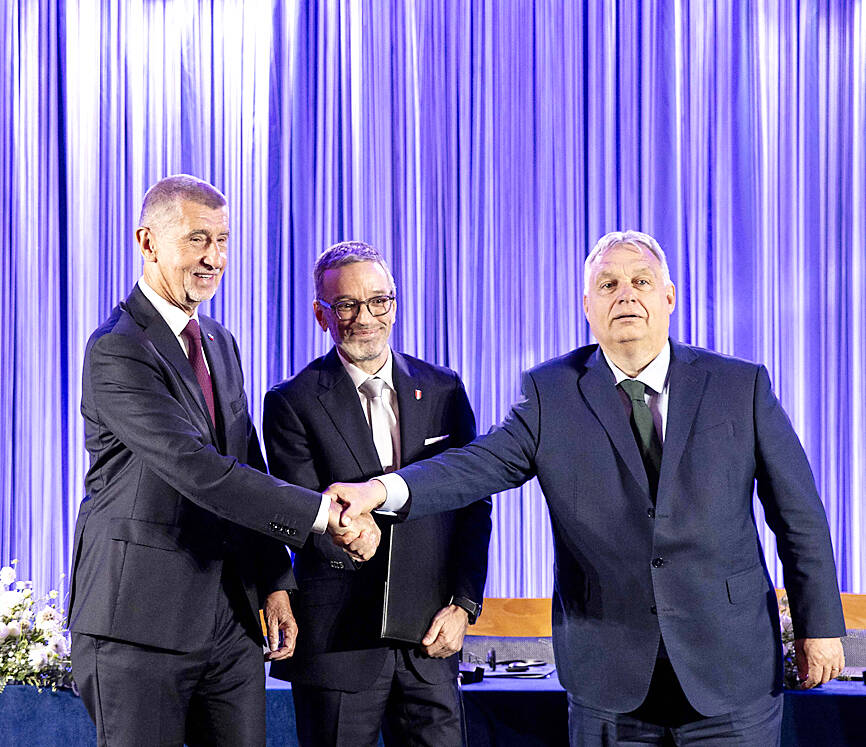
Photo: AFP
Last year, the European Parliament adopted a non-binding resolution highlighting Hungary’s “backsliding” on democratic values, and questioning how it could “credibly” assume the bloc’s six-month presidency.
Budapest insists it is ready to assume “the duties and responsibilities” steering the bloc of 27 countries.
“We will be honest brokers, working loyally with all member states and institutions,” Hungarian EU Affairs Minister Janos Boka said in the middle of last month, as he unveiled the presidency’s program.
“At the same time, we believe Hungary has a strong mandate to pursue a strong European policy. Our work will reflect this vision of Europe,” he added.
Hungary’s program slogan — “Make Europe Great Again” — echoing the rallying cry of Orban’s “good friend” former US president Donald Trump — which already caused a stir in Brussels.
After Hungary last held the EU presidency in 2011, Orban boasted about handing out “flicks,” “smacks” and “friendly slaps” to the “excitable tormentors” of the European Parliament.
This time, the 61-year-old nationalist leader is even more combative, having vowed to “occupy Brussels” during the campaign for European elections early last month, banking on a right-wing breakthrough.
However, even though far-right parties made gains, Orban’s Fidesz party stands isolated, unable to find a group in the European Parliament that suits it.
On Sunday, Orban announced he wanted to form his own group, together with Austria’s far-right Freedom Party and the centrist ANO party of former Czech prime minister Andrej Babis. They still need parties from at least four other countries to join them.
Last week, Orban failed to derail a deal to return Ursula von der Leyen as head of the powerful European Commission and two others from a centrist alliance taking the other top jobs.
Meanwhile, Von der Leyen put off a courtesy visit to Budapest, originally planned for the presidency opening. A new date has not been set. -
To garner support for Hungary’s program, Orban toured key European capitals last week.
Among the country’s seven priorities for its EU presidency are stemming “illegal migration” and bringing the Western Balkans countries “one step closer” to EU membership.
Orban can use the presidency to set the agenda, but he cannot achieve results without the commission’s support, Daniel Hegedus, a senior fellow at the German Marshall Fund said.
He added that Orban has limited opportunity to act as a spoiler, as the outgoing Belgian presidency and EU institutions have rushed to conclude important decisions.
Last week, the EU adopted a fresh sanction package against Russia and formally launched “historic” accession talks with Ukraine.
“Everybody was striving to reduce instability, thus restricting the room for maneuver for the Hungarian presidency,” Hegedus said.
But more “trolling on the communication front” is to be expected, he added.
Among Hungary’s battles with Brussels, Budapest is looking to unlock billions of euros in EU funds frozen over issues, including LGBTQ rights, the treatment of asylum seekers and public procurement.

‘NO SECURITY RISK’: The Railway Bureau reassured the public that the technicians’ activities were limited to technical guidance and did not involve sensitive systems The Railway Bureau yesterday said it had invited eight Chinese technicians to assist with an airport MRT construction project. The bureau issued the confirmation after an Internet user said Chinese nationals had entered the construction zone of Taiwan Taoyuan International Airport’s Terminal 3 project. They asked why “individuals from an enemy state” were allowed access to such a major national infrastructure project, which raised serious concerns over Taiwan’s industrial safety, sensitive systems and information security. The bureau’s Northern Region Engineering Branch Office said subcontractor Taiwan Handle Industrial Co (台灣手把工業) of the Taoyuan airport MRT’s “Contract No. CU05 Project A14 Station Civil, MEP &
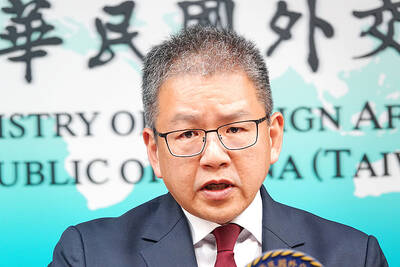
Taiwan is still in the process of assessing the possibility of recruiting workers from Eswatini, the Ministry of Foreign Affairs said yesterday, adding that its goal is to help Eswatini upgrade its vocational training centers. If there are plans to recruit workers from Eswatini, safeguarding national security, protecting public health and ensuring the employment rights of Taiwanese would be prerequisites, Department of West Asian and African Affairs Director-General Yen Chia-liang (顏嘉良) told a news conference. Key considerations would also include filling labor shortages in specific industries, and fostering bilateral professional and technical exchanges, he said. Yen was asked about the progress of labor

A US uncrewed surface vessel (USV) encountered multiple Chinese warships during an autonomous transit of the Taiwan Strait, US defense company Seasats said in a statement on Wednesday. Seasats announced that a Lightfish USV had completed the first autonomous transit of the Taiwan Strait. Over five days, the USV traversed the entire length of the Strait while constantly monitoring surface vessel traffic, the company said. The Lightfish encountered multiple Chinese warships, one of which was a Chinese People’s Liberation Army Navy (PLAN) Type 056 corvette, it said. The Chinese vessels were operating “well within Taiwan’s exclusive economic zone without transmitting their identity via the
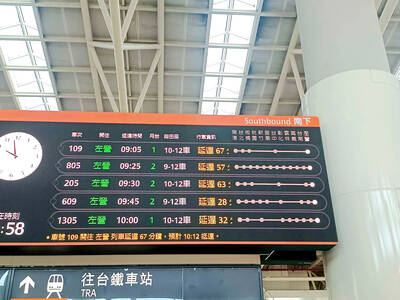
The nation’s usually punctual high-speed rail system yesterday was hit by major disruptions after all scheduled services were canceled and replaced with three hourly trains offering only non-reserved seating, affecting more than 200,000 passengers. Preliminary findings indicate the disruption was caused by a faulty power module in a track switch control cabinet, Taiwan High-Speed Rail Corp (THSRC) said, adding that as a full system inspection could only be conducted after operations end for the day, a decision on whether normal service would resume today would be announced before the first train departs. During a routine inspection early yesterday, a switch signal abnormality


 RSS
RSS