


Taiwan-US defense research exchanges have been elevated to a “semi-official” level, the Institute for National Defense and Security Research's annual report to the Legislative Yuan suggested.
The institute was last year invited by the US Indo-Pacific Command to participate in discussions about the Chinese Communist Party’s (CCP) military strategy against Taiwan, the report said.
The request indicates the level of importance the US Indo-Pacific Command places on Taiwan’s responses to the changing situation in the Taiwan Strait, the report said.
Photo: Aaron Tu, Taipei Times
This was also highlighted by the institute last year being invited for the first time to trilateral talks with Japanese and US officials, including some from the US Department of Defense’s (DOD) Defense Threat Reduction Agency.
The institute, which is Taiwan’s only official defense think tank, last year also participated in exchanges with think tanks in Australia, Europe, Japan, South Korea, the US and other countries, the report said, adding that those attending the exchanges often included active-duty military personnel and officials.
For example, one of the exchanges the institute joined was an electronic warfare symposium at the invitation of the Association of Old Crows and the US Indo-Pacific Command, the report said.
It also discussed the US redefining information warfare in response to current trends.
DOD officials who attended exchanges discussed in depth whether the US and Japan would intervene in the event of a conflict in the Taiwan Strait, how such an intervention would occur and how to send the right signals to deter China from starting a conflict, the report said.
In May last year, the institute joined 12 representatives from the National Security Council, the Ministry of Foreign Affairs, the Executive Yuan’s Office of Trade Negotiations, and the Ministry of National Defense to attend the Global Security Forum organized by the Center for Strategy and International Security.
Participants included Rick Waters, then-US deputy assistant secretary at the US Department of State’s Bureau of East Asian and Pacific Affairs; Rush Doshi, then-China affairs director at the US National Security Council; US Deputy Assistant Secretary of Defense for China, Taiwan and Mongolia Michael S. Chase; US Air Force Headquarters Deputy Director for Concepts and Strategy Jessica Powers; and former Royal Australian Air Force general Mark Binskin.
The institute last year also joined a delegation from the defense ministry that attended a military exercise on “gray zone” tactics with the US think tank RAND Corp.
The results of the exercise were released at the Taiwan-US Monterey Talks later in the year.
Last year the first Japan-Taiwan Strategic Dialogue was also held, during which the institute met with retired Japanese generals, as well as high-ranking officials in the Japanese government and NATO.
The institute said that it was “deeply impressed by the scale of exchanges and contacts between Japan and NATO, the linking capabilities between the two, and the depth of mutual understanding on various issues displayed by both sides.”

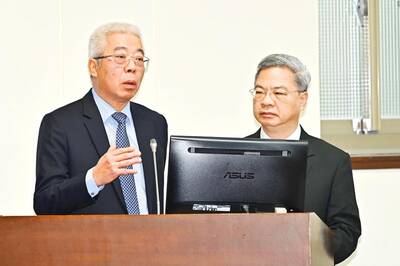
Taiwan has arranged for about 8 million barrels of crude oil, or about one-third of its monthly needs, to be shipped from the Red Sea this month to bypass the Strait of Hormuz and ease domestic supply pressures, CPC Corp, Taiwan (CPC, 台灣中油) said yesterday. The state-run oil company has worked with Middle Eastern suppliers to secure routes other than the Strait of Hormuz, through which about 20 percent of the world’s oil and liquefied natural gas typically passes, CPC chairman Fang Jeng-zen (方振仁) said at a meeting of the legislature’s Economics Committee in Taipei. Suppliers in Saudi Arabia have indicated they
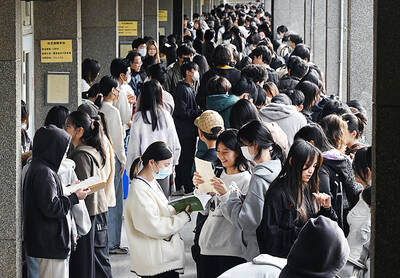
A global survey showed that 60 percent of Taiwanese had attained higher education, second only to Canada, the Ministry of the Interior said. Taiwan easily surpassed the global average of 43 percent and ranked ahead of major economies, including Japan, South Korea and the US, data from the Organisation for Economic Co-operation and Development (OECD) for 2024 showed. Taiwan has a high literacy rate, data released by the ministry showed. As of the end of last year, Taiwan had 20.617 million people aged 15 or older, accounting for 88.5 percent of the total population, with a literacy rate of 99.4 percent, the data
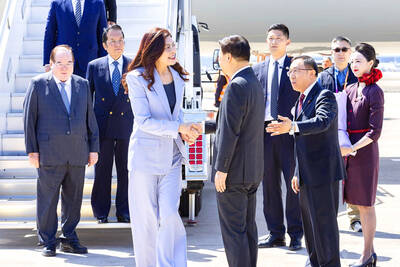
CCP ‘PAWN’? Beijing could use the KMT chairwoman’s visit to signal to the world that many people in Taiwan support the ‘one China’ principle, an academic said Chinese Nationalist Party (KMT) Chairwoman Cheng Li-wun (鄭麗文) yesterday arrived in China for a “peace” mission and potential meeting with Chinese President Xi Jinping (習近平), while a Taiwanese minister detailed the number of Chinese warships currently deployed around the nation. Cheng is visiting at a time of increased Chinese military pressure on Taiwan, as the opposition-dominated Legislative Yuan stalls a government plan for US$40 billion in extra defense spending. Speaking to reporters before going to the airport, Cheng said she was going on a “historic journey for peace,” but added that some people felt uneasy about her trip. “If you truly love Taiwan,

NEW LOW: The council in 2024 based predictions on a pessimistic estimate for the nation’s total fertility rate of 0.84, but last year that rate was 0.69, 17 percent lower An expected National Development Council (NDC) report expects the nation’s population to drop below 12 million by 2065, with the old-age dependency ratio to top 100 percent sooner than 2070, sources said yesterday. The council is slated to release its latest population projections in August, using an ultra-low fertility model, the sources said. The previous report projected that Taiwan’s population would fall to 14.37 million by 2070, but based on a new estimate of the total fertility rate (TFR) — the average number of children born to a woman over her lifetime — the population is expected to reach 12 million by


 RSS
RSS