


Mainland Affairs Council (MAC) Minister Chiu Chui-cheng (邱垂正) yesterday urged Taiwanese to think carefully before deciding to travel to China and to be vigilant about their personal safety when in China.
Chiu made the comment after the council confirmed a day earlier that a member of a Taiwanese tour group traveling in China had been detained for several days.
MAC Deputy Minister and spokesman Liang Wen-chieh (梁文傑) said that it was the first time a member of a tour group had been detained by Chinese authorities.
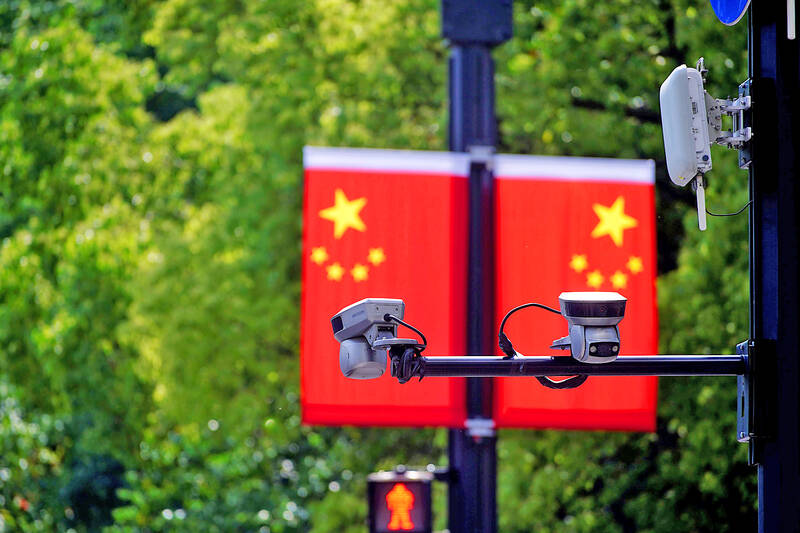
Photo: Reuters
The person was released several days after the five-day tour group had returned to Taiwan, Liang said.
The person is now back in Taiwan, the council said, adding that it is investigating the details of what happened.
Tour guides or tour leaders should immediately notify the Tourism Administration within 24 hours should tour members be detained, Liang said, citing regulations governing travel agencies.
The council has posted on platforms including Facebook to warn people to be vigilant about their personal safety. It also asks those traveling to China to register on its online platform.
The Tourism Administration said that it had been notified of the incident.
The person could have been detained because they worked in a “sensitive” profession before retirement, a source familiar with the matter said.
The council said that due to China’s state security and counterespionage laws, the number of Taiwanese being detained and investigated upon entry has increased.
The council reminded Taiwanese that such incidents are not limited to independent travelers, but could also happen to members of tour groups.
In a separate case, a user on the social media platform Threads on Wednesday said that he had traveled to Nanjing for an arts and books exhibition, but was taken away for questioning by Chinese police, and was forced to remove all his clothing for inspection.
He was released a few days later, the person wrote.
Asked about the incidents, Premier Cho Jung-tai (卓榮泰) warned Taiwanese to be wary of their safety when traveling to China, as its legal system is unclear and legal procedures are deficient.
A ban on tour travel to China starting on Saturday last week would be reviewed on a rolling basis, with changes being made depending on vital factors including safety and the quality of the travel experience, he said.
The government originally decided to only allow tour groups scheduled to leave for China before May 31 to go ahead, but Cho on Thursday last week said group tours organized before Saturday last week could proceed as planned.
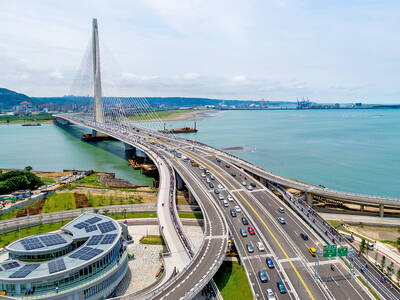
The Ministry of Transportation and Communications yesterday inaugurated the Danjiang Bridge across the Tamsui River in New Taipei City, saying that the structure would be an architectural icon and traffic artery for Taiwan. Feted as a major engineering achievement, the Danjiang Bridge is 920m long, 211m tall at the top of its pylon, and is the longest single-pylon asymmetric cable-stayed bridge in the world, the government’s Web site for the structure said. It was designed by late Iraqi-British architect Zaha Hadid. The structure, with a maximum deck of 70m, accommodates road and light rail traffic, and affords a 200m navigation channel for boats,
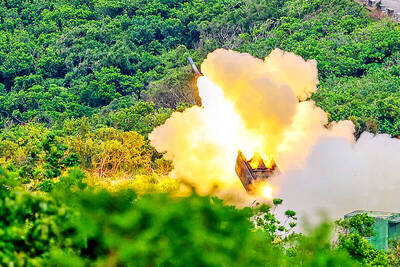
PRECISION STRIKES: The most significant reason to deploy HIMARS to outlying islands is to establish a ‘dead zone’ that the PLA would not dare enter, a source said A High Mobility Artillery Rocket System (HIMARS) would be deployed to Penghu County and Dongyin Island (東引) in Lienchiang County (Matsu) to force the Chinese military to retreat at least 100km from the coastline, a military source said yesterday. Taiwan has been procuring HIMARS and Army Tactical Missile Systems (ATACMS) from the US in batches. Once all batches have been delivered, Taiwan would possess 111 HIMARS units and 504 ATACMS, which have a range of 300km. Considering that “offense is the best defense,” the military plans to forward-deploy the systems to outlying islands such as Penghu and Dongyin so that
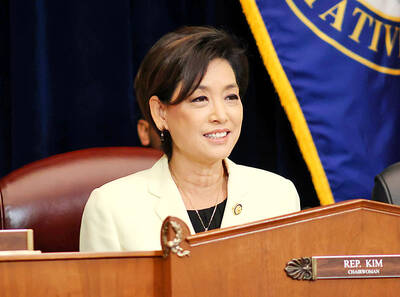
‘CLEAR MESSAGE’: The bill would set up an interagency ‘tiger team’ to review sanctions tools and other economic options to help deter any Chinese aggression toward Taiwan US Representative Young Kim has introduced a bill to deter Chinese aggression against Taiwan, calling for an interagency “tiger team” to preplan coordinated sanctions and economic measures in response to possible Chinese military or political action against Taiwan. “[Chinese President] Xi Jinping [習近平] has directed the People’s Liberation Army to be ready to invade Taiwan by 2027. China has a plan. America should have one too,” Kim said in a news release on Thursday last week. She introduced the “Deter PRC [People’s Republic of China] aggression against Taiwan act” to “ensure the US has a coordinated sanctions strategy ready should

TAIWAN ISSUE: US treasury secretary Scott Bessent said on the first day of meetings that ‘it wouldn’t be a US-China summit without the Taiwan issue coming up’ There were no surprises on the first day of the summit between US President Donald Trump and Chinese President Xi Jinping (習近平), the Mainland Affairs Council (MAC) said yesterday, as the government reiterated that cross-strait stability is crucial to the Asia-Pacific region, as well as the world. As the two presidents met for a highly anticipated summit yesterday, Chinese state media reported that Xi warned Trump that missteps regarding Taiwan could push their two countries into “conflict.” Trump arrived in China with accolades for his host, calling Xi a “great leader” and “friend,” and extending an invitation to visit the White House


 RSS
RSS