


The Chinese Communist Party (CCP) has once again used militaristic rhetoric in an attempt to intimidate Taiwan and neighboring countries, the Mainland Affairs Council (MAC) said yesterday of Chinese Ministry of Defense Dong Jun’s (董軍) comments at the Shangri-La Dialogue in Singapore.
During the annual defense and security forum, Dong said in a speech titled “Chinese Global Security Perspective” that China would “act resolutely and forcefully at all times to curb the independence of Taiwan,” adding that “whoever dares to split Taiwan from China will be crushed to pieces and suffer his own destruction.”
“The issue of Taiwan is at the core of China’s interests. The ‘one China’ principle is the globally accepted fundamental principle in international relations. The problem is that the Democratic Progressive Party is using a progressive approach to de-Sinicize Taiwan. It has attempted to cut off social, historical and cultural ties across the Taiwan Strait. Its separatist statements are ridiculous and show that it is arrogant. What the party did would cause it to be nailed on the pillar of shame in history,” he said.
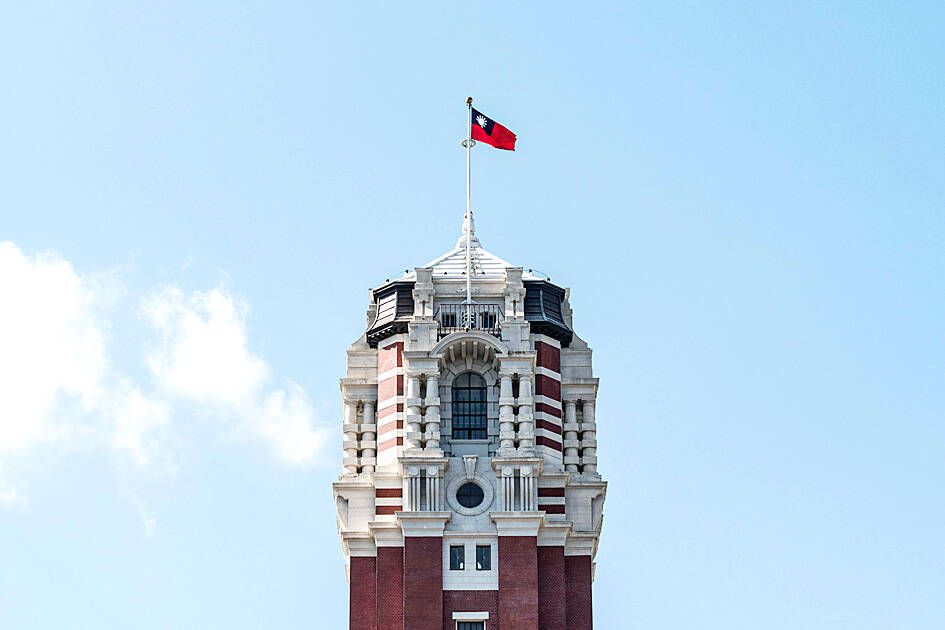
Photo: Yasuyoshi Chiba, AFP
In Taipei, Presidential Office spokesman Lii Wen (李問) said that Beijing distorted the position of the Taiwanese government at the conference, and has been using political means to prevent Taiwan from sending representatives to speak at the forum.
“This shows that China lacks confidence to engage in dialogue with the Taiwanese government. Its irrational remarks would never help it gain recognition from the international community,” Lii said.
It is Taiwan’s position to maintain the “status quo,” he said.
“As a responsible member of the international community, Taiwan is dedicated to maintaining cross-strait peace and stability. Recently, China unilaterally launched military exercises around the nation. Such a dangerous and irresponsible means of communication not only destroys the status quo, it challenges the international order,” he said.
President William Lai (賴清德) has on multiple occasions expressed his willingness to communicate with Beijing, Lii said, adding that both sides should share the responsibility of maintaining peace.
The MAC said it was regrettable that CCP officials had made belligerent and irrational remarks at the conference.
“The Republic of China (Taiwan) is a sovereign nation and has never been a part of the People’s Republic of China. It is a fact — and the status quo — that both sides are not subordinate to one another,” it said. “The CCP has repeatedly falsely linked UN General Assembly Resolution 2758 — which did not involve issues related to the status of Taiwan — to its so-called ‘one China’ principle. It has attempted to make the principle recognized by the international community. Neither Taiwan nor Taiwanese would accept it.”
Beijing’s frequent threats of using force to annex Taiwan severely contravenes Article 2, paragraph 4 of the UN Charter, which states that “all members shall refrain in their international relations from the threat or use of force against the territorial integrity or political independence of any state.”
“We want to solemnly tell the CCP government that it should not repeatedly misjudge the situation. They would get the opposite of what they seek if they continue to disrespect the choice of the people and their human rights by resorting to military threats, as such behavior contradicts international law,” the council said, adding that “the international community should jointly respond to” Dong’s statements.
Lai showed goodwill in his inauguration speech when he said that he would neither yield nor provoke China, the council said.
Lai said he would “choose dialogue over confrontation, exchange over containment” and pursue “peace in the Taiwan Strait, mutual benefits and prosperous coexistence” as common goals, it added.
“We hope that Beijing would feel and appreciate the goodwill and jointly pursue the positive development of cross-strait relations,” it said.
Additional reporting by AFP

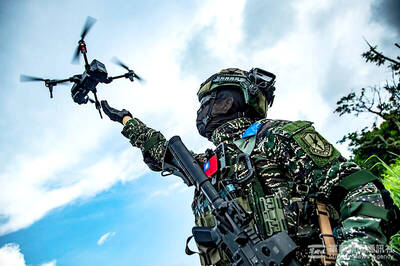
RESILIENCE: Taiwan plays a key role in semiconductors, energy, information infrastructure and advanced manufacturing, AIT Director Raymond Greene said Taiwan’s continued investment in deterrence and resilience remains vital, especially in uncrewed systems and other emerging technologies, American Institute in Taiwan (AIT) Director Raymond Greene said yesterday. Greene made the remarks at the annual National Strategic Summit on Supply Chain Resilience held by the Research Institute for Democracy, Society and Emerging Technology (DSET), a government-backed think tank. As Taiwan last year became the US’ fourth-largest trading partner and supply chain security is becoming more important, cooperation in emerging technologies continues to deepen between the two countries, he said. The US is committed to accelerating innovation, building key infrastructure, strengthening cooperation

The National Chungshan Institute of Science and Technology yesterday showcased its locally developed variants of the Vision 60 robotic patrol dog, which it plans to deploy on the nation’s outlying territories in the South China Sea. The variants were produced under the Joint Lab project — created by the institute and domestic companies — and assembled with domestically produced motors, lenses and artificial intelligence (AI) systems alongside licensed tech from the US, Missile and Rocket Systems Research Division deputy director Jen Kuo-kang (任國光) told the media event at a military base in Taipei’s Dazhi (大直) area. Taiwan has built up its strengths

RIGHT DIRECTION: Taiwan’s efforts to prevent forced labor include a proposal to ‘fully prohibit’ employers from withholding workers’ documents, an official said Taiwan is to establish a mechanism to restrict imports of goods linked to forced labor, the Executive Yuan said yesterday, after the US proposed imposing additional tariffs on Taiwanese goods over labor concerns. “The Ministry of Labor and the Ministry of Economic Affairs are to establish an interministerial review procedure,” Executive Yuan spokesperson Michelle Lee (李慧芝) said at a news briefing in Taipei. “The government is to use the Foreign Trade Act [貿易法] as the legal basis to restrict imports of goods produced with forced labor” and bring its supply chain governance more in line with international standards on human rights, resilience
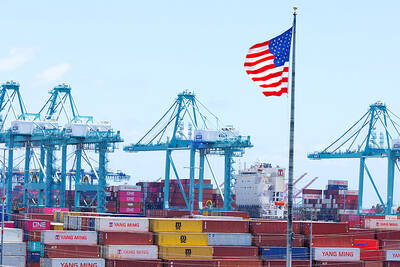
NOT IMMEDIATE: Taiwan has a chance to appeal the proposed 10 percent tariff before it starts, while other countries face a 12.5 percent tariff from the trade office Taiwan is among 60 economies determined by the US to have failed to impose or enforce a ban on the importation of goods produced with forced labor, according to a notice released on Tuesday by the Office of the US Trade Representative (USTR), which proposed imposing an additional 10 percent or more tariff on them. The USTR in a statement said that following an investigation, it had determined under Section 301 of the Trade Act of 1974 that the failure of the 60 economies to impose and effectively enforce a prohibition on the importation of goods produced with forced labor is


 RSS
RSS