


Politicians across party lines yesterday expressed regret that many Taiwanese singers and entertainers have been forced to make pro-China statements.
President William Lai (賴清德) on Monday said in his inaugural speech that Taiwan and the People’s Republic of China are not subordinate to one another.
“Taiwan is not a country and will never be a country. Taiwanese independence is the road toward destruction... China will eventually actualize a full unification,” China Central Television wrote on Sina Weibo on Wednesday.
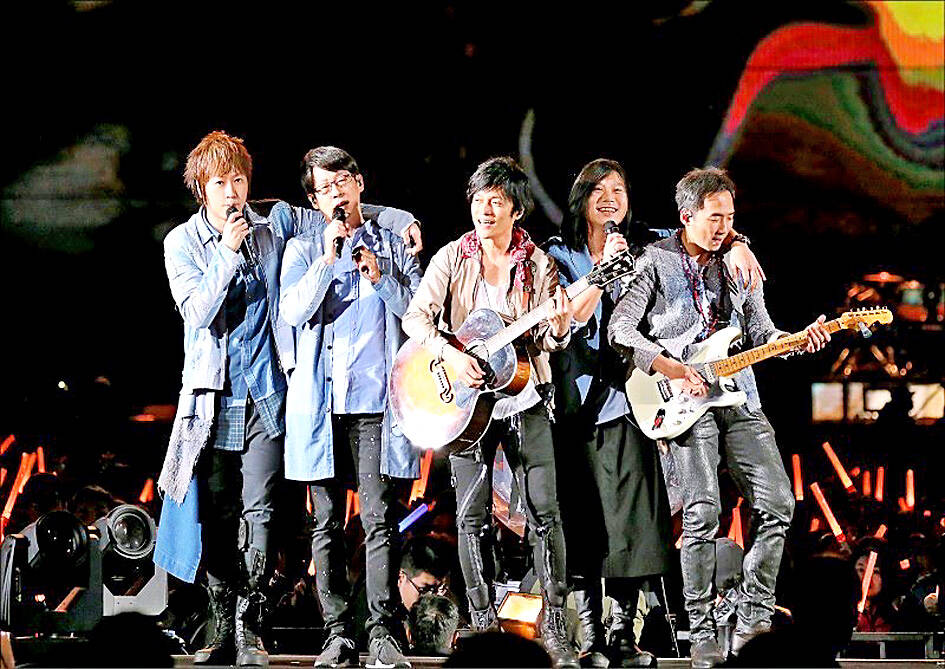
Photo courtesy of B’in Music
Taiwanese entertainers Patty Hou (侯佩岑) and Ouyang Nana (歐陽娜娜) shared the post on Sina Weibo and both said: “Taiwan will certainly be unified with the motherland.”
As of Friday, more than 45 other Taiwanese, including singers Angela Chang (張韶涵), Rainie Yang (楊丞琳), Kenji Wu (吳克群) and actors Darren Wang (王大陸) and Jiro Wang (汪東城), had also shared the CCTV post.
Taiwanese band Mayday’s (五月天) lead singer, Ashin (阿信), on Friday during a show in Beijing said: “We Chinese definitely have Peking duck when in Beijing.”

Photo: Screen grab from Sina Weibo
At a concert in Nanchang, China, on Friday, Taiwanese singer Jolin Tsai (蔡依林) said: “Our Chinese [brethren] in Nanchang are the most passionate.”
Taiwanese singer Cyndi Wang (王心凌), also on tour in China, shared a Sina Weibo post by China’s People’s Daily stating that “Taiwan independence is the road toward destruction,” and said “I am a part of the zhonghua minzu (中華民族, ethnic Chinese group).”
Democratic Progressive Party (DPP) Legislator Rosalia Wu (吳思瑤) yesterday said the Chinese Communist Party (CCP) has run out of moves to make and can only hope to influence Taiwan through its entertainers.
Wu said she believed that these artists and entertainers were politically coerced, adding: “Our greatest enemy is the CCP, not these artists and entertainers.”
Kaohsiung Mayor Chen Chi-mai (陳其邁), also from the DPP, urged China to respect performers’ freedom of speech, not force them to “take a side.”
Chinese Nationalist Party (KMT) Legislator Lee Yan-hsiu (李彥秀) expressed regret and said the move was not helpful in encouraging goodwill across the Strait.
It was evident that the entertainers were forced to make the statements as a result of Lai’s inaugural address, she said.
KMT Legislator Hsu Yu-chen (許宇甄) urged China to restrain itself and called on both sides to relaunch cross-strait talks and “leave music to music.”
The Taiwan People’s Party in a statement said it condemned all acts that constrain the development of music, arts and culture, urging Beijing to respect performers, and not to harm cross-strait relations by coercing the entertainers to make public political stance.
Separately, Golden Horse Award-winning actor Mo Tzu-yi (莫子儀) on Facebook on Friday urged people “to together protect the nation and the people’s democracy.”
Alluding to the recent controversy surrounding legislative reforms, he said discussions and following procedure are key to resolving political differences.
“No one can be sure how long we can safeguard our hard-won democracy and freedom,” he said.
Some of the people who commented said his post set him apart from other Taiwanese artists who made political statements in favor of China.
Additional reporting by Chiu Yi-chin

A signaling system malfunction disrupted high-speed rail (HSR) services beginning at 8am today, with trains temporarily reduced to three northbound and three southbound trains per hour as authorities conduct inspections. The malfunction occurred on a section of track in Miaoli County during pre-operation checks early this morning, forcing northbound and southbound trains to use a single track, the HSR operator said. The regular schedule has been replaced with three hourly trains offering only nonreserved seating in each direction, stopping at every station, it said, adding that business class cars would still have reserved seating. Departures from terminal stations are scheduled at the top

Taiwan is still in the process of assessing the possibility of recruiting workers from Eswatini, the Ministry of Foreign Affairs said yesterday, adding that its goal is to help Eswatini upgrade its vocational training centers. If there are plans to recruit workers from Eswatini, safeguarding national security, protecting public health and ensuring the employment rights of Taiwanese would be prerequisites, Department of West Asian and African Affairs Director-General Yen Chia-liang (顏嘉良) told a news conference. Key considerations would also include filling labor shortages in specific industries, and fostering bilateral professional and technical exchanges, he said. Yen was asked about the progress of labor

VERBOSE VESSELS: A CGA cutter and a China Coast Guard exchanged verbal barbs for more than a day in Taiwanese-controlled waters before the Chinese vessel left The Taiwanese and Chinese coast guards had a standoff near the strategically located Pratas Islands (Dongsha Islands, 東沙群島) in the north of the South China Sea, the Coast Guard Administration (CGA) said yesterday. The two sides engaged in intense radio exchanges over sovereignty claims during the 33-hour standoff. China Coast Guard vessel 3501 eventually left the restricted waters, 26.6 nautical miles (49.2km) west of the Pratas Islands, at 5pm yesterday, the CGA said. Lying approximately between southern Taiwan and Hong Kong, the Taiwan-controlled Pratas are seen by some security experts as vulnerable to Chinese attack due to their distance — more than

A US uncrewed surface vessel (USV) encountered multiple Chinese warships during an autonomous transit of the Taiwan Strait, US defense company Seasats said in a statement on Wednesday. Seasats announced that a Lightfish USV had completed the first autonomous transit of the Taiwan Strait. Over five days, the USV traversed the entire length of the Strait while constantly monitoring surface vessel traffic, the company said. The Lightfish encountered multiple Chinese warships, one of which was a Chinese People’s Liberation Army Navy (PLAN) Type 056 corvette, it said. The Chinese vessels were operating “well within Taiwan’s exclusive economic zone without transmitting their identity via the


 RSS
RSS