


Two Chinese warships yesterday docked in a commercial port in Cambodia as part of the biggest-ever joint military drills with the Southeast Asian nation, with Beijing’s ambassador hailing their “ironclad” friendship.
Cambodia has long been a staunch ally of China and has received billions of dollars in investment.
The Jingangshan amphibious warfare ship and Qijiguang training ship sailed in to the Sihanoukville Autonomous Port as onlookers waved Cambodian and Chinese flags from the piers.
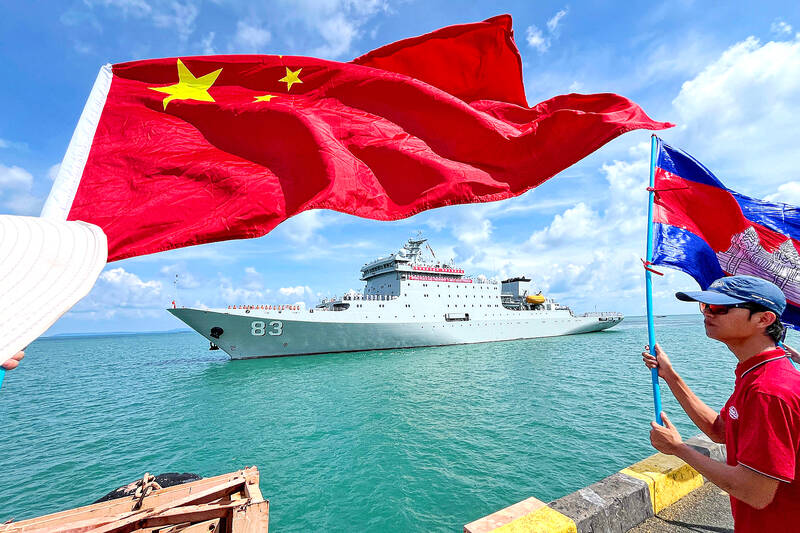
Photo: AFP
The port is north of the Ream Naval Base, which was originally built partly using US funds and is where China has financed a broad expansion project.
That construction has been carefully watched by the US and others over concerns it could become a new outpost for the Chinese navy on the Gulf of Thailand.
The gulf is adjacent to the South China Sea, which China claims virtually in its entirety, and would give easy access to the Malacca Strait, one of the most important shipping lanes in the world.
Chinese Ambassador to Cambodia Wang Wentian (王文天) dismissed concerns about Ream, telling reporters at Sihanoukville that wherever the Chinese navy sails “we bring friendship, we bring cooperation” and nothing else.
“The cooperation between the two armies, between China and Cambodia, is conducive to the security of both countries and the security of the region,” he said, standing on the pier.
The Chinese vessels docked at the port as part of 15 days of land and sea drills involving 760 Chinese military personnel along with about 1,300 Cambodians and 11 Cambodian vessels.
The Qijiguang bore a banner reading: “Bring peace and friendship to meet good friends” as it approached the port.
“We are ironclad friends,” Wang said.
Two Chinese warships docked at Ream in December last year for the first time after work began to expand the base. Cambodian officials last year denied a new 363m pier at Ream was intended to berth aircraft carriers.
At the start of the drills on Thursday, China’s military showed off its hardware including so-called “robodogs” — remote-controlled four-legged robots with automatic rifles mounted on their backs.
Handlers kept the dogs of war on the leash, demonstrating only their walking capabilities to watching journalists and top brass — not their shooting skills.

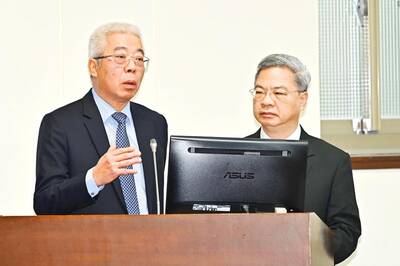
Taiwan has arranged for about 8 million barrels of crude oil, or about one-third of its monthly needs, to be shipped from the Red Sea this month to bypass the Strait of Hormuz and ease domestic supply pressures, CPC Corp, Taiwan (CPC, 台灣中油) said yesterday. The state-run oil company has worked with Middle Eastern suppliers to secure routes other than the Strait of Hormuz, through which about 20 percent of the world’s oil and liquefied natural gas typically passes, CPC chairman Fang Jeng-zen (方振仁) said at a meeting of the legislature’s Economics Committee in Taipei. Suppliers in Saudi Arabia have indicated they
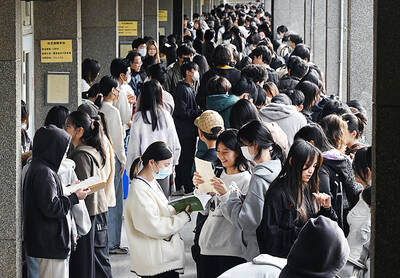
A global survey showed that 60 percent of Taiwanese had attained higher education, second only to Canada, the Ministry of the Interior said. Taiwan easily surpassed the global average of 43 percent and ranked ahead of major economies, including Japan, South Korea and the US, data from the Organisation for Economic Co-operation and Development (OECD) for 2024 showed. Taiwan has a high literacy rate, data released by the ministry showed. As of the end of last year, Taiwan had 20.617 million people aged 15 or older, accounting for 88.5 percent of the total population, with a literacy rate of 99.4 percent, the data
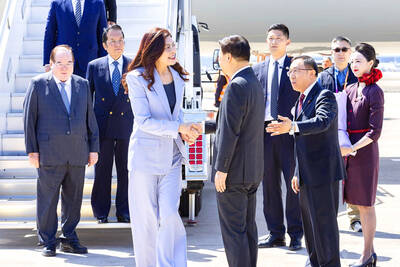
CCP ‘PAWN’? Beijing could use the KMT chairwoman’s visit to signal to the world that many people in Taiwan support the ‘one China’ principle, an academic said Chinese Nationalist Party (KMT) Chairwoman Cheng Li-wun (鄭麗文) yesterday arrived in China for a “peace” mission and potential meeting with Chinese President Xi Jinping (習近平), while a Taiwanese minister detailed the number of Chinese warships currently deployed around the nation. Cheng is visiting at a time of increased Chinese military pressure on Taiwan, as the opposition-dominated Legislative Yuan stalls a government plan for US$40 billion in extra defense spending. Speaking to reporters before going to the airport, Cheng said she was going on a “historic journey for peace,” but added that some people felt uneasy about her trip. “If you truly love Taiwan,

NEW LOW: The council in 2024 based predictions on a pessimistic estimate for the nation’s total fertility rate of 0.84, but last year that rate was 0.69, 17 percent lower An expected National Development Council (NDC) report expects the nation’s population to drop below 12 million by 2065, with the old-age dependency ratio to top 100 percent sooner than 2070, sources said yesterday. The council is slated to release its latest population projections in August, using an ultra-low fertility model, the sources said. The previous report projected that Taiwan’s population would fall to 14.37 million by 2070, but based on a new estimate of the total fertility rate (TFR) — the average number of children born to a woman over her lifetime — the population is expected to reach 12 million by


 RSS
RSS