


The Mainland Affairs Council (MAC) yesterday said that any collaboration between the Lienchiang (Matsu) County Government and China’s Fujian Provincial Government to promote an international transportation card would contravene cross-strait law.
In early March, Chinese media reported that the Fujian government was offering the pass preloaded with 300 yuan (US$42) to Lienchiang residents to travel to the Chinese province.
From March 6 to 12, the Lienchiang County Government set up counters at township offices to gauge interest in the card.
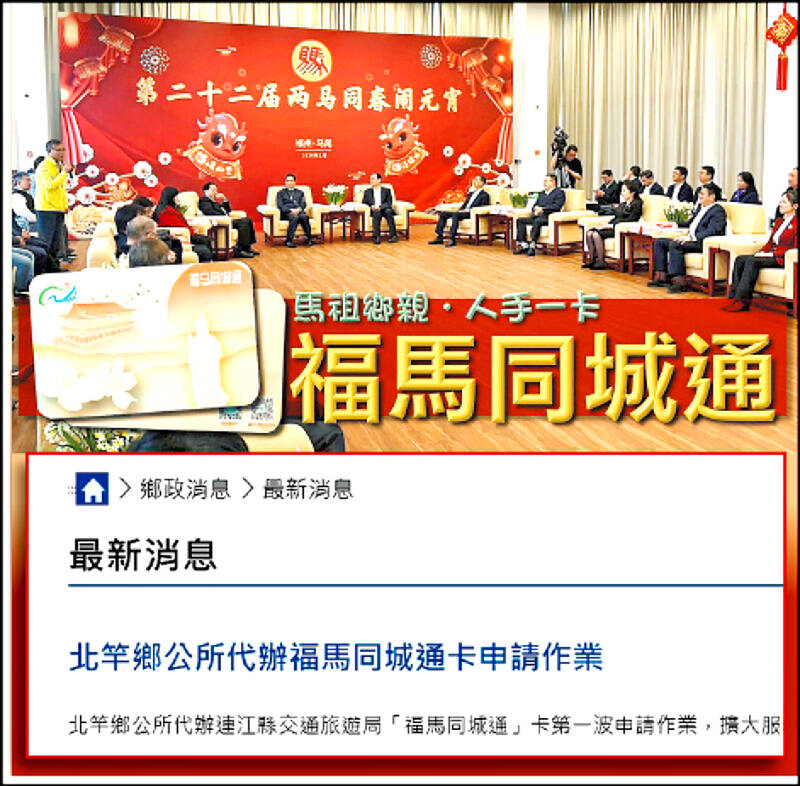
Photos from Wang Chung-ming’s Facebook account and the Beigan Township Office Web site
In addition, the Matsu Daily, the county government’s official media source, on March 10 quoted the Fuzhou Daily as saying that Lienchiang residents could apply for the pass through some Chinese apps, including WeChat.
Promoting the “Fujian-Matsu city pass” contravenes the Act Governing Relations Between the People of the Taiwan Area and the Mainland Area (臺灣地區與大陸地區人民關係條例), MAC Deputy Minister Jan Jyh-horng (詹志宏) told reporters yesterday.
After receiving an invitation to collaborate on the scheme in March, the county had contacted the council to ask whether it would contradict Article 33-1 of the act, he said, adding that it recommended against collaboration, as it would “most certainly” contravene the article.
The council told the county that the collaboration, requiring the traveler’s national ID and Taiwan Compatriot Permit, risks leaking county residents’ personal information to China, Jan said.
The county government did not officially promote the event following clear MAC opposition, but allowed its residents to visit Fuzhou to apply for a pass, he said.
The Lienchiang County Government said it would not deliver personal information to China, but it wanted to inform Chinese officials how many residents had the intention of applying for the pass, he said, adding that the county government told the council that it would “only send a number.”
If the county government had continued with the program, it would have contravened the act, Jan said.
Also yesterday, the Ministry of Transportation and Communications replied to Democratic Progressive Party Legislator Michelle Lin’s (林楚茵) query, affirming that the ministry had not received any applications from the the county government regarding the issue.
The government encourages healthy interactions across the Taiwan Strait, but it is against using pretexts to sneak past “united front” rhetoric, it said.
The ministry urged the public to be alert to Chinese actions that seek to divide the Taiwanese public and create opportunities for infiltration.
Additional reporting by Chen Cheng-yu and CNA
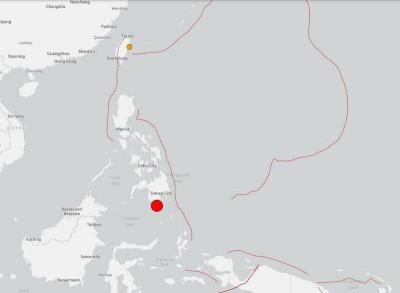
A magnitude 7.8 earthquake struck off the southern coast of Mindanao in the Philippines at 7:38am today, prompting the US Tsunami Warning System to issue an alert for neighboring countries, including Taiwan. The system issued a purple alert indicating a "tsunami threat." The potential threat zone includes Taiwan, the Philippines, Papua New Guinea, Yap and Palau. Philippine authorities were assessing the damage from the quake, with the office of civil defense seeking to verifying initial reports that 15 people had been killed and 129 injured in the region, mostly from falling debris. Arlene Hollero, disaster chief of Maasim town in the Philippines' Sarangani Province,

‘GRAY ZONE’ PRESSURE: Beijing’s activities are intended to create the deceitful impression that China has jurisdiction over the area around Taiwan, the CGA said Taiwan’s rights over its territorial waters and exclusive economic zone must not be violated by any country, the Mainland Affairs Council said yesterday, adding that it will not accept any unprovoked actions. The council issued the remarks in response to the China Coast Guard conducting maritime enforcement drills near eastern Taiwan and claiming to fully exercise China’s maritime administrative law enforcement authority. The Coast Guard Administration (CGA) has been closely monitoring the situation and is taking concrete steps to defend the nation’s sovereignty and secure its waters, the council said. China has no sovereign rights over the waters off eastern

RESILIENCE: Taiwan plays a key role in semiconductors, energy, information infrastructure and advanced manufacturing, AIT Director Raymond Greene said Taiwan’s continued investment in deterrence and resilience remains vital, especially in uncrewed systems and other emerging technologies, American Institute in Taiwan (AIT) Director Raymond Greene said yesterday. Greene made the remarks at the annual National Strategic Summit on Supply Chain Resilience held by the Research Institute for Democracy, Society and Emerging Technology (DSET), a government-backed think tank. As Taiwan last year became the US’ fourth-largest trading partner and supply chain security is becoming more important, cooperation in emerging technologies continues to deepen between the two countries, he said. The US is committed to accelerating innovation, building key infrastructure, strengthening cooperation

The National Chungshan Institute of Science and Technology yesterday showcased its locally developed variants of the Vision 60 robotic patrol dog, which it plans to deploy on the nation’s outlying territories in the South China Sea. The variants were produced under the Joint Lab project — created by the institute and domestic companies — and assembled with domestically produced motors, lenses and artificial intelligence (AI) systems alongside licensed tech from the US, Missile and Rocket Systems Research Division deputy director Jen Kuo-kang (任國光) told the media event at a military base in Taipei’s Dazhi (大直) area. Taiwan has built up its strengths


 RSS
RSS