


Taiwan’s listed manufacturing companies accelerated their research and development (R&D) spending last year to a record high NT$692.7 billion (US$21.4 billion), despite declines in sales and profits, the Ministry of Economic Affairs said yesterday.
The spending was up 2.9 percent from NT$673 billion a year earlier, driven mainly by expenditures by those in the electronic parts, computer products and optical components industries, the ministry said in a statement.
Companies in the electronic components sector spent NT$450.7 billion on R&D last year, up 2.2 percent year-on-year and accounting for 65.1 percent of overall spending, while those in the computer products and optical components sector spent NT$158 billion, up 4 percent from the previous year and contributing 22.8 percent to the total, the ministry said.
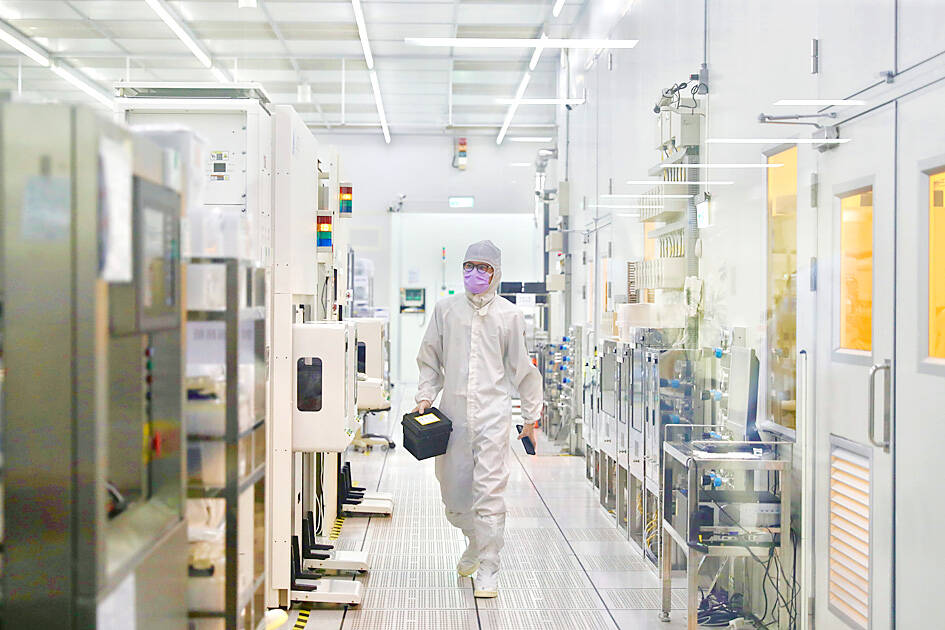
Photo: Ritchie B. Tongo, EPA-EFE
In terms of individual companies, global foundry giant Taiwan Semiconductor Manufacturing Co (TSMC, 台積電) topped its local peers with R&D spending of NT$178.7 billion, up 11.1 percent from the previous year and accounting for 25.8 percent of total spending, the ministry said.
Smartphone chip designer MediaTek Inc (聯發科) came in second with spending of NT$80.6 billion and networking chip designer Realtek Semiconductor Corp (瑞昱) was in third place at NT$20.1 billion, it said.
The data compiled by the ministry showed that the 1,101 manufacturing firms listed on the Taiwan Stock Exchange and the Taipei Exchange — excluding overseas Taiwanese businesses with a primary listing in Taiwan — were still developing technologies to maintain their leading edge in the market, even though sales and profits decreased from the previous year.
The firms last year reported combined net sales of NT$18.88 trillion, down 10.7 percent year-on-year, while their overall operating profits decreased 26.4 percent to NT$1.49 trillion, with operating margin dropping 1.7 percentage points to 7.9 percent, the ministry said.
The setback was mainly due to headwinds facing the electronic components, the computer products and optical components, the chemical materials and fertilizer, and the petroleum and coal products sectors, it said.
Among the firms, Hon Hai Precision Industry Co (鴻海) garnered the highest sales of NT$3.45 trillion last year, followed by TSMC’s NT$2.15 trillion and Pegatron Corp’s (和碩) NT$1.18 trillion.
TSMC posted the highest operating profit of NT$907.4 billion, ahead of United Microelectronics Corp’s (聯電) NT$48.7 billion and MediaTek’s NT$42.3 billion.
With slowing growth momentum, investments in fixed assets by the listed manufacturing firms fell 20.9 percent year-on-year to NT$1.2 trillion last year, as a significant decline in investment by the electronic components industry offset higher outlays by the chemical materials and fertilizer, and the petroleum and coal products sectors, the ministry said.
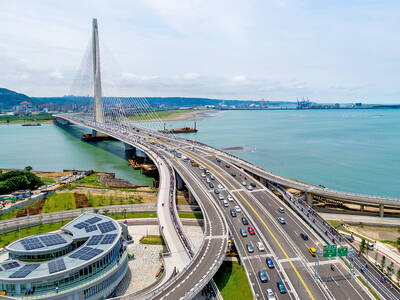
The Ministry of Transportation and Communications yesterday inaugurated the Danjiang Bridge across the Tamsui River in New Taipei City, saying that the structure would be an architectural icon and traffic artery for Taiwan. Feted as a major engineering achievement, the Danjiang Bridge is 920m long, 211m tall at the top of its pylon, and is the longest single-pylon asymmetric cable-stayed bridge in the world, the government’s Web site for the structure said. It was designed by late Iraqi-British architect Zaha Hadid. The structure, with a maximum deck of 70m, accommodates road and light rail traffic, and affords a 200m navigation channel for boats,
Taiwan Semiconductor Manufacturing Co (TSMC, 台積電), the world’s largest foundry service provider, yesterday said that global semiconductor revenue is projected to hit US$1.5 trillion in 2030, after the figure exceeds US$1 trillion this year, as artificial intelligence (AI) demand boosts consumption of token and compute power. “We are still at the beginning of the AI revolution, but we already see a significant impact across the whole semiconductor ecosystem,” TSMC deputy cochief operating officer Kevin Zhang (張曉強) said at the company’s annual technology symposium in Hsinchu City. “It is fair to say that in the past decade, smartphones and other mobile devices were
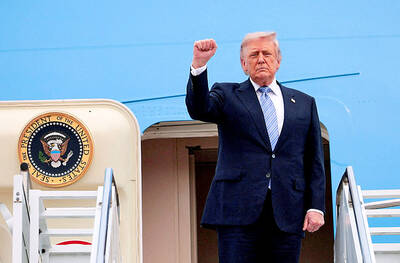
US-CHINA SUMMIT: MOFA welcomed US reassurance of no change in its Taiwan policy; Trump said he did not comment when Xi talked of opposing independence US President Donald Trump yesterday said he has not made a decision on whether to move forward with a major arms package for Taiwan after hearing concerns about it from Chinese President Xi Jinping (習近平). Trump’s comments on Taiwan came as he flew back to Washington after wrapping up critical talks in which both leaders said important progress was made in stabilizing US-China relations even as deep differences persist between the world’s two biggest powers on Iran and Taiwan. “I will make a determination,” Trump said, adding: “I’ll be making decisions. But, you know, I think the last thing we need right
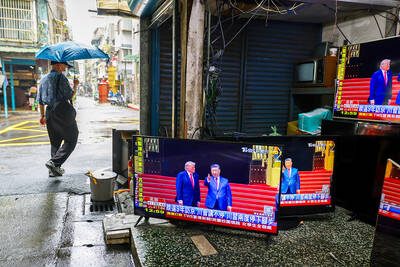
TAIWAN ISSUE: US treasury secretary Scott Bessent said on the first day of meetings that ‘it wouldn’t be a US-China summit without the Taiwan issue coming up’ There were no surprises on the first day of the summit between US President Donald Trump and Chinese President Xi Jinping (習近平), the Mainland Affairs Council (MAC) said yesterday, as the government reiterated that cross-strait stability is crucial to the Asia-Pacific region, as well as the world. As the two presidents met for a highly anticipated summit yesterday, Chinese state media reported that Xi warned Trump that missteps regarding Taiwan could push their two countries into “conflict.” Trump arrived in China with accolades for his host, calling Xi a “great leader” and “friend,” and extending an invitation to visit the White House


 RSS
RSS