


US President Joe Biden said he was committed to “deepening maritime and security ties” with Japan and the Philippines, as he sought to assure allies worried about increasingly assertive Chinese actions in disputed waters.
“The United States’ defense commitments to Japan and to the Philippines are ironclad,” Biden said on Thursday before a meeting with Japanese Prime Minister Fumio Kishida and Philippine President Ferdinand Marcos Jr at the White House, their first trilateral summit.
“Any attack on Philippine aircraft, vessels or armed forces in the South China Sea would invoke our mutual defense treaty,” Biden added.
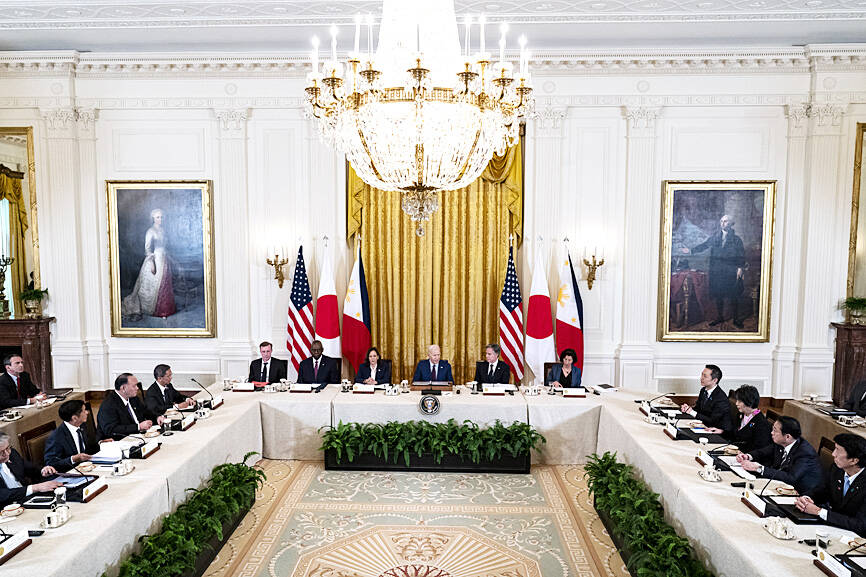
Photo: EPA-EFE
The Philippines under Marcos has adopted a more assertive footing to the growing number of Chinese patrols in the South China Sea, where both nations have competing maritime claims. Tensions are centered around the Second Thomas Shoal (Renai Shoal, 仁愛暗沙), where Manila maintains a grounded World War-II era ship. Chinese vessels have used water cannons to block Philippine military missions that rotate and resupply troops on the ship.
Beijing yesterday responded that defense cooperation between nations should not target any specific country. Chinese Ministry of National Defense spokesman Colonel Wu Qian (吳謙) criticized a “certain non-regional country” for frequently sending military vessels and aircraft to the South China Sea, and gathering its allies to build “small cliques” against China.
“These acts are irresponsible and extremely dangerous,” he said.
Biden, Kishida and Marcos agreed to step up military exercises, including plans for Philippine and Japan Coast Guard members to patrol aboard a US Coast Guard vessel in the Indo-Pacific region, a joint statement released on Thursday evening said.
The nations also plan to conduct more training exercises at sea.
Maritime security topped the summit agenda following a series of incidents, including Chinese Coast Guard ships firing water cannons last month at a civilian Philippine boat. The three countries on Sunday joined Australia for military drills in the South China Sea.
“We steadfastly oppose the dangerous and coercive use of Coast Guard and maritime militia vessels in the South China Sea, as well as efforts to disrupt other countries’ offshore resource exploitation,” the three leaders said in the joint statement.
At the White House earlier, Kishida said that “as the world faces a complex crisis, it is important that we work in a multilayered effort with like-minded countries and allies to maintain and strengthen a free and open international order based on the rule of law.”
Biden and Kishida have striven to demonstrate unity with the Philippines, part of a broader US strategy to bolster partnerships in the Indo-Pacific and encourage allies to strengthen their own ties amid growing alarm over China’s military and economic influence.

SECURITY: As China is ‘reshaping’ Hong Kong’s population, Taiwan must raise the eligibility threshold for applications from Hong Kongers, Chiu Chui-cheng said When Hong Kong and Macau citizens apply for residency in Taiwan, it would be under a new category that includes a “national security observation period,” Mainland Affairs Council (MAC) Minister Chiu Chui-cheng (邱垂正) said yesterday. President William Lai (賴清德) on March 13 announced 17 strategies to counter China’s aggression toward Taiwan, including incorporating national security considerations into the review process for residency applications from Hong Kong and Macau citizens. The situation in Hong Kong is constantly changing, Chiu said to media yesterday on the sidelines of the Taipei Technology Run hosted by the Taipei Neihu Technology Park Development Association. With

CARROT AND STICK: While unrelenting in its military threats, China attracted nearly 40,000 Taiwanese to over 400 business events last year Nearly 40,000 Taiwanese last year joined industry events in China, such as conferences and trade fairs, supported by the Chinese government, a study showed yesterday, as Beijing ramps up a charm offensive toward Taipei alongside military pressure. China has long taken a carrot-and-stick approach to Taiwan, threatening it with the prospect of military action while reaching out to those it believes are amenable to Beijing’s point of view. Taiwanese security officials are wary of what they see as Beijing’s influence campaigns to sway public opinion after Taipei and Beijing gradually resumed travel links halted by the COVID-19 pandemic, but the scale of
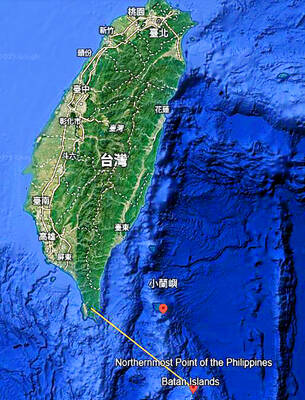
A US Marine Corps regiment equipped with Naval Strike Missiles (NSM) is set to participate in the upcoming Balikatan 25 exercise in the Luzon Strait, marking the system’s first-ever deployment in the Philippines. US and Philippine officials have separately confirmed that the Navy Marine Expeditionary Ship Interdiction System (NMESIS) — the mobile launch platform for the Naval Strike Missile — would take part in the joint exercise. The missiles are being deployed to “a strategic first island chain chokepoint” in the waters between Taiwan proper and the Philippines, US-based Naval News reported. “The Luzon Strait and Bashi Channel represent a critical access

Pope Francis is be laid to rest on Saturday after lying in state for three days in St Peter’s Basilica, where the faithful are expected to flock to pay their respects to history’s first Latin American pontiff. The cardinals met yesterday in the Vatican’s synod hall to chart the next steps before a conclave begins to choose Francis’ successor, as condolences poured in from around the world. According to current norms, the conclave must begin between May 5 and 10. The cardinals set the funeral for Saturday at 10am in St Peter’s Square, to be celebrated by the dean of the College


 RSS
RSS