


A new analysis found that last year, only 10 countries and 9 percent of global cities had air quality that met WHO guidelines for harmful fine-particle, or PM2.5, pollution.
Some of the places most affected were in the Middle East, Africa, and central and south Asia. Bangladesh, Pakistan, India, Tajikistan and Burkina Faso ranked as the five countries with the most polluted air last year, weighted by population, said a report by IQAir, a Swiss air quality technology company that collects air-sensor data around the world.
The capital cities with the worst air were New Delhi, Dhaka, Ouagadougou, Dushanbe and Baghdad, IQAir found.
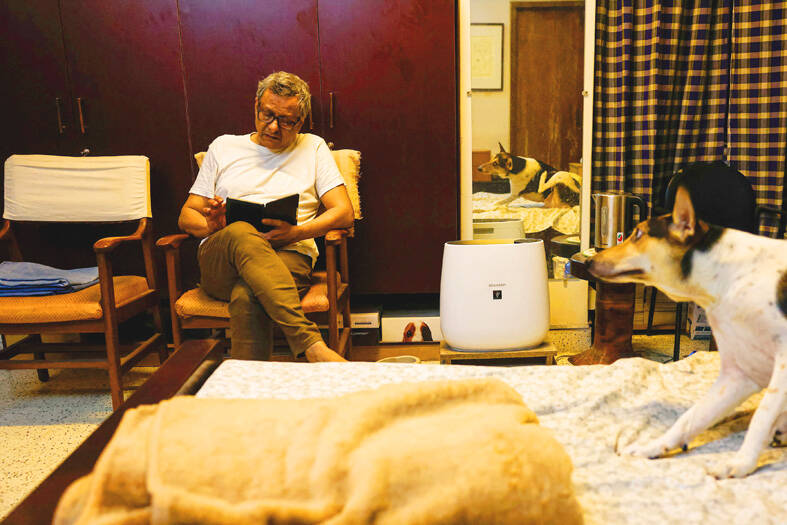
Photo: Reuters
Capitals with the lowest concentrations of PM2.5 were mostly in Oceania, Scandinavia and the Caribbean, and included Wellington, Reykjavik and Hamilton.
One of the most common forms of air pollution, PM2.5 “kills more people than any other pollutant that is out there,” said Glory Dolphin Hammes, CEO of the North American division of IQAir, which has released annual World Air Quality reports since 2017.
Sources of PM2.5 pollution vary widely, from brick kilns in Bangladesh to mining in Latin America. However, the overwhelming source is the burning of fossil fuels such as coal, oil and gas.
Outdoor air pollution, caused primarily by PM2.5, is responsible for the early deaths of more than 4 million people worldwide each year, the WHO has said.
A separate analysis led by a researcher at the Max Planck Institute for Chemistry in Germany found that fossil fuels are responsible for 65 percent of those deaths.
“The first thing to understand about PM2.5 is it’s a very complex mixture of gases and particles that are suspended in the air, and it’s defined by size,” said Misbath Daouda, an assistant professor of health equity and environmental justice at the University of California at Berkeley who was not involved in IQAir’s analysis.
The particles are “small enough that they can enter different organ systems and the bloodstream; they can irritate the lungs and the respiratory system. And that’s what makes them so detrimental for health,” Daouda said.
PM2.5 pollution is linked to increased rates of heart attack and stroke, and can cause what is known as oxidative stress — essentially, stress that damages the body’s cells faster than they can repair themselves.
Oxidative stress is associated with a variety of illnesses ranging from Parkinson’s disease to cancer.
More recent research have shown that exposure to PM2.5 can also affect brain development, “so that’s a concern for young children,” Daouda said.

US PUBLICATION: The results indicated a change in attitude after a 2023 survey showed 55 percent supported full-scale war to achieve unification, the report said More than half of Chinese were against the use of force to unify with Taiwan under any circumstances, a survey conducted by the Atlanta, Georgia-based Carter Center and Emory University found. The survey results, which were released on Wednesday in a report titled “Sovereignty, Security, & US-China Relations: Chinese Public Opinion,” showed that 55.1 percent of respondents agreed or somewhat agreed that “the Taiwan problem should not be resolved using force under any circumstances,” while 24.5 percent “strongly” or “somewhat” disagreed with the statement. The results indicated a change in attitude after a survey published in “Assessing Public Support for (Non)Peaceful Unification
The CIA has a message for Chinese government officials worried about their place in Chinese President Xi Jinping’s (習近平) government: Come work with us. The agency released two Mandarin-language videos on social media on Thursday inviting disgruntled officials to contact the CIA. The recruitment videos posted on YouTube and X racked up more than 5 million views combined in their first day. The outreach comes as CIA Director John Ratcliffe has vowed to boost the agency’s use of intelligence from human sources and its focus on China, which has recently targeted US officials with its own espionage operations. The videos are “aimed at
‘MISGUIDED EDICT’: Two US representatives warned that Somalia’s passport move could result in severe retaliatory consequences and urged it to reverse its decision Minister of Foreign Affairs Lin Chia-lung (林佳龍) has ordered that a special project be launched to counter China’s “legal warfare” distorting UN Resolution 2758, a foreign affairs official said yesterday. Somalia’s Civil Aviation Authority on Wednesday cited UN Resolution 2758 and Mogadishu’s compliance with the “one China” principle as it banned people from entering or transiting in the African nation using Taiwanese passports or other Taiwanese travel documents. The International Air Transport Association’s system shows that Taiwanese passport holders cannot enter Somalia or transit there. The Ministry of Foreign Affairs (MOFA) protested the move and warned Taiwanese against traveling to Somalia or Somaliland
SECURITY: Grassroots civil servants would only need to disclose their travel, while those who have access to classified information would be subject to stricter regulations The government is considering requiring legislators and elected officials to obtain prior approval before traveling to China to prevent Chinese infiltration, an official familiar with national security said yesterday. President William Lai (賴清德) in March announced 17 measures to counter China’s growing infiltration efforts, including requiring all civil servants to make trips to China more transparent so they can be held publicly accountable. The official said that the government is considering amending the Act Governing Relations Between the People of the Taiwan Area and Mainland Area (臺灣地區與大陸地區人民關係條例) to require all civil servants to follow strict regulations before traveling to China.


 RSS
RSS