


North Korea yesterday fired multiple ballistic missiles in a defiant show of force that coincided with a visit to Seoul by US Secretary of State Antony Blinken for a Summit for Democracy.
North Korea fired three ballistic missiles toward waters off its east coast that reached a maximum altitude of about 50km and flew about 300km to land outside of Japan’s exclusive economic zone, the Ministry of Defense in Tokyo said.
South Korea’s Joint Chiefs of Staff said in a text message to reporters about the launch that several short-range ballistic missiles were fired from about 7:44am from near Pyongyang that flew about 300km.
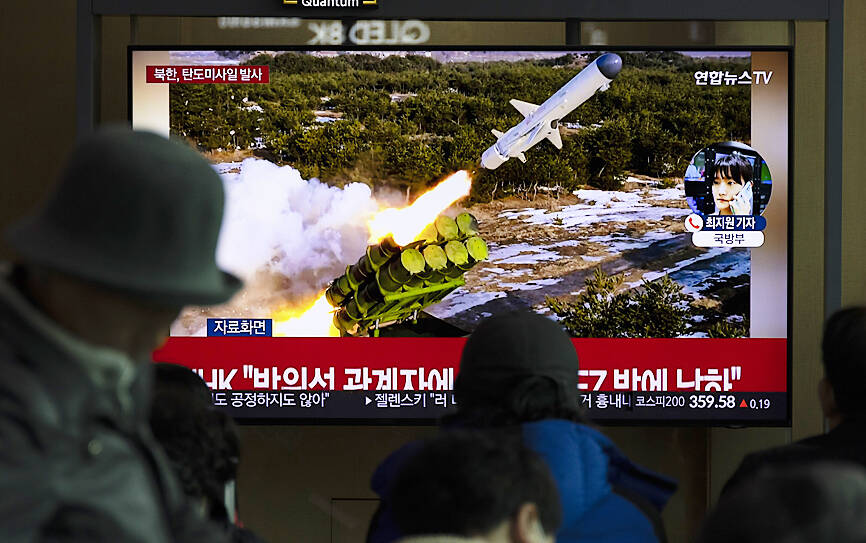
Photo: EPA-EFE
The US, South Korea and Japan all condemned North Korea’s first ballistic missile test in about two months, calling it a threat to regional security and a contravention of UN Security Council resolutions.
It is unclear what was in the barrage. North Korea, which often comments on missile launches the following day, has been known to engage in provocations designed to coincide with high-profile political events involving the US, South Korea and Japan.
The launches followed the conclusion of US and South Korean joint military drills on Thursday last week, which included training on land, sea and in the air against contingencies posed by North Korea.
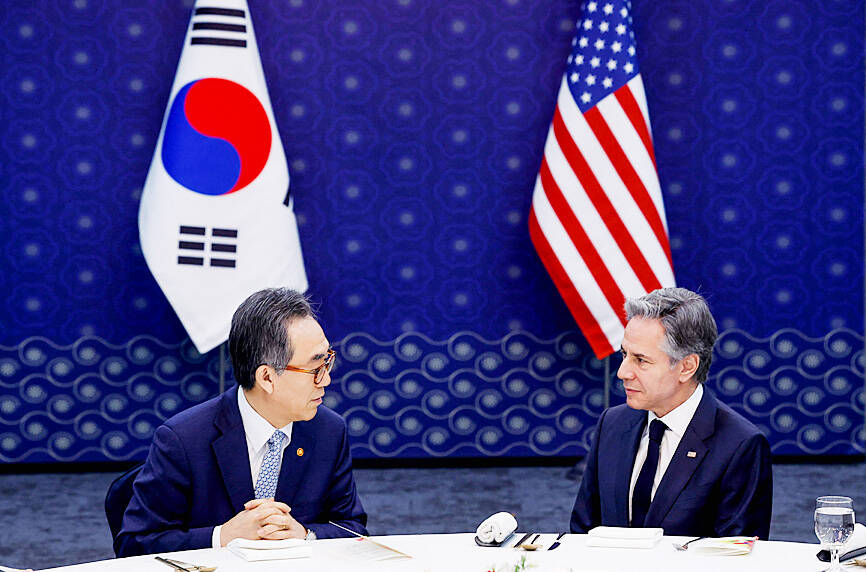
Photo: AFP
Pyongyang’s propaganda apparatus slammed the ideals advanced by the US ahead of the Summit for Democracy, which was launched under US President Joe Biden’s administration as a way for leaders to show solidarity.
US-style democracy is the “sinister intention of imperialists” to consolidate power around US-led Western forces, North Korea’s main newspaper, Rodong Sinmun, said in an article over the weekend ahead of the summit.
Hours after the missile launches, South Korean Minister of National Defense Shin Won-sik told a news conference that Pyongyang has shipped about 7,000 containers filled with munitions and other military equipment to Russia since last year to help support its war in Ukraine.
Shin said that after initially relying on ships, the North has been increasingly using its rail networks to send arms supplies to Russia through their land border.
In exchange for sending possibly several million artillery shells and other supplies, North Korea has received more than 9,000 Russian containers likely filled with aid, Shin said.
He raised suspicions that Russia could be providing North Korea with fuel, possibly in defiance of UN Security Council sanctions that tightly cap the country’s imports of oil and petroleum products.
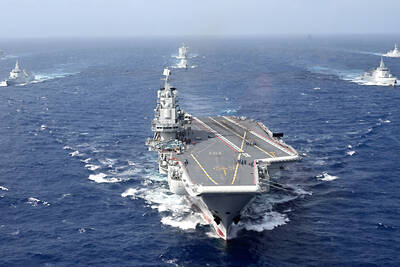
PROVOCATIVE: Chinese Deputy Ambassador to the UN Sun Lei accused Japan of sending military vessels to deliberately provoke tensions in the Taiwan Strait China denounced remarks by Japan and the EU about the South China Sea at a UN Security Council meeting on Monday, and accused Tokyo of provocative behavior in the Taiwan Strait and planning military expansion. Ayano Kunimitsu, a Japanese vice foreign minister, told the Council meeting on maritime security that Tokyo was seriously concerned about the situation in the East China and South China seas, and reiterated Japan’s opposition to any attempt to change the “status quo” by force, and obstruction of freedom of navigation and overflight. Stavros Lambrinidis, head of the EU delegation to the UN, also highlighted South China Sea
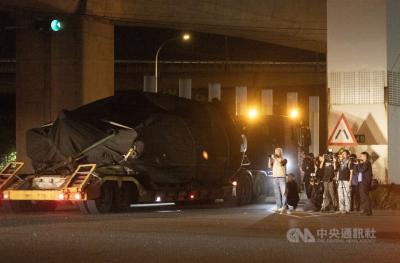
The final batch of 28 M1A2T Abrams tanks purchased from the US arrived at Taipei Port last night and were transported to the Armor Training Command in Hsinchu County’s Hukou Township (湖口), completing the military’s multi-year procurement of 108 of the tanks. Starting at 12:10am today, reporters observed more than a dozen civilian flatbed trailers departing from Taipei Port, each carrying an M1A2T tank covered with black waterproof tarps. Escorted by military vehicles, the convoy traveled via the West Coast Expressway to the Armor Training Command, with police implementing traffic control. The army operates about 1,000 tanks, including CM-11 Brave Tiger
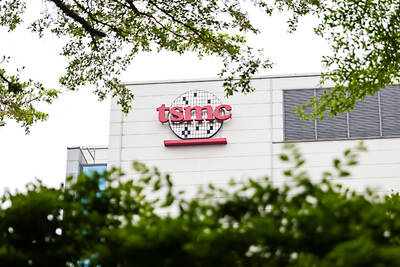
Taiwan Semiconductor Manufacturing Co (TSMC, 台積電), the world’s largest contract chipmaker, said it expects its 2-nanometer (2nm) chip capacity to grow at a compound annual rate of 70 percent from this year to 2028. The projection comes as five fabs begin volume production of 2-nanometer chips this year — two in Hsinchu and three in Kaohsiung — TSMC senior vice president and deputy cochief operating officer Cliff Hou (侯永清) said at the company’s annual technology symposium in Silicon Valley, California, last week. Output in the first year of 2-nanometer production, which began in the fourth quarter of last year, is expected to
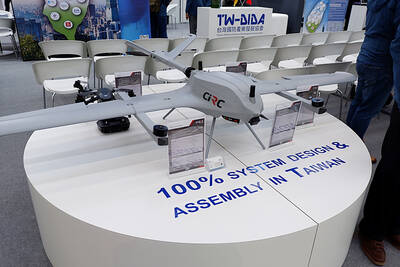
Taiwan’s drone exports surged past US$100 million in the first quarter, exceeding last year’s full-year total, with the Czech Republic emerging as the largest buyer, the Ministry of Economic Affairs said. Exports of complete drones reached US$115.85 million in the period, about 1.2 times the total recorded for all of last year, the ministry said in a report. Exports to the Czech Republic accounted for about US$100 million, far outpacing other markets. Poland, last year’s top destination, recorded about US$11.75 million in the first quarter. Taiwan’s drone exports have expanded rapidly in the past few years, with last year’s total


 RSS
RSS