


The mother of late Russian opposition leader Alexei Navalny visited his grave on Saturday, a day after thousands of Russians risked arrest to pay tribute to the anti-corruption campaigner at his funeral.
Navalny, Russian President Vladimir Putin’s fiercest critic for more than a decade, died in an Arctic prison colony last month, where he was serving a 19-year sentence on “extremism” charges largely seen as political retribution for his opposition to the Kremlin.
His mother, Lyudmila Navalnaya, visited his grave, which was covered in flowers and wreaths, at the Borisovo cemetery in southern Moscow early yesterday morning.
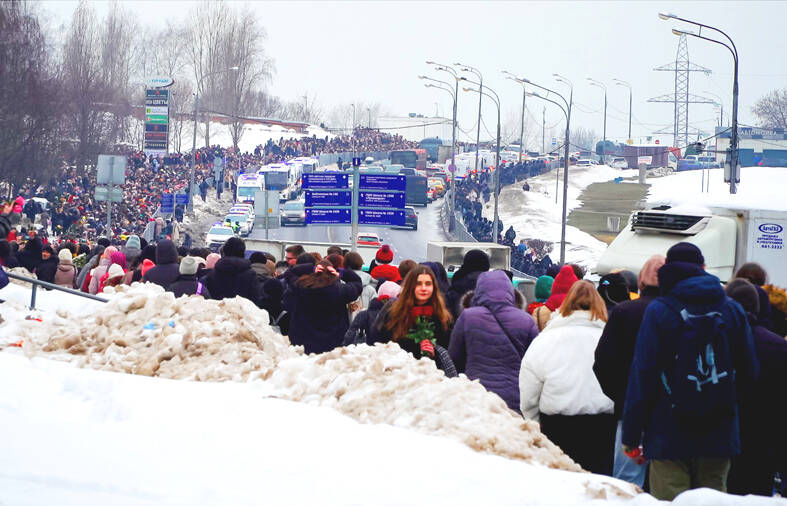
Photo: AFP
She was accompanied by Alla Abrosimova, the mother of Navalny’s widow, Yulia Navalnaya.
Yulia Navalnaya, the couple’s two children and Navalny’s brother all live abroad and did not attend the funeral, where they could have been arrested for their own opposition to Putin.
Most of his closest aides — in jail or in exile — were also unable to attend the service in the Maryino district of Moscow, where Navalny used to live.
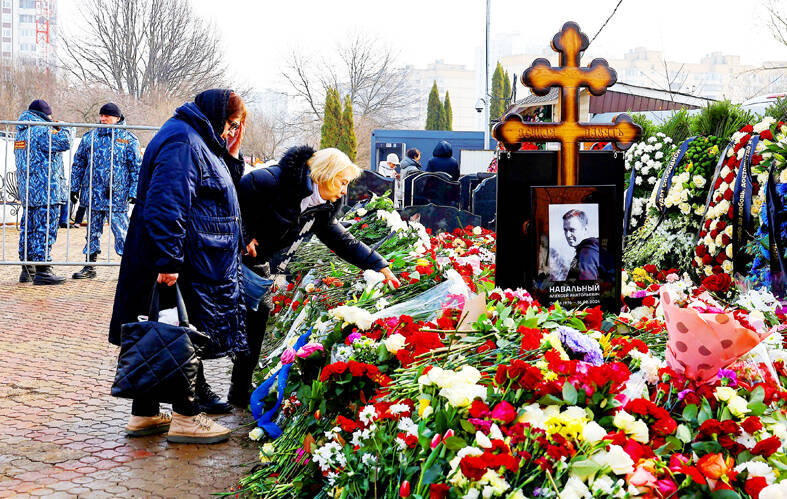
Photo: Reuters
Despite a heavy police presence and official warnings, thousands of mourners on Friday paid their respects to the 47-year-old.
Navalny’s body first lay in an open casket in a packed church in Maryino, southern Moscow, for a ceremony attended by his parents.
The coffin was closed immediately after the service, meaning many mourners who had wanted to file past were not able to pay their last respects at the Mother of God Quench My Sorrows church.
It was transported to the Borisovo cemetery, near the banks of the Moskva River, where several large wreaths were arranged around the grave.
“We won’t forget you,” “Forgive us” some people shouted as the coffin arrived.
“No to war,” some also chanted while others yelled “Down with the power of murderers” and “We will not forgive.”
Rights monitoring group OVD-Info said police had arrested at least 128 people attending tributes to Navalny in 19 cities across Russia on Friday.
“Any unauthorized gatherings will be in violation of the law and those who participate in them will be held responsible,” Kremlin spokesman Dmitry Peskov said, according to TASS news agency.
“What are they afraid of? Why so many cars?” one mourner, Anna Stepanova, said outside the church.
“The people who came here, they are not scared. Alexei wasn’t either,” she added.
German Chancellor Olaf Scholz praised the thousands who turned out as “courageous” and French President Emmanuel Macron also paid tribute to the “courage” of those who went to pay their last respects.
The French, German and US ambassadors were seen among mourners outside the church, as were some of Russia’s last free independent politicians.

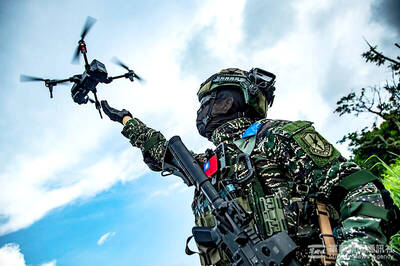
RESILIENCE: Taiwan plays a key role in semiconductors, energy, information infrastructure and advanced manufacturing, AIT Director Raymond Greene said Taiwan’s continued investment in deterrence and resilience remains vital, especially in uncrewed systems and other emerging technologies, American Institute in Taiwan (AIT) Director Raymond Greene said yesterday. Greene made the remarks at the annual National Strategic Summit on Supply Chain Resilience held by the Research Institute for Democracy, Society and Emerging Technology (DSET), a government-backed think tank. As Taiwan last year became the US’ fourth-largest trading partner and supply chain security is becoming more important, cooperation in emerging technologies continues to deepen between the two countries, he said. The US is committed to accelerating innovation, building key infrastructure, strengthening cooperation

The National Chungshan Institute of Science and Technology yesterday showcased its locally developed variants of the Vision 60 robotic patrol dog, which it plans to deploy on the nation’s outlying territories in the South China Sea. The variants were produced under the Joint Lab project — created by the institute and domestic companies — and assembled with domestically produced motors, lenses and artificial intelligence (AI) systems alongside licensed tech from the US, Missile and Rocket Systems Research Division deputy director Jen Kuo-kang (任國光) told the media event at a military base in Taipei’s Dazhi (大直) area. Taiwan has built up its strengths

RIGHT DIRECTION: Taiwan’s efforts to prevent forced labor include a proposal to ‘fully prohibit’ employers from withholding workers’ documents, an official said Taiwan is to establish a mechanism to restrict imports of goods linked to forced labor, the Executive Yuan said yesterday, after the US proposed imposing additional tariffs on Taiwanese goods over labor concerns. “The Ministry of Labor and the Ministry of Economic Affairs are to establish an interministerial review procedure,” Executive Yuan spokesperson Michelle Lee (李慧芝) said at a news briefing in Taipei. “The government is to use the Foreign Trade Act [貿易法] as the legal basis to restrict imports of goods produced with forced labor” and bring its supply chain governance more in line with international standards on human rights, resilience

NOT IMMEDIATE: Taiwan has a chance to appeal the proposed 10 percent tariff before it starts, while other countries face a 12.5 percent tariff from the trade office Taiwan is among 60 economies determined by the US to have failed to impose or enforce a ban on the importation of goods produced with forced labor, according to a notice released on Tuesday by the Office of the US Trade Representative (USTR), which proposed imposing an additional 10 percent or more tariff on them. The USTR in a statement said that following an investigation, it had determined under Section 301 of the Trade Act of 1974 that the failure of the 60 economies to impose and effectively enforce a prohibition on the importation of goods produced with forced labor is


 RSS
RSS