


More than 100 Web sites disguised as local news outlets in Europe, Asia and Latin America are pushing pro-China content in a widespread influence campaign linked to a Beijing public relations firm, digital watchdog Citizen Lab said on Wednesday.
Spread over Web sites in 30 countries, the propaganda material is interspersed with news aggregated from local news outlets and Chinese state media, according to a research report by the Toronto-based group.
“While the campaign’s websites enjoyed negligible exposure to date, there is a heightened risk of inadvertent amplification by the local media and target audiences, as a result of the quick multiplication of these websites and their adaptiveness to local languages and content,” researcher Alberto Fittarelli said in the report.
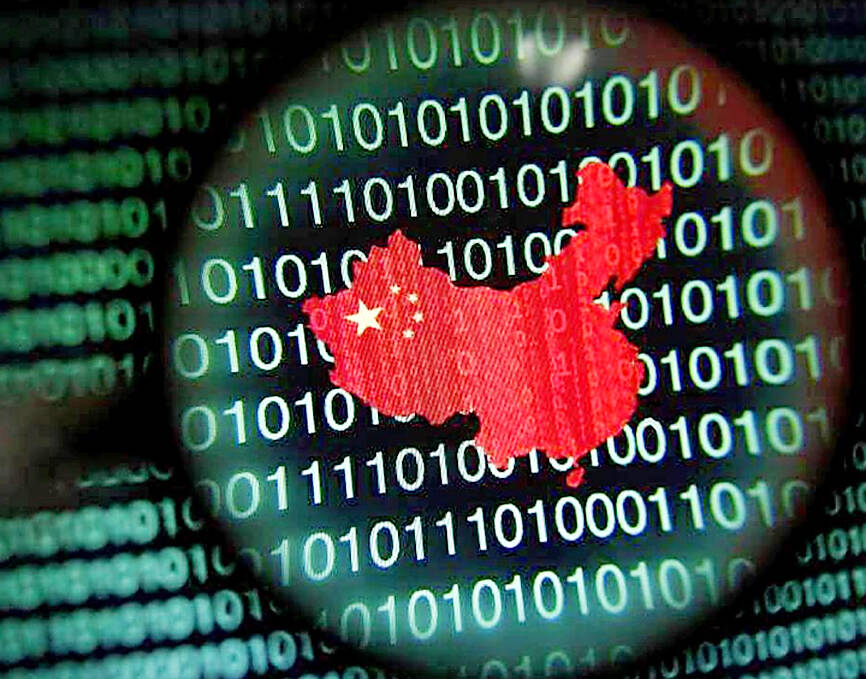
Photo: Reuters
The sites’ content sways between conspiracy theories, often about the US or its allies — such as a piece blaming American scientists for “leaking” COVID-19 — to articles attacking Beijing’s critics.
It is rare for researchers to link such operations to specific entities. Citizen Lab said the campaign began in mid-2020 and traced the network to public relations firm Shenzhen Haimaiyunxiang Media Co Ltd, also known as “Haimai.”
The company did not respond to a Reuters request for comment and a phone number listed on an archived version of its Web site was not reachable.
“As a principle, it is a typical bias and double standard to allege that the pro-China contents and reports are ‘disinformation’, and to call the anti-China ones ‘true information,’” a spokesperson for China’s embassy in Washington said in an e-mailed statement.
Citizen Lab said one of the Web sites in the campaign was Roma Journal, which looks every bit like a local Italian news outlet: Headlines discuss the Italian prime minister’s political prospects, a hot air balloon festival in a northern province and a book launch.
However, a “press releases” button at a corner of its homepage leads to a range of Chinese state media articles on topics such as China’s contribution to the global economic recovery and its push towards technological innovation.
Much of the content on the sites Citizen Lab found was sourced from a press releases service called Times Newswire, which analysts at cybersecurity firm Mandiant last year found to be at the center of a separate Chinese influence operation that targeted US audiences.
While online influence campaigns are increasingly common as powerful people and governments worldwide seek to manipulate public opinion, experts tracking such operations say China is one of the biggest sources of such drives alongside Russia and Iran.
Chinese influence operations have increased and expanded well beyond Asia, social media giant Meta said in a report in November last year, calling it “the most notable change in the threat landscape” since 2020.
Citizen Lab dug deeper into the network it found after a series of such Web sites popped up in South Korea and Italy.
South Korean National Cyber Security Center — part of the country’s national intelligence agency — exposed 18 of the sites in a report in November last year, also linking the operation to Haimai.
Roma Journal was not legally registered as a news outlet in Italy, the country’s Il Foglio newspaper reported.
It was not unusual the campaign was found to be low-engagement, said Dakota Cary, a China-focused consultant at cybersecurity firm SentinelOne.
“I think that’s really important, because they still think that it’s worthwhile to fund these campaigns,” he said. “And so I think, if anything, we should expect to see this continue.”
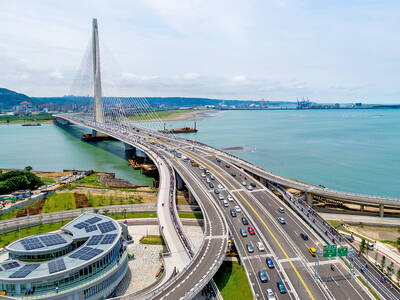
The Ministry of Transportation and Communications yesterday inaugurated the Danjiang Bridge across the Tamsui River in New Taipei City, saying that the structure would be an architectural icon and traffic artery for Taiwan. Feted as a major engineering achievement, the Danjiang Bridge is 920m long, 211m tall at the top of its pylon, and is the longest single-pylon asymmetric cable-stayed bridge in the world, the government’s Web site for the structure said. It was designed by late Iraqi-British architect Zaha Hadid. The structure, with a maximum deck of 70m, accommodates road and light rail traffic, and affords a 200m navigation channel for boats,

Taiwan Semiconductor Manufacturing Co (TSMC, 台積電), the world’s largest foundry service provider, yesterday said that global semiconductor revenue is projected to hit US$1.5 trillion in 2030, after the figure exceeds US$1 trillion this year, as artificial intelligence (AI) demand boosts consumption of token and compute power. “We are still at the beginning of the AI revolution, but we already see a significant impact across the whole semiconductor ecosystem,” TSMC deputy cochief operating officer Kevin Zhang (張曉強) said at the company’s annual technology symposium in Hsinchu City. “It is fair to say that in the past decade, smartphones and other mobile devices were
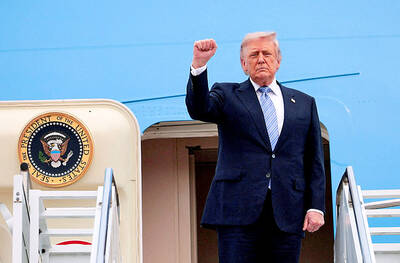
US-CHINA SUMMIT: MOFA welcomed US reassurance of no change in its Taiwan policy; Trump said he did not comment when Xi talked of opposing independence US President Donald Trump yesterday said he has not made a decision on whether to move forward with a major arms package for Taiwan after hearing concerns about it from Chinese President Xi Jinping (習近平). Trump’s comments on Taiwan came as he flew back to Washington after wrapping up critical talks in which both leaders said important progress was made in stabilizing US-China relations even as deep differences persist between the world’s two biggest powers on Iran and Taiwan. “I will make a determination,” Trump said, adding: “I’ll be making decisions. But, you know, I think the last thing we need right
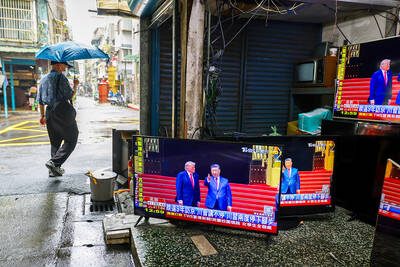
TAIWAN ISSUE: US treasury secretary Scott Bessent said on the first day of meetings that ‘it wouldn’t be a US-China summit without the Taiwan issue coming up’ There were no surprises on the first day of the summit between US President Donald Trump and Chinese President Xi Jinping (習近平), the Mainland Affairs Council (MAC) said yesterday, as the government reiterated that cross-strait stability is crucial to the Asia-Pacific region, as well as the world. As the two presidents met for a highly anticipated summit yesterday, Chinese state media reported that Xi warned Trump that missteps regarding Taiwan could push their two countries into “conflict.” Trump arrived in China with accolades for his host, calling Xi a “great leader” and “friend,” and extending an invitation to visit the White House


 RSS
RSS