


The government must deal with illegal foreign migrant workers before they become a threat to national security, said a Control Yuan report published yesterday on a case in which 10 Vietnamese drowned last year.
Authorities at first thought it was due to a human smuggling operation when people found floating bodies washing ashore in the spring last year, but an investigation by various agencies and Vietnamese government officials helped to verify that the 10 corpses were Vietnamese whose boat had capsized in rough seas, the report said.
Four people remain unaccounted for. Their bodies were not recovered and they might have swum ashore to look for work in Taiwan, the report by Control Yuan members Yeh Ta-hua (葉大華) and Pasuya Poiconu said.
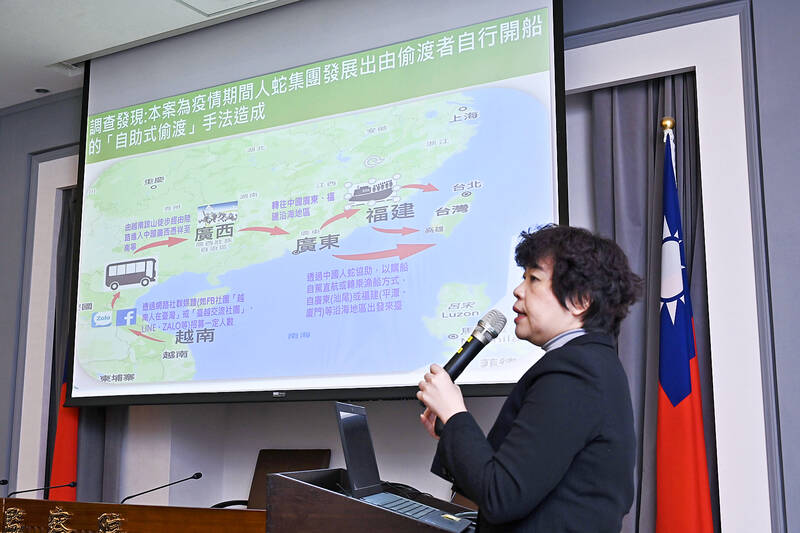
Photo: Tu Chien-jung, Taipei Times
Thirteen other bodies recovered from the sea last year were Taiwanese citizens, and police reports and checks with families led to the conclusion that most had been swept out to sea when fishing or walking on the shore, although some had spoken about committing suicide, the report said.
Testimony from family members and friends of the Vietnamese who drowned indicated that the 14 Vietnamese planned to enter Taiwan by sea to look for jobs and earn higher wages than they could back home.
Support networks for illegal Vietnamese workers are in place in Taiwan, Yeh said.
The report found that Vietnamese try to reach Taiwan by their own means and are not part of human smuggling operations, and that there is no Taiwanese involvement such as contacts to receive them at a prearranged destination, Yeh said.
The findings indicated that groups in Vietnam advertise on social media to sign up sufficient numbers to enter Taiwan by sea, for which they pay a fee of NT$100,000 to NT$200,000.
After taking a bus to the northern Vietnamese border, they walk into China and make their way to the coast of Fujian Province, where gangsters help them to buy a wooden boat to cross, or arrange for a fishing boat to cross to Taiwan, Yeh said.
National Immigration Agency (NIA) records showed that of the 14 Vietnamese who drowned or are missing, 13 had previously worked in Taiwan, but were repatriated back home after taking illegal jobs and breaching their contracts or overstaying their visas. Seven were listed as having tried to illegally enter Taiwan before, Poicuno said.
“Some in the group needed to work to pay off debt, to improve their family’s livelihood, and others wanted to reunite with family members or friends already working in Taiwan... The core problem is the nation’s labor market imbalance and a disparity in supply and demand for workers, leading to foreign migrant workers being willing to take risks to take an illegal job,” the report said.
The report reprimanded the Coast Guard Administration, the NIA and the National Police Agency for negligence and laxity of law enforcement, and for being unable to combat the illegal entry of migrant workers by sea.
Corrective measure must be taken before the situation causes national security concerns and the Cabinet should lead coordination efforts to implement effective border controls, the report said.
It also recommended that authorities crack down on underground banking and money transfer businesses, illicit labor brokers and hiring agencies, and other unlawful businesses serving undocumented foreign workers in Taiwan.
‘ABUSE OF POWER’: Lee Chun-yi allegedly used a Control Yuan vehicle to transport his dog to a pet grooming salon and take his wife to restaurants, media reports said Control Yuan Secretary-General Lee Chun-yi (李俊俋) resigned on Sunday night, admitting that he had misused a government vehicle, as reported by the media. Control Yuan Vice President Lee Hung-chun (李鴻鈞) yesterday apologized to the public over the issue. The watchdog body would follow up on similar accusations made by the Chinese Nationalist Party (KMT) and would investigate the alleged misuse of government vehicles by three other Control Yuan members: Su Li-chiung (蘇麗瓊), Lin Yu-jung (林郁容) and Wang Jung-chang (王榮璋), Lee Hung-chun said. Lee Chun-yi in a statement apologized for using a Control Yuan vehicle to transport his dog to a
BEIJING’S ‘PAWN’: ‘We, as Chinese, should never forget our roots, history, culture,’ Want Want Holdings general manager Tsai Wang-ting said at a summit in China The Mainland Affairs Council (MAC) yesterday condemned Want Want China Times Media Group (旺旺中時媒體集團) for making comments at the Cross-Strait Chinese Culture Summit that it said have damaged Taiwan’s sovereignty, adding that it would investigate if the group had colluded with China in the matter and contravened cross-strait regulations. The council issued a statement after Want Want Holdings (旺旺集團有限公司) general manager Tsai Wang-ting (蔡旺庭), the third son of the group’s founder, Tsai Eng-meng (蔡衍明), said at the summit last week that the group originated in “Chinese Taiwan,” and has developed and prospered in “the motherland.” “We, as Chinese, should never

‘A SURVIVAL QUESTION’: US officials have been urging the opposition KMT and TPP not to block defense spending, especially the special defense budget, an official said The US plans to ramp up weapons sales to Taiwan to a level exceeding US President Donald Trump’s first term as part of an effort to deter China as it intensifies military pressure on the nation, two US officials said on condition of anonymity. If US arms sales do accelerate, it could ease worries about the extent of Trump’s commitment to Taiwan. It would also add new friction to the tense US-China relationship. The officials said they expect US approvals for weapons sales to Taiwan over the next four years to surpass those in Trump’s first term, with one of them saying
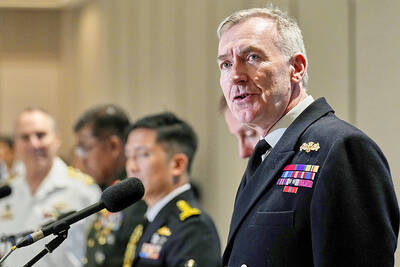
INDO-PACIFIC REGION: Royal Navy ships exercise the right of freedom of navigation, including in the Taiwan Strait and South China Sea, the UK’s Tony Radakin told a summit Freedom of navigation in the Indo-Pacific region is as important as it is in the English Channel, British Chief of the Defence Staff Admiral Tony Radakin said at a summit in Singapore on Saturday. The remark came as the British Royal Navy’s flagship aircraft carrier, the HMS Prince of Wales, is on an eight-month deployment to the Indo-Pacific region as head of an international carrier strike group. “Upholding the UN Convention on the Law of the Sea, and with it, the principles of the freedom of navigation, in this part of the world matters to us just as it matters in the


 RSS
RSS