


Reports that Japan rejected Taiwan’s offer of aid after a magnitude 7.5 earthquake on Monday struck the Noto region of Ishikawa Prefecture are untrue, the Ministry of Foreign Affairs said yesterday.
The National Fire Agency on Monday night completed mobilization of 160 search-and-rescue personnel to depart for Japan if required.
The ministry notified Japan of its preparedness and expressed its willingness to help.
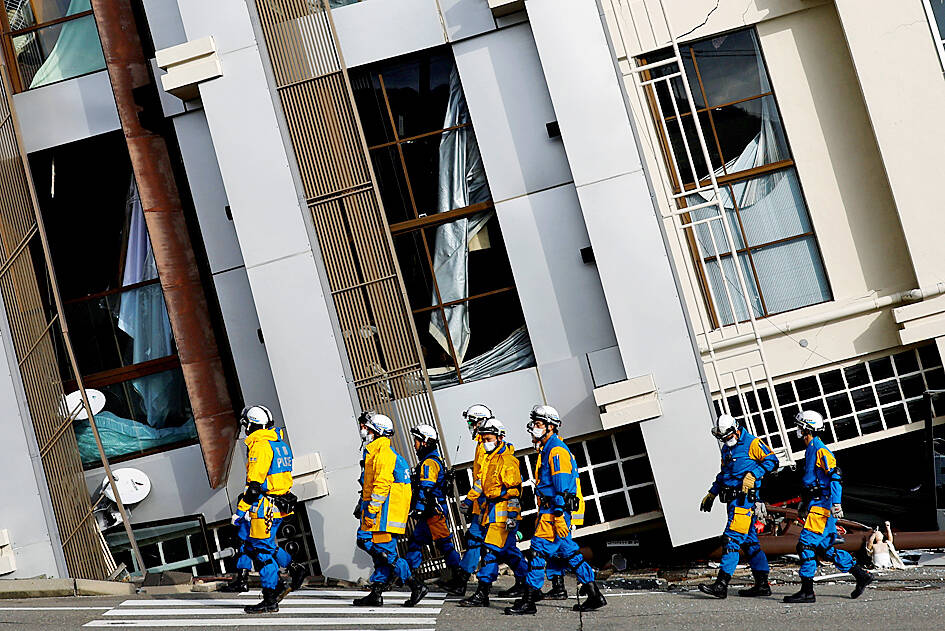
Photo: Reuters
However, Tokyo had deployed thousands of Japan Self-Defense Forces personnel and would consider accepting foreign assistance depending on the situation, the ministry said.
Online rumors saying that Japan “rejected” Taiwan’s help were inappropriate and “inconsistent” with the actual communication between the two governments, it said.
Taiwan “fully understands and respects” the plans of the Japanese government and maintains close contact with Japan to provide any assistance as needed, it said.
Japanese Prime Minister Fumio Kishida on Thursday told a news conference that dozens of countries and regions around the globe — including Taiwan, the US, other NATO countries and China — had expressed their condolences and offered to assist after the earthquake.
While feeling deeply grateful for the offers, Japan was not planning to accept any human or material support from other countries for the time being, but only support that would not affect its rescue system on site, Kishida said, citing Taiwan’s donation of ¥60 million (US$413,009) as an example.
Japanese Chief Cabinet Secretary Yoshimasa Hayashi yesterday told a news conference that Japan would cooperate closely with US troops in Japan according to the damage and needs of earthquake-stricken areas.
US Department of Defense spokesman Brigadier General Patrick Ryder on Thursday said that “our military forces in Japan are ready to assist as needed,” adding that the forces were “in regular contact with the government of Japan to discuss how we might help.”
The Japan Self-Defense Forces were fully engaged in immediate rescue missions on site, so it would be difficult for them to quickly establish a collaborative structure alongside foreign support, the Nikkei Shimbun reported yesterday.
The US military launched its Operation Tomodachi in the aftermath of the 2011 Tohoku earthquake and tsunami, and set up a joint coordination center with Japan to cooperate on transporting supplies and other missions after the Kumamoto earthquake in 2016, the newspaper said.
The Self-Defense Forces had mobilized 10,000 troops by Tuesday to help with the rescue efforts and had dispatched about 5,000 troops to the affected areas by Thursday, the paper said.
As of yesterday, about 33,000 people had been evacuated to about 370 evacuation centers in Ishikawa Prefecture, it said, adding that about 27,000 homes were without electricity due to the quake, while about 68,000 houses in 14 cities and towns had no water supply.

Japan has deployed long-range missiles in a southwestern region near China, the Japanese defense minister said yesterday, at a time when ties with Beijing are at their lowest in recent years. The missiles were installed in Kumamoto in the southern region of Kyushu, as Japan is attempting to shore up its military capacity as China steps up naval activity in the East China Sea. “Standoff defense capabilities enable us to counter the threat of enemy forces attempting to invade our country ... while ensuring the safety of our personnel,” Japanese Minister of Defense Shinjiro Koizumi said. “This is an extremely important initiative for
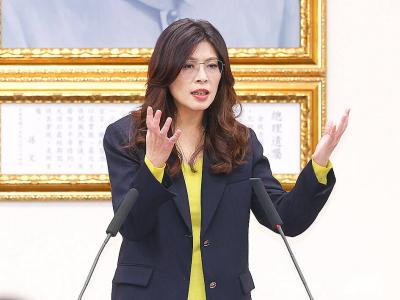
Chinese Nationalist Party (KMT) Chairwoman Cheng Li-wun (鄭麗文) today accepted an invitation from Chinese President Xi Jinping (習近平) to lead a delegation to China next month, saying she hopes to promote the peaceful development of cross-strait relations and bring stability to the Taiwan Strait. “I am grateful and happy to accept this invitation,” Cheng said in a statement from the KMT chairperson’s office. Cheng said she hopes both sides can work together to promote the peaceful development of cross-strait relations, enhance exchange and cooperation, bring stability to the Taiwan Strait and improve people’s livelihoods. At today's news conference, Cheng said any efforts to

MORE POPULAR: Taiwan Pass sales increased by 59 percent during the first quarter compared with the same period last year, the Tourism Administration said The Tourism Administration yesterday said that it has streamlined the Taiwan Pass, with two versions available for purchase beginning today. The tourism agency has made the pass available to international tourists since 2024, allowing them to access the high-speed rail, Taiwan Railway Corp services, four MRT systems and four Taiwan Tourist Shuttles. Previously, five types of Taiwan Pass were available, but some tourists have said that the offerings were too complicated. The agency said only two types of Taiwan Pass would be available, starting from a three-day pass with the high-speed rail and a three-day pass with Taiwan Railway Corp. The former costs NT$2,800

The nation’s fastest supercomputer, Nano 4 (晶創26), is scheduled to be launched in the third quarter, and would be used to train large language models in finance and national defense sectors, the National Center for High-Performance Computing (NCHC) said. The supercomputer, which would operate at about 86.05 petaflops, is being tested at a new cloud computing center in the Southern Taiwan Science Park in Tainan. The exterior of the server cabinet features chip circuitry patterns overlaid with a map of Taiwan, highlighting the nation’s central position in the semiconductor industry. The center also houses Taiwania 2, Taiwania 3, Forerunner 1 and


 RSS
RSS