


A passenger plane yesterday collided with a Japanese coast guard aircraft and burst into flames on the runway of Tokyo’s Haneda airport, officials said.
National broadcaster NHK reported that all occupants of Japan Airlines Flight JAL-516, believed to total 379 people, got out safely before the plane was entirely engulfed in flames.
The Japan Coast Guard said that the pilot of its plane had escaped. NHK reported that the five other members of the crew had been found dead.
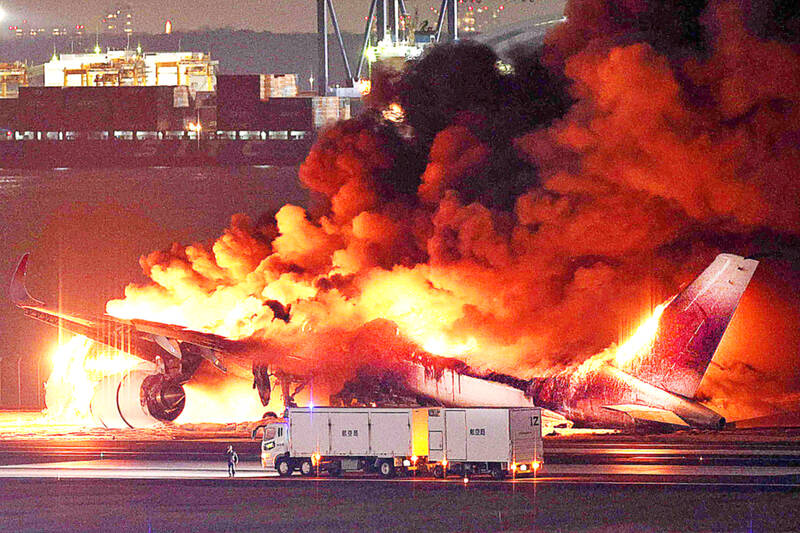
Photo: AFP
Local TV video showed a large eruption of fire and smoke from the side of the Japan Airlines plane as it taxied on a runway. The area around the wing then caught fire. Footage an hour later showed the plane fully on fire.
Japan Coast Guard spokesman Yoshinori Yanagishima confirmed the collision between the passenger plane and its flight MA-722, a Bombardier Dash-8.
Swede Anton Deibe, 17, who was a passenger on the Japan Airlines plane, told Swedish newspaper Aftonbladet that “the entire cabin was filled with smoke within a few minutes. We threw ourselves down on the floor. Then the emergency doors were opened and we threw ourselves at them.”
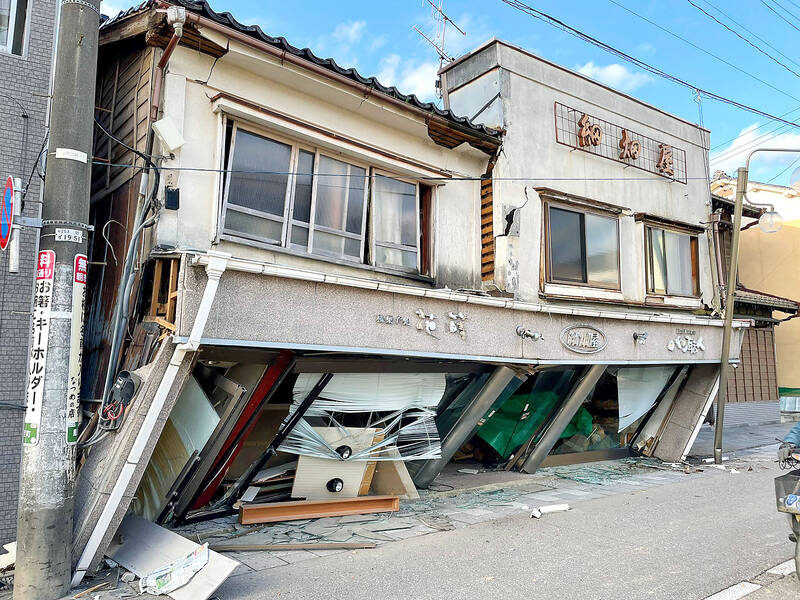
Photo: AFP / courtesy of X user @kanonstay
“The smoke in the cabin stung like hell. It was a hell. We have no idea where we are going so we just run out into the field. It was chaos,” added Deibe, who was traveling with his parents and sister.
Kyodo said the coast guard plane, which is based at Haneda, had been due to head to Niigata to deliver relief goods to residents affected by a deadly earthquake on Monday.
Meanwhile, Japanese rescuers yesterday were battling the clock and powerful aftershocks to find survivors of the earthquake that killed at least 48 people and caused widespread destruction.
The magnitude 7.5 quake that rattled Ishikawa Prefecture on the main island of Honshu triggered tsunami waves more than 1m high, caused a major fire and tore apart roads.
On the Noto Peninsula, the destruction included buildings damaged by fire, houses flattened, fishing boats sunk or washed ashore, and highways hit by landslides.
“I’m amazed the house is this broken and everyone in my family managed to come out of it unscathed,” said Akiko, standing outside her parents’ tilting home in the badly hit city of Wajima.
The way this year started “will be etched into my memory forever,” she said after what she called the “long and violent” earthquake.
“It was such a powerful jolt,” Tsugumasa Mihara, 73, said as he lined up with hundreds of others for water in the nearby town of Shika.
Local authorities put the death toll at 48, but the number was expected to rise as rescuers combed through the rubble.
“Very extensive damage has been confirmed, including numerous casualties, building collapses and fires,” Japanese Prime Minister Fumio Kishida said after a disaster response meeting. “We have to race against time to search for and rescue victims of the disaster.”
Aerial news footage showed the terrifying scale of a fire that ripped through the old market area of Wajima, where a seven-story commercial building also collapsed. Quake damage impaired rescue efforts to put out the blaze.
Almost 33,000 households were without power in the region, which saw temperatures touch freezing overnight, the local energy provider said. Many cities were without running water.
The quake was one of more than 210 to shake the region through yesterday evening.
Several jolts were felt early yesterday, including one measuring magnitude 5.6 that prompted NHK to switch to a special program.
“Please take deep breaths,” the presenter said, reminding viewers to check for fires in their kitchens.
Waves at least 1.2m high hit Wajima on Monday and a series of smaller tsunamis were reported elsewhere.
Warnings of much larger waves proved unfounded and yesterday Japan lifted all tsunami warnings.
Images on social media showed vehicles, houses and bridges in Ishikawa wobbling violently as terrified people cowered in shops and train stations. Houses collapsed and huge cracks appeared in roads, while others were hit by landslides.
A team of firefighters crawled under a collapsed commercial building in Wajima looking for survivors, television footage showed.
“Hang in there. Hang in there,” they shouted as they battled through piles of wooden beams with an electric saw.
The fire in Wajima engulfed as many as 200 structures, reports said, with people evacuated in the dark, some with blankets and others carrying babies.
Ishikawa Governor Hiroshi Hase wrote on social media that roads had been cut in widespread areas by landslides or cracking, while in the port of Suzu “multiple” vessels had capsized.
Suzu’s mayor called the damage in the city “catastrophic,” and said 1,000 houses had been completely destroyed there.
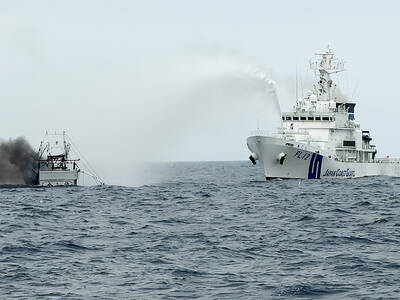
CREDIT-GRABBER: China said its coast guard rescued the crew of a fishing vessel that caught fire, who were actually rescued by a nearby Taiwanese boat and the CGA Maritime search and rescue operations do not have borders, and China should not use a shipwreck to infringe upon Taiwanese sovereignty, the Coast Guard Administration (CGA) said yesterday. The coast guard made the statement in response to the China Coast Guard (CCG) saying it saved a Taiwanese fishing boat. The Chuan Yu No. 6 (全漁6號), a fishing vessel registered in Keelung, on Thursday caught fire and sank in waters northeast of Diaoyutai Islands (釣魚台). The vessel left Keelung’s Badouzih Fishing Harbor (八斗子漁港) at 3:35pm on Sunday last week, with seven people on board — a 62-year-old Taiwanese captain surnamed Chang (張) and six

RISKY BUSINESS: The ‘incentives’ include initiatives that get suspended for no reason, creating uncertainty and resulting in considerable losses for Taiwanese, the MAC said China’s “incentives” failed to sway sentiment in Taiwan, as willingness to work in China hit a record low of 1.6 percent, a Ministry of Labor survey showed. The Directorate-General of Budget, Accounting and Statistics (DGBAS) also reported that the number of Taiwanese workers in China has nearly halved from a peak of 430,000 in 2012 to an estimated 231,000 in 2024. That marked a new low in the proportion of Taiwanese going abroad to work. The ministry’s annual survey on “Labor Life and Employment Status” includes questions respondents’ willingness to seek employment overseas. Willingness to work in China has steadily declined from

The Legislative Yuan’s Finance Committee yesterday approved proposed amendments to the Amusement Tax Act (娛樂稅法) that would abolish taxes on films, cultural activities and competitive sporting events, retaining the fee only for dance halls and golf courses. The proposed changes would set the maximum tax rate for dance halls and golf courses at 50 and 20 percent respectively, with local governments authorized to suspend the levies. Article 2 of the act says that “amusement tax shall be levied on tickets sold or fees charged by amusement places, facilities or activities” in six categories: “Cinema; professional singing, story-telling, dancing, circus, magic show, acrobatics

Tainan, Taipei and New Taipei City recorded the highest fines nationwide for illegal accommodations in the first quarter of this year, with fines issued in the three cities each exceeding NT$7 million (US$220,639), Tourism Administration data showed. Among them, Taipei had the highest number of illegal short-term rental units, with 410. There were 3,280 legally registered hotels nationwide in the first quarter, down by 14 properties, or 0.43 percent, from a year earlier, likely indicating operators exiting the market, the agency said. However, the number of unregistered properties rose to 1,174, including 314 illegal hotels and 860 illegal short-term rental


 RSS
RSS