


Taiwan reached another defense milestone after the domestically developed Teng Yun 2 drone stayed airborne for more than 20 hours during its most recent test flight, a source said yesterday.
The drone broke its first record in June last year when it flew for 10 hours straight, following the entire perimeter of Taiwan’s air defense identification zone.
The new 20-hour record means that the drone could be used to monitor the Taiwan Strait for nearly an entire day at a time, the source said.
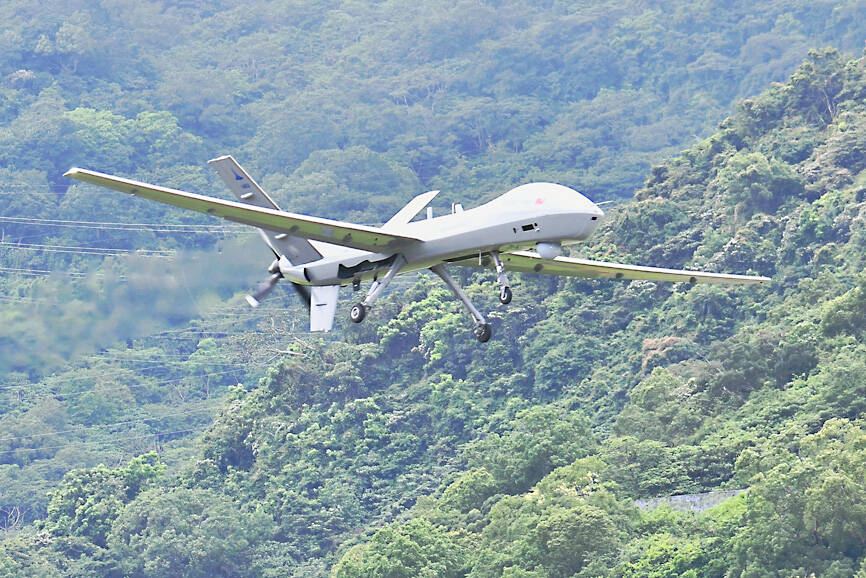
Photo: Yu Tai-lang, Taipei Times
Designed by the Chungshan Institute of Science and Technology, the Teng Yun 2, or “Cloud Rider 2” (騰雲二型), can operate day and night in all weather conditions, and is capable of aerial image surveillance and reconnaissance, electronic parameter reconnaissance, electronic interference, meteorological observation and relaying signals.
The Teng Yun 2 is a large, long-endurance, satellite-guided, medium-altitude drone that can carry multiple payloads, meaning that it can be used for surveillance or strike missions, information from the institute showed.
It can also take off and land autonomously, and has multiple guidance and control links, as well as ground-networked communication links.
“During a combat scenario, the drone could provide remote, real-time surveillance information, and could play an important early warning role,” the source said.
The Teng Yun 2 is expected to be used by the military alongside US-made MQ-9 Reaper drones, with the Reapers being responsible for high-altitude surveillance and reconnaissance missions, and the Teng Yun 2 to be used for medium and low-altitude missions, the source said.
The drone’s capabilities would give the military more flexible and robust surveillance capabilities, they said.
“However, the number of drones that the air force will purchase is still undetermined, and that would affect how they are deployed,” the source said.
The Chinese military is also developing drones, which it hopes will strengthen its surveillance and reconnaissance capabilities, so Taiwan’s military must simultaneously surveil at different altitudes to give it an advantage, the source said.
In other military news, the Ministry of National Defense said that over the past 24 hours it had detected eight Chinese fighter jets crossing the median line of the Taiwan Strait, as well as one Chinese balloon.
The ministry said the Chinese J-10, J-11 and J-16 fighter jets had crossed the median line to the north and center of the Strait.
The median line once served as an unofficial barrier between the two sides, but Chinese planes now regularly fly over it.
Taiwan sent its own forces to monitor the fighter jets, the ministry said.
The ministry also reported another Chinese balloon in the Strait.
Taipei officials have said the balloons are most likely for monitoring the weather, and the spate of sightings could be due to the direction of winds.
The balloon was spotted after crossing the median line late on Saturday morning, 97 nautical miles (180km) northwest of Keelung at an altitude of approximately 6,100m, the ministry said, adding that it headed east and disappeared about an hour later.
The potential for China to use balloons for spying became a global issue in February when the US shot down what it said was a Chinese surveillance balloon. China said the balloon was a civilian craft that had accidentally drifted into the US.
Additional reporting by Reuters

Tropical Storm Gaemi strengthened into a typhoon at 2pm yesterday, and could make landfall in Yilan County tomorrow, the Central Weather Administration (CWA) said yesterday. The agency was scheduled to issue a sea warning at 11:30pm yesterday, and could issue a land warning later today. Gaemi was moving north-northwest at 4kph, carrying maximum sustained winds near its center of up to 118.8kph and gusts of 154.8kph. The circumference is forecast to reach eastern Taiwan tomorrow morning, with the center making landfall in Yilan County later that night before departing from the north coast, CWA weather forecaster Kuan Shin-ping (官欣平) said yesterday. Uncertainty remains and

SEA WARNING LIKELY: The storm, named Gaemi, could become a moderate typhoon on Wednesday or Thursday, with the Taipei City Government preparing for flooding A tropical depression east of the Philippines developed into a tropical storm named Gaemi at 2pm yesterday, and was moving toward eastern Taiwan, the Central Weather Administration (CWA) said. Gaemi could begin to affect Taiwan proper on Tuesday, lasting until Friday, and could develop into a moderate typhoon on Wednesday or Thursday, it said. A sea warning for Gaemi could be issued as early as Tuesday morning, it added. Gaemi, the third tropical storm in the Pacific Ocean this typhoon season, is projected to begin moving northwest today, and be closest to Taiwan on Wednesday or Thursday, the agency said. Today, there would likely

DISRUPTIONS: The high-speed rail is to operate as normal, while several airlines either canceled flights or announced early departures or late arrivals Schools and offices in 15 cities and counties are to be closed today due to Typhoon Gaemi, local governments announced last night. The 15 are: Taipei, New Taipei City, Taoyuan, Tainan, Keelung, Hsinchu and Kaohsiung, as well as Yilan, Hualien, Hsinchu, Miaoli, Chiayi, Pingtung, Penghu and Lienchiang counties. People should brace for torrential rainfall brought by the storm, with its center forecast to make landfall on the east coast between tonight and tomorrow morning, the Central Weather Administration (CWA) said. The agency issued a sea warning for the typhoon at 11:30pm on Monday, followed by a land warning at 11:30am yesterday. As of

CASUALTY: A 70-year-old woman was killed by a falling tree in Kaohsiung as the premier warned all government agencies to remain on high alert for the next 24 hours Schools and offices nationwide are to be closed for a second day today as Typhoon Gaemi crosses over the nation, bringing torrential rain and whipping winds. Gaemi was forecast to make landfall late last night. From Tuesday night, its outer band brought substantial rainfall and strong winds to the nation. As of 6:15pm last night, the typhoon’s center was 20km southeast of Hualien County, Central Weather Administration (CWA) data showed. It was moving at 19kph and had a radius of 250km. As of 3pm yesterday, one woman had died, while 58 people were injured, the Central Emergency Operation Center said. The 70-year-old


 RSS
RSS