


Taiwan has inked a NT$17.2 billion (US$546.5 million) deal to buy US-made bombs and missiles for fighter jets over nine years, the Ministry of National Defense said in a procurement notice yesterday.
According to the ministry’s notice, Taiwan’s defense mission and the US finalized the contract on Nov. 13, which specified that air-to-air and air-to-surface weapons would be furnished for military aircraft operating out of Taitung.
The purchase likely consists of munitions designed for use by Lockheed Martin F-16Vs, jets designated for the 7th Tactical Flight Wing.
Photo: Chang Chia-ming, Taipei Times
The nation ordered 66 F-16Vs from the US, but there has been significant delays in their delivery. In May, Washington announced that the first batch is to be delivered late next year, instead of this year as originally planned, citing “complex developmental challenges.”
The ministry had said at the time that the plan to receive the last batch of the fighters by 2026 remained unchanged.
The notice provided no additional information on the type of aircraft the nation is to obtain.
Asked about the issue in July, Democratic Progressive Party Legislator Wang Ting-yu (王定宇) said that the air force’s long-range precision strike capabilities depend on the acquisition of AGM-158 Joint Air-to-Surface Standoff Missiles.
The missiles’ range of more than 300km, stealth characteristics and damage potential would enhance the nation’s deterrence capability if the US approves their export, he said at the time.
However, the US had not approved the sale of AGM-158s or given any indications of its intentions, Wang said at the time.
Taipei has expressed its desire to obtain the weapon systems and prepared sufficient funds, he added.
Meanwhile, the ministry yesterday said Taiwan has signed a NT$9.47 billion deal for Orbital ATK’s 30mm Mk44 Bushmaster II cannon ammunition for CM-34 infantry fighting vehicles, which is to be delivered over six years.
A defense official said on condition of anonymity that the army urgently needs to replenish its stock of 30mm shells, as it expends large quantities of this type of ammunition and expects that larger amounts would be used in battle.
The order included high-explosive incendiary tracer rounds, multipurpose rounds and inert training rounds, the official said.
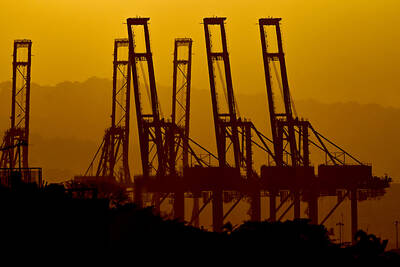
A subsidiary of a Hong Kong-based company that has lost control of two critical ports on the Panama Canal said it is seeking US$2 billion of compensation in damages from Panama over its “illegal” takeover of the ports. Panama Ports Co, a unit of Hong Kong’s CK Hutchison Holdings (長江和記實業), on Friday said in a statement that it is demanding the sum under international arbitration proceedings that it had already started. The Panamanian government last week seized control of the Balboa and Cristobal ports on each end of the Panama Canal, after the country’s Supreme Court declared earlier that a concession allowing
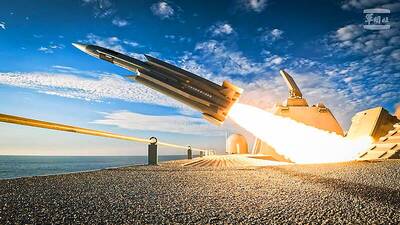
DETERRENCE: With 1,000 indigenous Hsiung Feng II and III missiles and 400 Harpoon missiles, the nation would boast the highest anti-ship missile density in the world With Taiwan wrapping up mass production of Hsiung Feng II and III missiles by December and an influx of Harpoon missiles from the US, Taiwan would have the highest density of anti-ship missiles in the world, a source said yesterday. Taiwan is to wrap up mass production of the indigenous anti-ship missiles by the end of year, as the Chungshan Institute of Science and Technology has been meeting production targets ahead of schedule, a defense official with knowledge of the matter said. Combined with the 400 Harpoon anti-ship missiles Taiwan expects to receive from the US by 2028, the nation would have

POSSIBILITIES EMERGE: With Taiwan’s victory and Japan’s narrow win over Australia, Taiwan now have a chance to advance if South Korea also beat the Aussies Taiwan has high hopes that the national baseball team would advance to the World Baseball Classic (WBC) quarter-finals after clinching a crucial 5-4 victory over South Korea in a nail-biting extra-inning game at the Tokyo Dome yesterday. Boosted by three home runs — two solo shots by Yu Chang (張育成) and Cheng Tsung-che (鄭宗哲) and a two-run homer by Stuart Fairchild — the triumph gave Taiwan a much-needed second victory in the five-team Pool C, where only the top two finishers would advance to the knockout stage in Miami, Florida. Entering extra innings with the game tied at four apiece, Taiwan scored
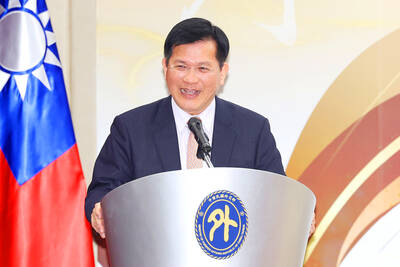
MISSION OF PEACE: The foreign minister urged Beijing to respect Taiwan’s existence as an independent nation, and work together to ensure peace and stability in the region Minister of Foreign Affairs Lin Chia-lung (林佳龍) yesterday rejected Chinese Minister of Foreign Affairs Wang Yi’s (王毅) comments about Taiwan, criticizing China as a “troublemaker” in the international community and a disruptor of cross-strait peace. Speaking at a news conference on the sidelines of the Chinese National People’s Congress, Wang said that Taiwan has always been a territory of China and that it would be impossible for it to become its own country. The “return” of Taiwan to China was the natural outcome of the Chinese people’s resistance against Japan in World War II, and that any pursuit of independence was “doomed


 RSS
RSS