


Taiwan nabbed the gold in both the women’s and men’s inline freestyle skating speed slalom yesterday at the Asian Games in Hangzhou, China, after skaters Liu Chiao-hsi (劉巧兮) and Wang Yu-chun (王宥鈞) respectively earned Taiwan’s 13th and 14th gold medals of the competition.
Boxer Lin Yu-ting (林郁婷) then added another gold to the tally later in the day by defeating Karina Ibragimova of Kazakhstan 5-0 in a three-round bout to win the women’s 54kg to 57kg category, bringing Taiwan’s total gold count to 15 with three more days to go.
The gold medal is of great significance, as she became the first Taiwanese to win gold in women's boxing at the Asian Games, Sports Administration Director-General Cheng Shih-chung (鄭世忠) said.
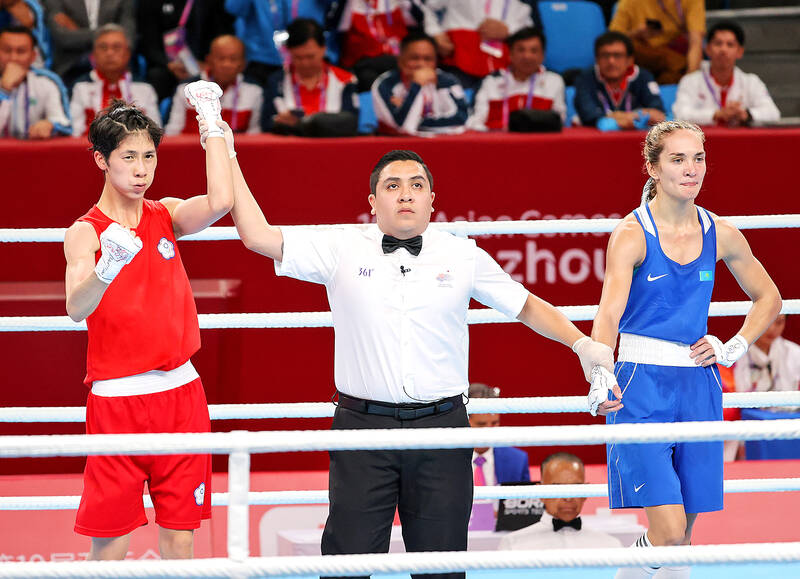
Photo: CNA
Cheng said he looks forward to seeing Lin concentrate on preparing for the Olympics next year.
The 27-year-old boxer secured a spot at next year's Olympic Games in Paris by reaching the semi-finals on Wednesday.
In the skating slalom final, 19-year-old Liu defeated Ahmadi Taraneh from Iran 2-0, after having previously triumphed against Romina Salek Esfahan, also from Iran, in the semi-finals and Nichakan Chinupun from Thailand in the round of eight.
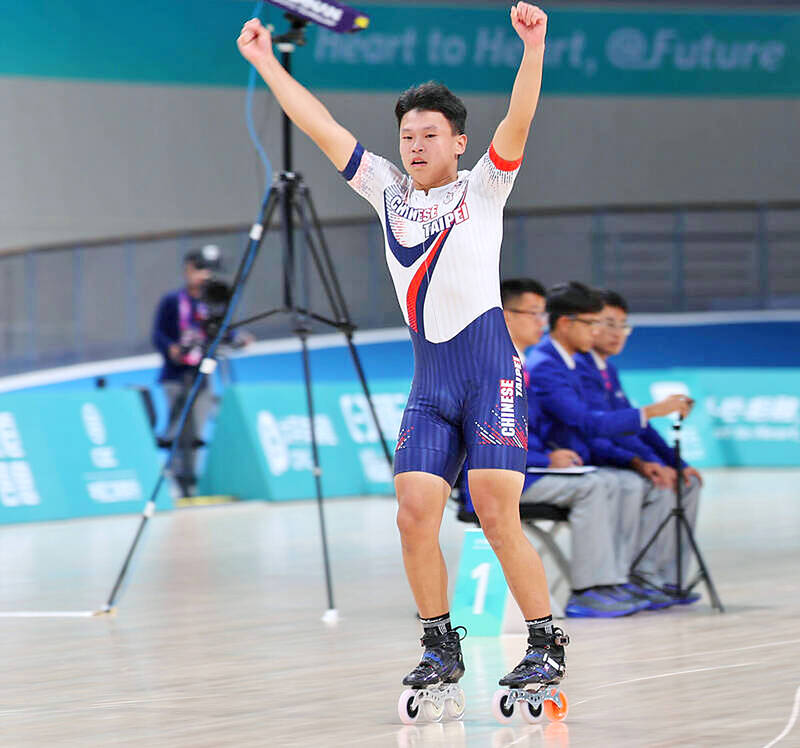
Photo courtesy of Chinese Taipei Olympic Committee
“The gold medal was heavier than what I imagined,” Liu told reporters after her victory.
Liu also won gold in the World Skate Games last year before injuring her Achilles tendinitis in May.
Taiwan’s Ting Yu-en (丁于恩), also 19, took bronze after defeating Iran’s Romina Salek Esfahani 2- 1 in the battle for third place.

Photo courtesy of Chinese Taipei Olympic Committee
This was the first time Ting had taken part in any adult competition and she told reporters that she and Liu had been encouraging each other and helping each other through the competition-related anxiety.
In the men’s competition, Wang, 15, earned the gold after defeating Zhang Hao (張顥) of China 2-0, while fellow Taiwanese Huang Pin-ruei (黃品睿) took bronze.
Huang, 16, beat Lesani Reza of Iran 2-0 after having broken the world record of 3.949 seconds earlier yesterday during the preliminaries with a time of 3.885 seconds.
Freestyle slalom skating is a highly technical field of roller skating that involves performing tricks around a straight line of equally spaced cones.
Skaters have 0.2 seconds added to their time for each mistake they make (touching the cones), and do not receive a score after making four mistakes.
Also yesterday, Taiwan’s compound women’s archery team settled for silver after losing to India in the gold medal match 229-230.
The team, comprising archers Huang I-jou (黃逸柔), Chen Yi-hsuan (陳怡瑄) and Wang Lu-yun (王律勻), performed well, but after Wang and Huang both shot 7 points, the team was forced to settle for second.
The team had defeated South Korea 230-224 earlier yesterday in the semi-finals.
Veteran archer Huang, 33, took silver in the women’s team event and placed fourth in the women’s individual event at the 2014 Asian Games held in Incheon, South Korea.
The athlete was one of the victims in the Formosa Fun Coast water park fire in 2015 and it took her more than 18 months to return to the field.
In soft tennis, Lin Wei-chieh (林韋傑) and Huang Shih-yuan (黃詩媛) secured a bronze medal despite losing to Japan in the mixed doubles.
The Taiwanese pair, who earlier in the day beat their Taiwanese counterparts Yu Kai-wen (余凱文) and Cheng Chu-ling (鄭竹玲) in the quarter-finals, lost 2-5 to Toshiki Uematsu and Noa Takahashi in a semi-final match that lasted 30 minutes.


RESILIENCE: Taiwan plays a key role in semiconductors, energy, information infrastructure and advanced manufacturing, AIT Director Raymond Greene said Taiwan’s continued investment in deterrence and resilience remains vital, especially in uncrewed systems and other emerging technologies, American Institute in Taiwan (AIT) Director Raymond Greene said yesterday. Greene made the remarks at the annual National Strategic Summit on Supply Chain Resilience held by the Research Institute for Democracy, Society and Emerging Technology (DSET), a government-backed think tank. As Taiwan last year became the US’ fourth-largest trading partner and supply chain security is becoming more important, cooperation in emerging technologies continues to deepen between the two countries, he said. The US is committed to accelerating innovation, building key infrastructure, strengthening cooperation

The National Chungshan Institute of Science and Technology yesterday showcased its locally developed variants of the Vision 60 robotic patrol dog, which it plans to deploy on the nation’s outlying territories in the South China Sea. The variants were produced under the Joint Lab project — created by the institute and domestic companies — and assembled with domestically produced motors, lenses and artificial intelligence (AI) systems alongside licensed tech from the US, Missile and Rocket Systems Research Division deputy director Jen Kuo-kang (任國光) told the media event at a military base in Taipei’s Dazhi (大直) area. Taiwan has built up its strengths

RIGHT DIRECTION: Taiwan’s efforts to prevent forced labor include a proposal to ‘fully prohibit’ employers from withholding workers’ documents, an official said Taiwan is to establish a mechanism to restrict imports of goods linked to forced labor, the Executive Yuan said yesterday, after the US proposed imposing additional tariffs on Taiwanese goods over labor concerns. “The Ministry of Labor and the Ministry of Economic Affairs are to establish an interministerial review procedure,” Executive Yuan spokesperson Michelle Lee (李慧芝) said at a news briefing in Taipei. “The government is to use the Foreign Trade Act [貿易法] as the legal basis to restrict imports of goods produced with forced labor” and bring its supply chain governance more in line with international standards on human rights, resilience

NOT IMMEDIATE: Taiwan has a chance to appeal the proposed 10 percent tariff before it starts, while other countries face a 12.5 percent tariff from the trade office Taiwan is among 60 economies determined by the US to have failed to impose or enforce a ban on the importation of goods produced with forced labor, according to a notice released on Tuesday by the Office of the US Trade Representative (USTR), which proposed imposing an additional 10 percent or more tariff on them. The USTR in a statement said that following an investigation, it had determined under Section 301 of the Trade Act of 1974 that the failure of the 60 economies to impose and effectively enforce a prohibition on the importation of goods produced with forced labor is


 RSS
RSS