


Saudi Arabian negotiations with Israel mean the prospects of normalized relations between the two is getting closer every day, but treatment of Palestinians remains a “very important” issue to be resolved, Saudi Arabian Crown Prince Mohammad bin Salman said in an interview with Fox News on Wednesday.
Saudi Arabia is discussing a major agreement with the US to normalize relations with Israel in exchange for a US defense pact and aid in developing its own civilian nuclear program.
Riyadh has said that any deal would require major progress toward the creation of a Palestinian state.
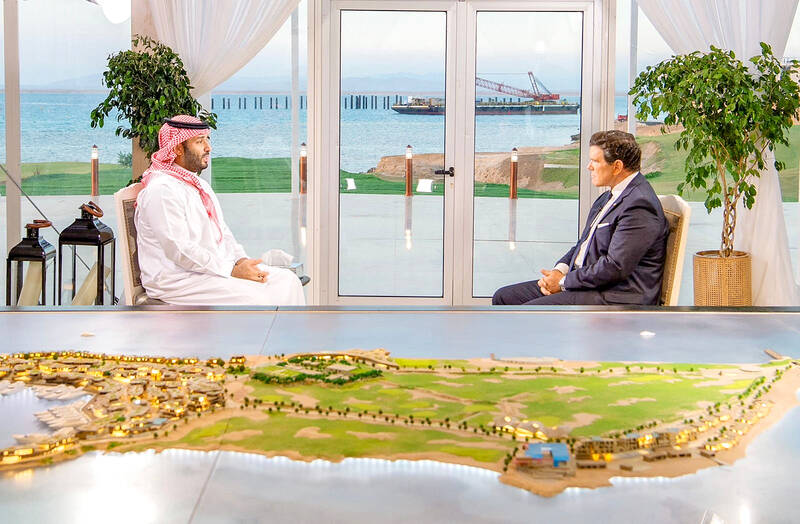
Photo: Reuters
“For us, the Palestinian issue is very important. We need to solve that part,” Prince Mohammad said on Special Report with Bret Baier in an interview conducted in English, adding that there had been “good negotiations” so far.
“We got to see where we go,” he said. “We hope that will reach a place, that it will ease the life of the Palestinians, get Israel as a player in the Middle East.”
He also denied reports that the talks had been suspended, saying: “Every day, we get closer.”
The interview aired shortly after US President Joe Biden met with Israeli Prime Minister Benjamin Netanyahu while both were in New York for the UN General Assembly.
Biden raised concerns about the Israeli government’s treatment of the Palestinians and urged Netanyahu to take steps to improve conditions in the West Bank.
Netanyahu’s office said that the meeting with Biden “mostly dealt with ways to establish an historic peace agreement between Israel and Saudi Arabia, which could greatly advance an end to the Arab-Israeli conflict and facilitate the establishment of an economic corridor to link Asia, the Middle East and Europe.”
Asked during the interview about working with someone as conservative as Netanyahu, Prince Mohammad said: “If we have a breakthrough, reaching a deal that gives the Palestinians their needs and [making] the region calm, we’ve got to work with whoever’s there.”

The CIA has a message for Chinese government officials worried about their place in Chinese President Xi Jinping’s (習近平) government: Come work with us. The agency released two Mandarin-language videos on social media on Thursday inviting disgruntled officials to contact the CIA. The recruitment videos posted on YouTube and X racked up more than 5 million views combined in their first day. The outreach comes as CIA Director John Ratcliffe has vowed to boost the agency’s use of intelligence from human sources and its focus on China, which has recently targeted US officials with its own espionage operations. The videos are “aimed at
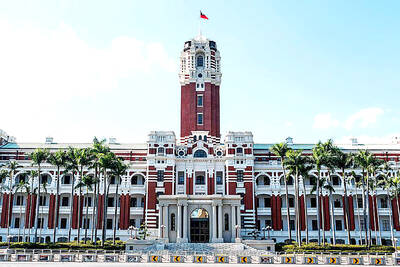
STEADFAST FRIEND: The bills encourage increased Taiwan-US engagement and address China’s distortion of UN Resolution 2758 to isolate Taiwan internationally The Presidential Office yesterday thanked the US House of Representatives for unanimously passing two Taiwan-related bills highlighting its solid support for Taiwan’s democracy and global participation, and for deepening bilateral relations. One of the bills, the Taiwan Assurance Implementation Act, requires the US Department of State to periodically review its guidelines for engagement with Taiwan, and report to the US Congress on the guidelines and plans to lift self-imposed limitations on US-Taiwan engagement. The other bill is the Taiwan International Solidarity Act, which clarifies that UN Resolution 2758 does not address the issue of the representation of Taiwan or its people in
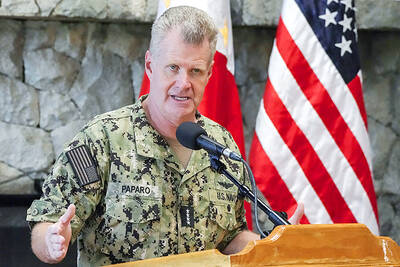
US Indo-Pacific Commander Admiral Samuel Paparo on Friday expressed concern over the rate at which China is diversifying its military exercises, the Financial Times (FT) reported on Saturday. “The rates of change on the depth and breadth of their exercises is the one non-linear effect that I’ve seen in the last year that wakes me up at night or keeps me up at night,” Paparo was quoted by FT as saying while attending the annual Sedona Forum at the McCain Institute in Arizona. Paparo also expressed concern over the speed with which China was expanding its military. While the US
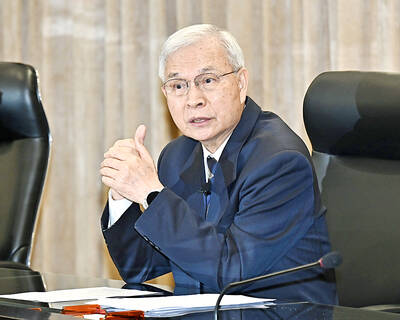
SHIFT: Taiwan’s better-than-expected first-quarter GDP and signs of weakness in the US have driven global capital back to emerging markets, the central bank head said The central bank yesterday blamed market speculation for the steep rise in the local currency, and urged exporters and financial institutions to stay calm and stop panic sell-offs to avoid hurting their own profitability. The nation’s top monetary policymaker said that it would step in, if necessary, to maintain order and stability in the foreign exchange market. The remarks came as the NT dollar yesterday closed up NT$0.919 to NT$30.145 against the US dollar in Taipei trading, after rising as high as NT$29.59 in intraday trading. The local currency has surged 5.85 percent against the greenback over the past two sessions, central


 RSS
RSS