


Any unprovoked attack on Taiwan would result in a “resolute reaction” from Washington, US Representative Rob Wittman said during a visit to Taipei yesterday, adding that the US is working on expediting arms sales to the nation.
Wittman, a Republican who serves as vice chairman of the US House of Representatives Committee on Armed Services, told President Tsai Ing-wen (蔡英文) at the Presidential Office that the US would do “everything possible” to ensure peace and stability in the Indo-Pacific, and that it was committed to building and projecting the strength of the region.
“Strength is the best deterrence to anyone that may think there’s an opportunity to act badly in this region,” said Wittman, who arrived in Taiwan on Thursday.

Photo: CNA
“Any hostile, unprovoked attack on Taiwan will result in a resolute reaction from the United States,” he said, while acknowledging Taiwan’s efforts to enhance its self-defense capabilities, such as extending compulsory military service to one year.
The US has “an obligation” to ensure that it addresses the US$19 billion backlog of arms deliveries to Taiwan, which cross-party members of the House have been working on, he said.
Wittman said he believed that the “deep and long-term relationship” between the US and Taiwan would continue to grow stronger, as it is based on shared values of democracy, the rule of law, and technological and economic development.
The ties have earned bipartisan support in the US Congress, he said, calling on both sides to pursue closer economic cooperation through mutual investment.
Tsai thanked Wittman and other delegation members for their support and attention to Taiwan’s security through concrete actions such as promoting pro-Taiwan legislation in the US Congress every year.
They helped ensure that the National Defense Authorization Act continues to include policy initiatives that bolster Taiwan’s self-defense capabilities and deepen Taiwan-US security cooperation, Tsai said.
In the face of authoritarian expansionism, the unity and cooperation of democratic partners is even more important, she said.
Taiwan will continue to work with the US and other democratic allies to protect regional stability and prosperity, she added.
She also thanked the US Congress for passing the first agreement under the US-Taiwan Initiative on 21st-Century Trade, which could deepen economic and trade ties between Taiwan and the US.
The next step toward closer industrial cooperation would be to eliminate double taxation between the two nations, which Tsai hoped US lawmakers would support.
Wittman is visiting Taiwan with two other committee members: US representatives Jen Kiggans and Carlos Gimenez. It is the second visit by senior committee officials following committee Chairman Mike Rogers’ trip in June, the Ministry of Foreign Affairs said on Thursday.
US representatives Alex Mooney and Michael Cloud are also in Taiwan.
All five lawmakers are members of the Congressional Taiwan Caucus and have displayed their firm support for the nation by proposing legislation and issuing statements, Presidential Office spokeswoman Olivia Lin (林聿禪) said.
Additional reporting by AFP

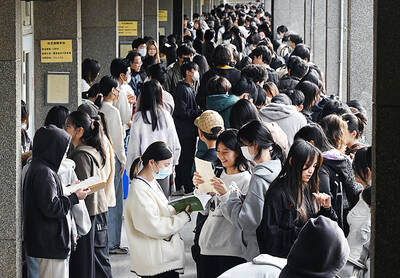
A global survey showed that 60 percent of Taiwanese had attained higher education, second only to Canada, the Ministry of the Interior said. Taiwan easily surpassed the global average of 43 percent and ranked ahead of major economies, including Japan, South Korea and the US, data from the Organisation for Economic Co-operation and Development (OECD) for 2024 showed. Taiwan has a high literacy rate, data released by the ministry showed. As of the end of last year, Taiwan had 20.617 million people aged 15 or older, accounting for 88.5 percent of the total population, with a literacy rate of 99.4 percent, the data

NEW LOW: The council in 2024 based predictions on a pessimistic estimate for the nation’s total fertility rate of 0.84, but last year that rate was 0.69, 17 percent lower An expected National Development Council (NDC) report expects the nation’s population to drop below 12 million by 2065, with the old-age dependency ratio to top 100 percent sooner than 2070, sources said yesterday. The council is slated to release its latest population projections in August, using an ultra-low fertility model, the sources said. The previous report projected that Taiwan’s population would fall to 14.37 million by 2070, but based on a new estimate of the total fertility rate (TFR) — the average number of children born to a woman over her lifetime — the population is expected to reach 12 million by
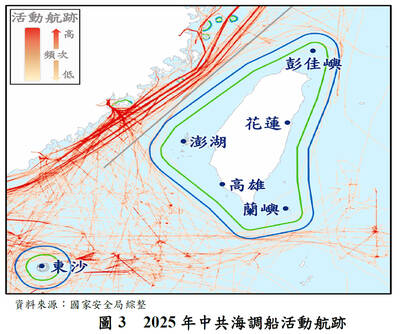
INTENSIFYING THREATS: Beijing’s tactics include massive attacks on the government service network, aircraft and naval vessel incursions and damaging undersea cables China is prepared to interfere in November’s nine-in-one local elections by launching massive attacks on the Taiwanese government’s service network (GSN), a report published by the National Security Bureau showed. The report was submitted to the Legislative Yuan ahead of the bureau’s scheduled briefing at the Foreign Affairs and National Defense Committee tomorrow. The national security team has identified about 13,000 suspicious Internet accounts and 860,000 disputed messages, the bureau said of China’s cognitive warfare against Taiwan. The disputed messages focus on major foreign affairs, national defense and economic issues, which were produced using generative artificial intelligence (AI) and distributed through Chinese

COUNTERING HOSTILITY: The draft bill would require the US to increase diplomatic pressure on China and would impose sanctions on those who sabotage undersea cable networks US lawmakers on Thursday introduced a bipartisan bill to bolster the resilience of Taiwan’s submarine cables to counter China’s hostile activities. The proposal, titled the critical undersea infrastructure resilience initiative act, was cosponsored by Republican representatives Mike Lawler and Greg Stanton, and Democratic Representative Dave Min. US Senators John Curtis and Jacky Rosen also introduced a companion bill in the US Senate, which has passed markup at the chamber’s Committee on Foreign Relations. The House’s version of the bill would prioritize the deployment of sensors to detect disruptions or potential sabotage in real-time and enhance early warning capabilities through global intelligence sharing frameworks,


 RSS
RSS