


Taiwan is a “sovereign, independent country,” Democratic Progressive Party (DPP) presidential candidate William Lai (賴清德) told Bloomberg Businessweek in an interview, adding that he had no plans to purse formal independence.
“Taiwan is already a sovereign, independent country called the Republic of China,” Vice President Lai said, echoing a stance President Tsai Ing-wen (蔡英文) made public three years ago, in his first interview with an international media outlet since becoming vice president in 2020.
“And in respect to unifying Taiwanese society, President Tsai has used the term Republic of China (Taiwan) to describe our country. I will continue to do so in the future,” he said. “There are no plans to change the name of our country.”
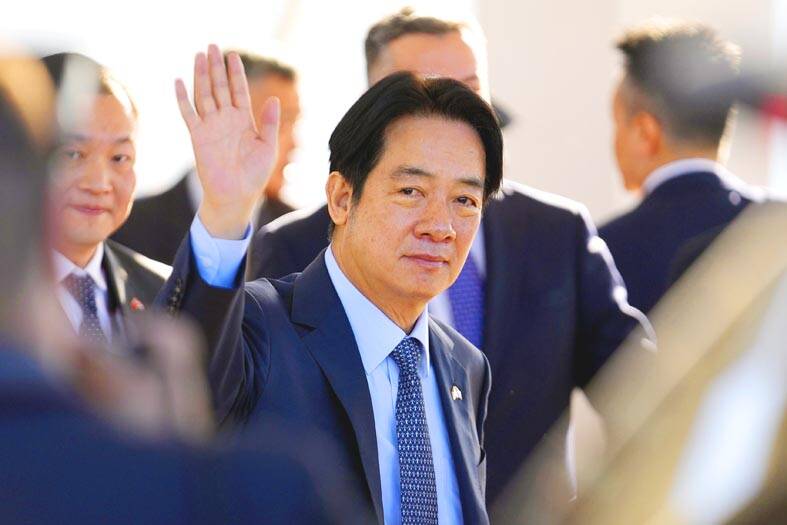
Photo: AP
“It is not necessary to declare independence,” he said in an interview aired on Tuesday while he is on a seven-day trip to the US and Paraguay. “The Republic of China and the People’s Republic of China are not subordinate to one another.”
Asked by editor Joel Weber about whether he has a road map to Taiwan’s formal independence, Lai, who has on more than one occasion described himself as a “pragmatic worker for Taiwan independence,” said “no such framework exists.”
“My responsibility is to maintain the status quo in the Taiwan Strait, while protecting Taiwan and maintaining democracy, peace and prosperity,” the 63-year-old said.
At the same time, Lai pitched himself as a “rational and steady” leader who is able to continue Tsai’s policy and work with the US government effectively.
“I have been part of President Tsai’s national security team,” which has “responsible and clear channels of communications” with Washington, he said.
Lai described next year’s presidential election as a decision between further engaging with the international community and working with China through caving in to its political agenda.
Lai is leading in most opinion polls, with Taiwan People’s Party Chairman Ko Wen-je (柯文哲) and New Taipei City Mayor Hou You-yi (侯友宜) of the Chinese Nationalist Party (KMT) trailing.
While stressing that he remains “open” to engaging in dialogue with China, Lai took note of the security challenges facing Taiwan because of Beijing’s “tendency to annex Taiwan” and refusal to denounce the use of force.
These challenges are of global concern, he said, adding that the international community must respond to China’s actions, which he said “are the reasons for tensions” in the Taiwan Strait.
Lai is in Paraguay for the inauguration of Paraguayan President Santiago Pena. Paraguay is one of only 13 UN member states to maintain diplomatic ties with Taipei.
He transited through New York on his way there, drawing anger from China, which said he was a separatist and “troublemaker,” and he is due back in Taipei on Friday after stopping over in San Francisco.
Additional reporting by Reuters

Tropical Storm Gaemi strengthened into a typhoon at 2pm yesterday, and could make landfall in Yilan County tomorrow, the Central Weather Administration (CWA) said yesterday. The agency was scheduled to issue a sea warning at 11:30pm yesterday, and could issue a land warning later today. Gaemi was moving north-northwest at 4kph, carrying maximum sustained winds near its center of up to 118.8kph and gusts of 154.8kph. The circumference is forecast to reach eastern Taiwan tomorrow morning, with the center making landfall in Yilan County later that night before departing from the north coast, CWA weather forecaster Kuan Shin-ping (官欣平) said yesterday. Uncertainty remains and

SEA WARNING LIKELY: The storm, named Gaemi, could become a moderate typhoon on Wednesday or Thursday, with the Taipei City Government preparing for flooding A tropical depression east of the Philippines developed into a tropical storm named Gaemi at 2pm yesterday, and was moving toward eastern Taiwan, the Central Weather Administration (CWA) said. Gaemi could begin to affect Taiwan proper on Tuesday, lasting until Friday, and could develop into a moderate typhoon on Wednesday or Thursday, it said. A sea warning for Gaemi could be issued as early as Tuesday morning, it added. Gaemi, the third tropical storm in the Pacific Ocean this typhoon season, is projected to begin moving northwest today, and be closest to Taiwan on Wednesday or Thursday, the agency said. Today, there would likely

DISRUPTIONS: The high-speed rail is to operate as normal, while several airlines either canceled flights or announced early departures or late arrivals Schools and offices in 15 cities and counties are to be closed today due to Typhoon Gaemi, local governments announced last night. The 15 are: Taipei, New Taipei City, Taoyuan, Tainan, Keelung, Hsinchu and Kaohsiung, as well as Yilan, Hualien, Hsinchu, Miaoli, Chiayi, Pingtung, Penghu and Lienchiang counties. People should brace for torrential rainfall brought by the storm, with its center forecast to make landfall on the east coast between tonight and tomorrow morning, the Central Weather Administration (CWA) said. The agency issued a sea warning for the typhoon at 11:30pm on Monday, followed by a land warning at 11:30am yesterday. As of

CASUALTY: A 70-year-old woman was killed by a falling tree in Kaohsiung as the premier warned all government agencies to remain on high alert for the next 24 hours Schools and offices nationwide are to be closed for a second day today as Typhoon Gaemi crosses over the nation, bringing torrential rain and whipping winds. Gaemi was forecast to make landfall late last night. From Tuesday night, its outer band brought substantial rainfall and strong winds to the nation. As of 6:15pm last night, the typhoon’s center was 20km southeast of Hualien County, Central Weather Administration (CWA) data showed. It was moving at 19kph and had a radius of 250km. As of 3pm yesterday, one woman had died, while 58 people were injured, the Central Emergency Operation Center said. The 70-year-old


 RSS
RSS