


The Philippine Coast Guard yesterday accused Chinese patrol vessels of blocking two of its boats in the South China Sea, describing their actions as “very dangerous.”
The Philippine Coast Guard said that the incident happened on Friday last week during a regular operation to resupply marines stationed in a run-down navy ship grounded at the Second Thomas Shoal (Renai Shoal, 仁愛暗沙) to assert Manila’s territorial claim in the waters.
As they neared the shoal, the two Philippine Coast Guard boats assigned as escorts for the navy mission were approached by two Chinese Coast Guard vessels.
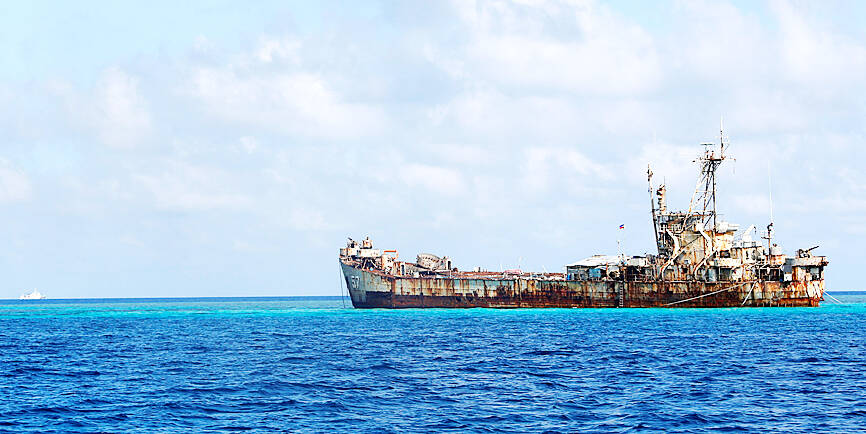
Photo: Reuters
One of the Chinese boats came within about 90m of the BRP Malabrigo’s bow, forcing its commanding officer to slow down to avoid a collision, Philippine Coast Guard Commodore Jay Tarriela told reporters.
“They dangerously conducted different maneuvers, even crossing the bow of the Philippine Coast Guard vessels and that kind of distance is very dangerous, because that’s already prone to collision,” said Tarriela, the coast guard spokesman for the West Philippine Sea.
Manila refers to waters immediately to its west as the West Philippine Sea.
The Chinese embassy in Manila did not immediately respond to a request for comment.
They were “constantly followed, harassed, and obstructed by the significantly larger Chinese coast guard vessels,” Tarriela wrote on Twitter later.
Second Thomas Shoal — which Taiwan also claims — is a submerged reef over which the Philippines stakes a claim to sovereignty via a handful of troops who live aboard a rusty World War II-era US ship that was intentionally grounded in 1999.
The shoal is inside the Philippines’ exclusive economic zone.
Tarriela said that the presence of Chinese navy ships in the area was “alarming,” adding that it raised “greater concerns.”
China has previously said its coast guard conducts regular operations in what it calls Chinese waters.
Beijing claims sovereignty over almost the entire South China Sea via a “nine-dash line” on its maps.
The Permanent Court of Arbitration in 2016 said that line has no basis under international law.
Additional reporting by Reuters

The National Chungshan Institute of Science and Technology yesterday showcased its locally developed variants of the Vision 60 robotic patrol dog, which it plans to deploy on the nation’s outlying territories in the South China Sea. The variants were produced under the Joint Lab project — created by the institute and domestic companies — and assembled with domestically produced motors, lenses and artificial intelligence (AI) systems alongside licensed tech from the US, Missile and Rocket Systems Research Division deputy director Jen Kuo-kang (任國光) told the media event at a military base in Taipei’s Dazhi (大直) area. Taiwan has built up its strengths

RIGHT DIRECTION: Taiwan’s efforts to prevent forced labor include a proposal to ‘fully prohibit’ employers from withholding workers’ documents, an official said Taiwan is to establish a mechanism to restrict imports of goods linked to forced labor, the Executive Yuan said yesterday, after the US proposed imposing additional tariffs on Taiwanese goods over labor concerns. “The Ministry of Labor and the Ministry of Economic Affairs are to establish an interministerial review procedure,” Executive Yuan spokesperson Michelle Lee (李慧芝) said at a news briefing in Taipei. “The government is to use the Foreign Trade Act [貿易法] as the legal basis to restrict imports of goods produced with forced labor” and bring its supply chain governance more in line with international standards on human rights, resilience

NOT IMMEDIATE: Taiwan has a chance to appeal the proposed 10 percent tariff before it starts, while other countries face a 12.5 percent tariff from the trade office Taiwan is among 60 economies determined by the US to have failed to impose or enforce a ban on the importation of goods produced with forced labor, according to a notice released on Tuesday by the Office of the US Trade Representative (USTR), which proposed imposing an additional 10 percent or more tariff on them. The USTR in a statement said that following an investigation, it had determined under Section 301 of the Trade Act of 1974 that the failure of the 60 economies to impose and effectively enforce a prohibition on the importation of goods produced with forced labor is

TIT-FOR-TAT: The US allegedly revoked the visa of a Chinese national working at Xinhua News Agency in the US in response to Beijing’s expulsion of Vivian Wang The Presidential Office yesterday condemned China for expelling a New York Times correspondent from Beijing following the newspaper’s interview with President William Lai (賴清德), saying the move highlighted Beijing’s suppression of press freedom and its threat to international news media. Taiwan has noted a series of recent incidents in which Beijing used similar tactics to “threaten and pressure international media outlets and journalists,” Presidential Office spokeswoman Karen Kuo (郭雅慧) said in a statement. “This concerns not only press freedom and freedom of expression, but also the safety of journalists, and Taiwan and relevant partners are paying close attention to the situation,” she


 RSS
RSS