

Taiwan moved up one spot to the sixth place in the global competitiveness rankings on better government and business efficiency, the Switzerland-based International Institute for Management Development (IMD) said yesterday.
It is the nation’s best showing since 2012 and it marked the fifth consecutive year it has advanced, even though Taiwan’s economy had declined noticeably, the IMD’s annual report said.
Taiwan was ranked the second-most competitive economy in Asia, behind Singapore, it said.
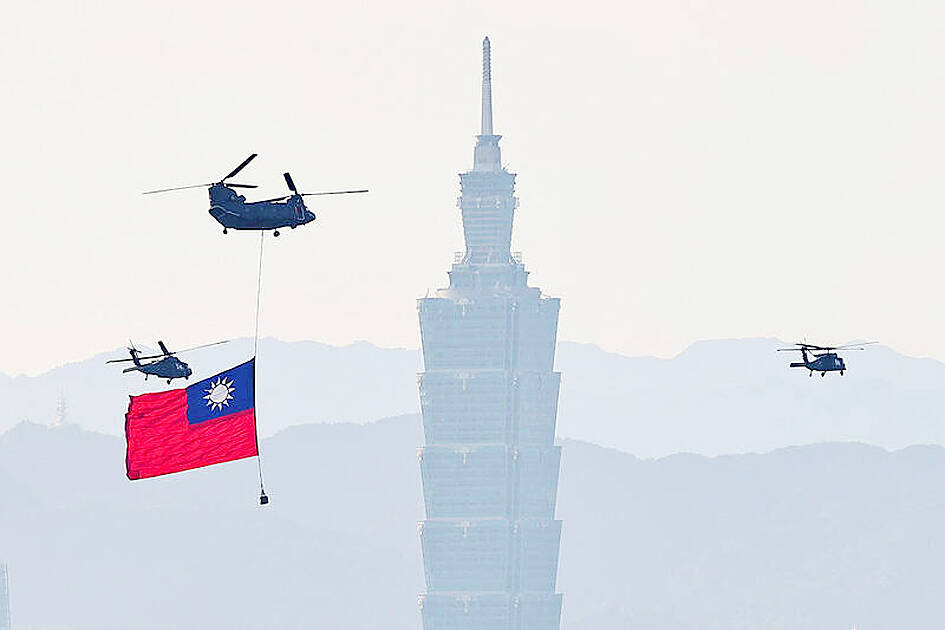
Photo: Reuters
The IMD report graded 64 economies based on their standings in four main categories: economic performance, government efficiency, business efficiency and infrastructure.
Taiwan this year gained two places in both the government efficiency and business efficiency rankings to sixth and fourth spot respectively, the report said.
The improved government efficiency came after Taiwan acted to lower government debt and bolster its financial health, said the National Development Council, which helped gather data on the nation’s behalf.
The subfactors on institutional framework, business legislation and social framework also retreated in the rankings, but the gauge on tax policy remained high at No. 4, the council said.
The progress in business efficiency reflected enhanced productivity and efficiency, and improved finances, management practices, attitudes and values, the IMD said.
Taiwanese companies are very good at using big data and analytics to support decisionmaking and demonstrate prowess at responding quickly to opportunities and threats, it said.
Local firms also beat their global peers in terms of entrepreneurship and the credibility of managers in society, it added.
However, the council said that Taiwan is relatively weak in labor market performance under the business efficiency category, falling from 17th to 25th in this year’s report.
The challenges lie particularly in the shortage of migrant and highly skilled foreign workers, the council said, adding that it would put more emphasis on retaining the foreign workforce.
The infrastructure reading climbed one spot to 12th place, thanks to healthy showings in technology infrastructure, including 4G and 5G coverage, research and development spending, and advanced technology leadership, the report said.
However, Taiwan’s economic ranking fell from ninth to 20th place, as the nation’s export-oriented economy took a hit from global economic weakness induced by drastic interest rate hikes by major central banks to curb inflation.
Denmark, Ireland and Switzerland were named the top three economies this year, while Singapore dropped one position to fourth, the Netherlands moved up one place to fifth and Hong Kong fell to seventh from fifth place, the report said.
The US improved one place to ninth, followed by the United Arab Emirates in 10th. China ranked 21st, while South Korea ranked 28th.
Additional reporting by CNA
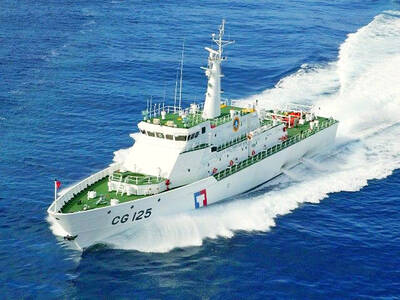
GEOPOLITICAL SIGNIFICANCE: The CGA’s nonmilitary role makes it a tool to avert diplomatic issues, an official said, while confirming the donation of a ship to Manila Coast Guard Administration (CGA) ships are scheduled to sail to the Philippines bearing the words “Taiwan Coast Guard” in a high-profile visit in October next year, the first such visit by a Taiwanese maritime law enforcement vessel to the Southeast Asian nation, the agency said yesterday. The CGA also confirmed that it had donated one of its decommissioned patrol vessels to the Philippines in a rare transfer of a retired ship to a nondiplomatic ally. The Republic of China (ROC) Navy last made such a visit in 1974, shortly before the Philippines switched diplomatic recognition to the People’s Republic of China in
CALL FOR CHANGE: They urged the UN to facilitate Taiwan’s involvement in the body, recognize its peace efforts and to work with members in preventing military conflict Representatives to the UN from five of Taiwan’s diplomatic allies sent a joint letter to UN Secretary-General Antonio Guterres on Friday, calling for the country’s inclusion in the body. Allies in the letter sent ahead of the 81st session of the UN General Assembly General Debate made three demands in support of Taiwan: inclusion, recognition and camaraderie. They implored the UN to seek an appropriate way to facilitate Taiwan’s meaningful involvement in the world governing body, saying that UN Resolution 2758, which accepted the People’s Republic of China (PRC) as a member of the UN, does not exclude Taiwan. Beijing claims that the

‘GLOBAL WARNING’: The infiltration is not just a local problem, as Beijing has been deploying the same tactics worldwide against Western democracies, a report said Between 50,000 and 100,000 Chinese spies are operating in Taiwan, far more than the National Security Bureau’s previous estimate of 5,000, German journalist and author Jurgen Kremb said on Monday. Kremb presented his research, titled “The War of Spies: How China’s Intelligence Services Are Infiltrating Taiwan — and What Europe Must Learn from It,” at a joint event held by the Taiwan offices of the Friedrich Naumann Foundation and the European Values Center for Security Policy. The report was published in June in the Ministry of Justice Investigation Bureau’s Prospect & Exploration Monthly (展望與探索月刊). By spies, he said he was referring to informants,
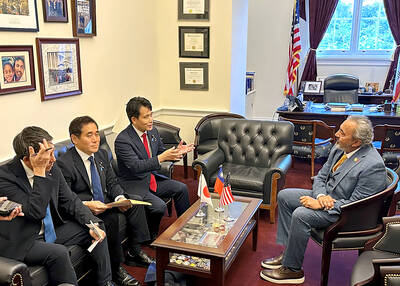
WASHINGTON MEETING: Japan’s Hirofumi Takinami said participants rejected the idea that the US should limit its defensive perimeter to the Second Island Chain US and Japanese lawmakers agree that the US must defend the First Island Chain, including Taiwan, and should not fall back to the Second Island Chain, while “a Taiwan contingency is a Japan contingency and therefore a US-Japan alliance contingency,” media reported after a meeting between officials of the two nations in Washington on Tuesday. A delegation of Japanese lawmakers from the Liberal Democratic Party met with US Senator Thom Tillis, co-chair of the Senate Taiwan Caucus, and US Representative Ami Bera, co-chair of the US Congressional Taiwan caucus, to discuss issues concerning East Asia and the Taiwan Strait. The Japanese and


 RSS
RSS