


Hon Hai Precision Industry Co (鴻海精密) predicts three-digit percentage growth for its artificial intelligence (AI) server business due to robust demand for AI products such as ChatGPT, chairman Young Liu (劉揚偉) said yesterday.
Hon Hai — known globally as Foxconn Technology Group (富士康科技集團) — is the world’s biggest contract electronics manufacturer and assembles devices for many international brands, most notably Apple Inc’s iPhone products.
It has also moved to diversify beyond electronics assembly, expanding into areas ranging from electric vehicles to semiconductors and servers.
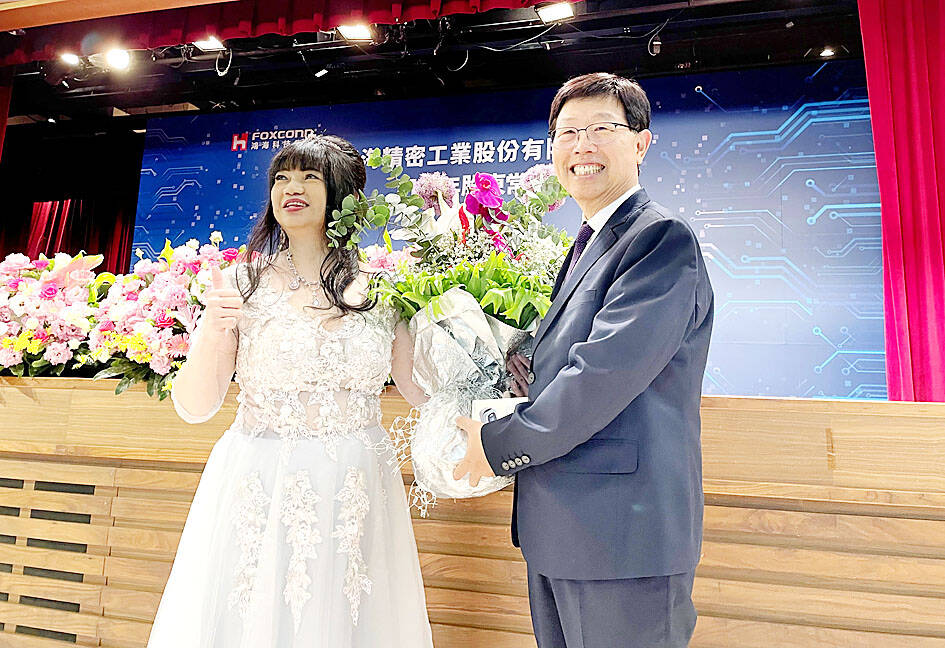
Photo: CNA
“In 2022 alone, Hon Hai’s revenue for servers reached NT$1.1 trillion [US$35.75 billion] to obtain a 40 percent global market share,” Liu told an annual shareholders’ meeting in Taipei.
AI servers made up about 20 percent of the company's total server sales last year, Liu said, adding that Hon Hai had taken advantage of solutions provided by Intel Corp, Advanced Micro Devices Inc and ARM Ltd to roll out AI servers.
Hon Hai ranks first in global market share for mobile phones, PCs and servers, with the AI server market now “rising faster than everyone has expected,” Liu said.
He attributed the jump in demand to ChatGPT, the AI program that burst into the spotlight late last year with the ability to generate essays, poems and conversations from the briefest of prompts. Its runaway success has sparked a gold rush with billions of dollars of investment in the field.
“For the second half of this year, we may have three-digit growth, not two digits... We will continue to boost our market share for servers,” Liu said.
He said the company’s latest AI servers also use Nvidia Corp chips.
Nvidia is known for creating graphics chips long coveted by gamers, but which have become engines for the kind of complex processes involved in AI, known as accelerated computing.
Nvidia, cofounded by Taiwanese-American Jensen Huang (黃仁勳), surged to a market value of more than US$1 trillion on Tuesday after its quarterly earnings report last week blew past expectations.
Despite the rosy future for AI, Hon Hai maintains a “flat” outlook for this year, Liu said, after its first-quarter profit plunged 56 percent on weakened demand due to a global downturn.
“The global tightening monetary [policies], coupled with tense geopolitics and the significant uncertainty of inflation have a relatively large impact on the economic outlook,” he said.
Meanwhile, Hon Hai has started trial production of a third-generation silicon carbide (SiC) semiconductor for use in electric vehicles for five clients, Liu said, adding that a 6-inch SiC wafer plant in Hsinchu acquired from Macronix International Co (旺宏電子) in 2021 has begun commercial production.
According to Hon Young Semiconductor Corp (鴻揚半導體), a Hon Hai subsidiary, the Hsinchu plant will be upgraded to an 8-inch wafer plant by 2025 with an ultimate annual production capacity of up to 200,000 units.
At the meeting, Hon Hai shareholders approved a proposal to issue NT$5.3 in cash dividend per share based on the company's earnings per share of NT$10.21 last year.
The cash dividend, the highest since the company launched an initial public offering in 1991, represents a payout ratio of 52 percent and is the fourth consecutive year Hon Hai has maintained a payout ratio above 50 percent.
Additional reporting by CNA

‘NO SECURITY RISK’: The Railway Bureau reassured the public that the technicians’ activities were limited to technical guidance and did not involve sensitive systems The Railway Bureau yesterday said it had invited eight Chinese technicians to assist with an airport MRT construction project. The bureau issued the confirmation after an Internet user said Chinese nationals had entered the construction zone of Taiwan Taoyuan International Airport’s Terminal 3 project. They asked why “individuals from an enemy state” were allowed access to such a major national infrastructure project, which raised serious concerns over Taiwan’s industrial safety, sensitive systems and information security. The bureau’s Northern Region Engineering Branch Office said subcontractor Taiwan Handle Industrial Co (台灣手把工業) of the Taoyuan airport MRT’s “Contract No. CU05 Project A14 Station Civil, MEP &

A US uncrewed surface vessel (USV) encountered multiple Chinese warships during an autonomous transit of the Taiwan Strait, US defense company Seasats said in a statement on Wednesday. Seasats announced that a Lightfish USV had completed the first autonomous transit of the Taiwan Strait. Over five days, the USV traversed the entire length of the Strait while constantly monitoring surface vessel traffic, the company said. The Lightfish encountered multiple Chinese warships, one of which was a Chinese People’s Liberation Army Navy (PLAN) Type 056 corvette, it said. The Chinese vessels were operating “well within Taiwan’s exclusive economic zone without transmitting their identity via the
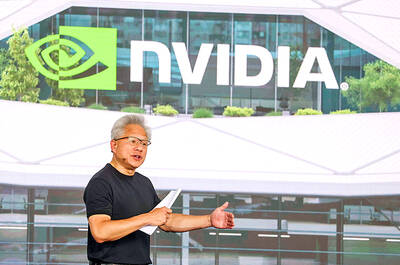
‘BOOMING’: ’ The number of partners we have here is incredible. You can see from their stock prices. They’re doing so well, they’re so happy,’ Jensen Huang said Nvidia Corp’s spending in Taiwan has ballooned to about US$150 billion a year, 10 times the US$10 billion to US$15 billion the company spent five years ago, Nvidia chief executive officer Jensen Huang (黃仁勳) said yesterday, suggesting Taiwan’s strategic importance in the global artificial intelligence (AI) supply chain. “Taiwan is the epicenter of the AI revolution. This is where the chips come, packaging comes. This is where the systems are made. This is where AI supercomputers were created,” Huang said at a meeting for the company’s employees in Beitou-Shilin Technology Park (北投士林科技園區) in Taipei, the planned site of Nvidia’s Taipei headquarters. “Taiwan
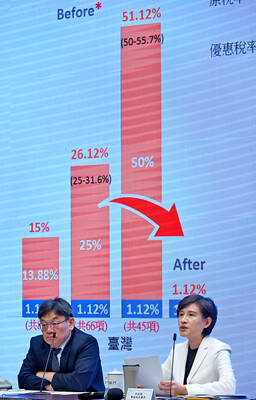
GREATER REACH? Auto parts and wood products would face tariffs of up to 15%, matching those targeting the EU, Japan and South Korea, Vice Premier said The US has announced that preferential tariff treatment for Taiwan’s non-semiconductor Section 232 goods would take effect retroactively from May 1, the Executive Yuan said yesterday. The US government yesterday posted a notice on the Federal Register’s public inspection Web site previewing tariff concessions for Taiwan under a memorandum of understanding (MOU) on Taiwan-US investment after two months of negotiations. The MOU signed on Jan. 15 stipulated three major preferential tariff arrangements: a 15 percent “reciprocal” tariff rate for Taiwan without stacking most-favored nation (MFN) rates; preferential Section 232 treatment for semiconductors and related products; and preferential Section 232 treatment for non-semiconductor


 RSS
RSS