


US authorities have arrested two suspected Chinese government agents in connection with an alleged plot by Beijing to disrupt and ultimately topple the exiled anti-communist Falun Gong spiritual movement.
John Chen and Lin Feng were charged in an indictment unsealed on Friday with scheming to revoke a New York-based Falun Gong organization’s tax-exempt status and paying bribes to an undercover officer posing as a US tax agent.
The undercover officer recorded multiple conversations with Chen, and investigators obtained a wire tap to record phone calls in which Chen and Feng discussed instructions they purportedly received from Chinese government officials, prosecutors said.
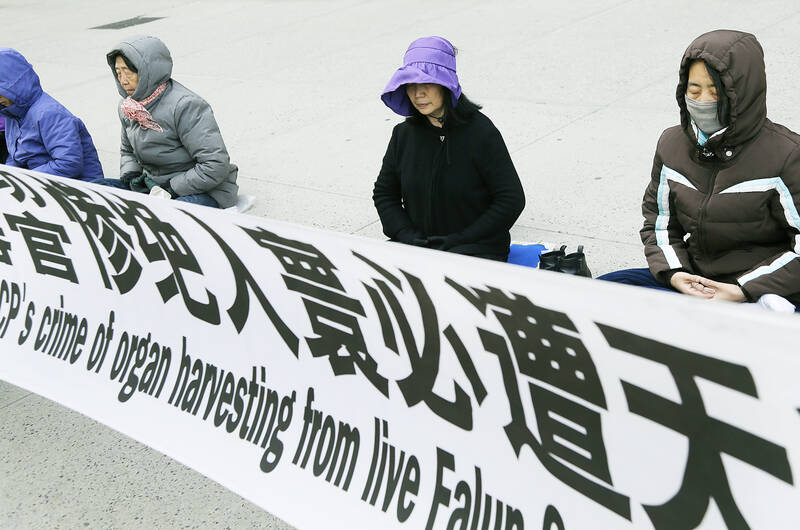
Photo: AP
In one recording Chen referred to Chinese government officials as akin to “blood brothers,” and in another, he said Beijing would be “very generous” in rewarding the undercover officer for help in revoking the Falun Gong organization’s nonprofit status, prosecutors said.
Chen, a 70-year-old US citizen, and Feng, a 43-year-old permanent US resident, are charged with acting as unregistered agents of a foreign government, bribing a public official and conspiracy to commit international money laundering.
Chen and Feng were born in Chinan but live in the Los Angeles area, where they were arrested on Friday. Information on an initial court appearance or lawyers who could speak on their behalf was not immediately available.
Messages seeking comment were left with the Chinese embassy in Washington and with the Falun Gong movement.
China banned the Falun Gong movement in 1999, classifying it as an evil cult and one of the “Five Poisons,” or chief threats to its rule. Since then, Falun Gong practitioners have found refuge at a 162-hectare compound called Dragon Springs in upstate New York.
The US Department of Justice has made a series of prosecutions in recent years to disrupt China’s efforts in the US to identify, locate and silence democracy advocates and others who are openly critical of Beijing’s policies. Such practices by foreign governments are known as “transnational repression.”
“The Chinese government has yet again attempted, and failed, to target critics of the [People’s Republic of China] here in the United States,” US Attorney General Merrick Garland said in a statement.
The US would “continue to investigate, disrupt, and prosecute” China’s efforts to “silence its critics and extend the reaches of its regime onto US soil,” Garland said.

The CIA has a message for Chinese government officials worried about their place in Chinese President Xi Jinping’s (習近平) government: Come work with us. The agency released two Mandarin-language videos on social media on Thursday inviting disgruntled officials to contact the CIA. The recruitment videos posted on YouTube and X racked up more than 5 million views combined in their first day. The outreach comes as CIA Director John Ratcliffe has vowed to boost the agency’s use of intelligence from human sources and its focus on China, which has recently targeted US officials with its own espionage operations. The videos are “aimed at
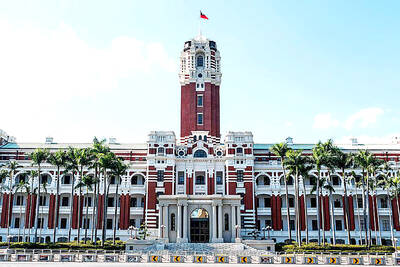
STEADFAST FRIEND: The bills encourage increased Taiwan-US engagement and address China’s distortion of UN Resolution 2758 to isolate Taiwan internationally The Presidential Office yesterday thanked the US House of Representatives for unanimously passing two Taiwan-related bills highlighting its solid support for Taiwan’s democracy and global participation, and for deepening bilateral relations. One of the bills, the Taiwan Assurance Implementation Act, requires the US Department of State to periodically review its guidelines for engagement with Taiwan, and report to the US Congress on the guidelines and plans to lift self-imposed limitations on US-Taiwan engagement. The other bill is the Taiwan International Solidarity Act, which clarifies that UN Resolution 2758 does not address the issue of the representation of Taiwan or its people in
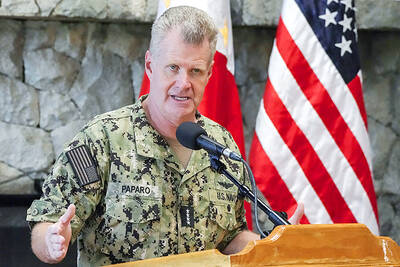
US Indo-Pacific Commander Admiral Samuel Paparo on Friday expressed concern over the rate at which China is diversifying its military exercises, the Financial Times (FT) reported on Saturday. “The rates of change on the depth and breadth of their exercises is the one non-linear effect that I’ve seen in the last year that wakes me up at night or keeps me up at night,” Paparo was quoted by FT as saying while attending the annual Sedona Forum at the McCain Institute in Arizona. Paparo also expressed concern over the speed with which China was expanding its military. While the US
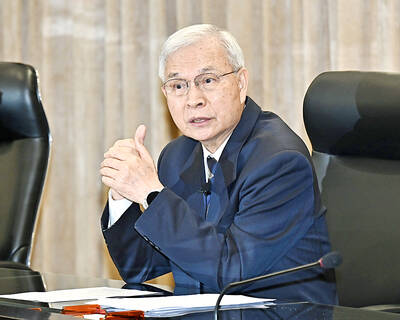
SHIFT: Taiwan’s better-than-expected first-quarter GDP and signs of weakness in the US have driven global capital back to emerging markets, the central bank head said The central bank yesterday blamed market speculation for the steep rise in the local currency, and urged exporters and financial institutions to stay calm and stop panic sell-offs to avoid hurting their own profitability. The nation’s top monetary policymaker said that it would step in, if necessary, to maintain order and stability in the foreign exchange market. The remarks came as the NT dollar yesterday closed up NT$0.919 to NT$30.145 against the US dollar in Taipei trading, after rising as high as NT$29.59 in intraday trading. The local currency has surged 5.85 percent against the greenback over the past two sessions, central


 RSS
RSS