


Taiwan’s partnership with like-minded countries will “prove to be the most effective defense of all” against daily Chinese threats, President Tsai Ing-wen (蔡英文) told a summit on Monday.
“We must remain united to deter and to stop [China’s] aggressive behavior,” Tsai said in a prerecorded video broadcast at the two-day Copenhagen Democracy Summit.
Tsai made particular note of Beijing’s “coercive measures,” such as the imposition of sanctions against countries, organizations and individuals who disagree with or question its behavior.
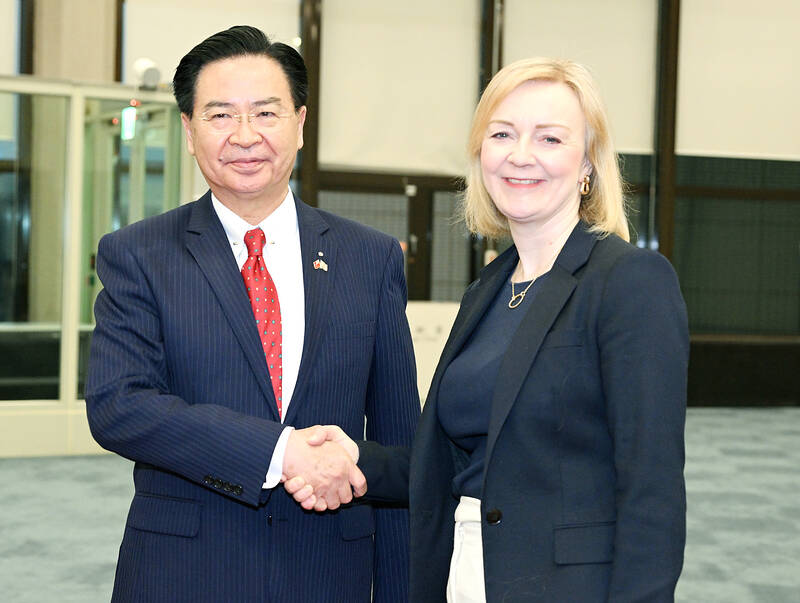
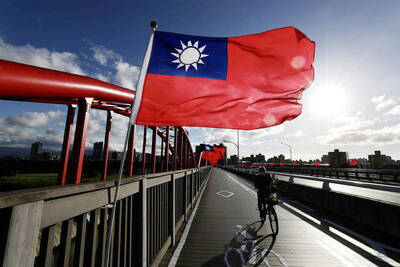
Photo: Tony Yao, Taipei Times
Authoritarian regimes such as China “actively conduct influence operations to erode our confidence in democratic institutions and freedom” through the spread of disinformation and misinformation, she said.
Faced with China’s daily threats, Taiwanese commitment to democracy “has never been stronger,” she said.
The summit, which opened on Monday in the Danish capital, is organized by the Alliance of Democracies Foundation, with support from dozens of organizations, including the Taipei-funded Taiwan Foundation for Democracy.
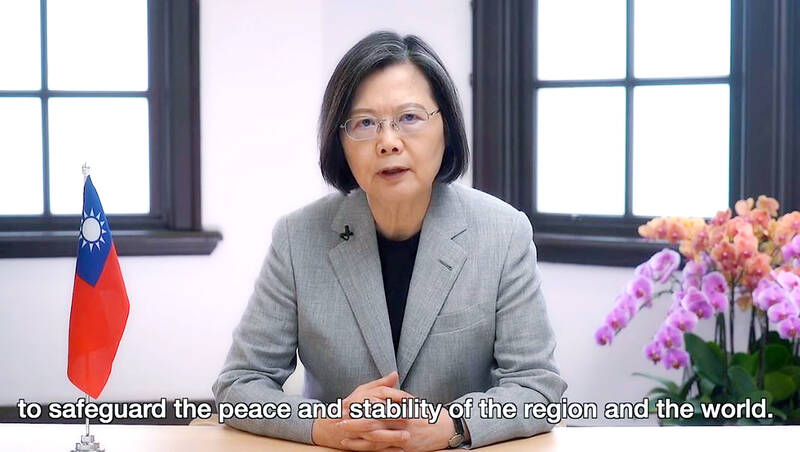
Photo: screen grab from the Alliance of Democracies Foundation’s YouTube channel
Tsai’s remarks on Monday, which focused on championing Taiwan’s democracy and calling for a united front against authoritarianism, echoed her previous three speeches at the summit in 2020, 2021 and last year.
Jack Yao (姚冠均), a Taiwanese soldier fighting in Ukraine, was also invited to speak remotely at the summit.
The Alliance of Democracies posted a still from his speech on Twitter with Yao’s call to action.
“If we don’t stop the Russian invasion in the front — your children, your families will have to face a much harder situation. To Taiwanese guys I like to say: If we don’t stop them, we will be next,” he was quoted as saying.
Meanwhile, former British prime minister Liz Truss said that engagement with Taiwan is “very important,” amid Beijing attempts to minimize Taiwan’s international space.
“I believe it is they — the democratically elected government of Taiwan — that knows what is best for their citizens and their future,” she said in an interview with Politico editor-in-chief Jamil Anderlini at the democracy summit when asked why she is visiting Taiwan.
Beijing is “trying to reduce the space that Taiwan has to operate” and reinterpret the “one China” policy to mean that no country should have any engagement with Taiwan, she said.
“I believe that is the wrong thing for us to do, because ... that makes it more likely that China will succeed in its ambitions of taking over Taiwan and extinguishing freedom and democracy there,” she said.
Western nations should respond to threats from Beijing by taking practical steps to develop engagement with Taiwan, including by supporting its participation in organizations such as the WHO and ensuring it can defend itself, Truss said.
“Rather than playing the man, we should play the bull,” she added.
Truss arrived in Taiwan at 6:23pm yesterday, and is to stay until Saturday. She was greeted by Minister of Foreign Affairs Joseph Wu (吳釗燮) upon her arrival.
She has said she was making the trip because she was invited by the Taiwanese government.
CREDIT-GRABBER: China said its coast guard rescued the crew of a fishing vessel that caught fire, who were actually rescued by a nearby Taiwanese boat and the CGA Maritime search and rescue operations do not have borders, and China should not use a shipwreck to infringe upon Taiwanese sovereignty, the Coast Guard Administration (CGA) said yesterday. The coast guard made the statement in response to the China Coast Guard (CCG) saying it saved a Taiwanese fishing boat. The Chuan Yu No. 6 (全漁6號), a fishing vessel registered in Keelung, on Thursday caught fire and sank in waters northeast of Diaoyutai Islands (釣魚台). The vessel left Keelung’s Badouzih Fishing Harbor (八斗子漁港) at 3:35pm on Sunday last week, with seven people on board — a 62-year-old Taiwanese captain surnamed Chang (張) and six
RISKY BUSINESS: The ‘incentives’ include initiatives that get suspended for no reason, creating uncertainty and resulting in considerable losses for Taiwanese, the MAC said China’s “incentives” failed to sway sentiment in Taiwan, as willingness to work in China hit a record low of 1.6 percent, a Ministry of Labor survey showed. The Directorate-General of Budget, Accounting and Statistics (DGBAS) also reported that the number of Taiwanese workers in China has nearly halved from a peak of 430,000 in 2012 to an estimated 231,000 in 2024. That marked a new low in the proportion of Taiwanese going abroad to work. The ministry’s annual survey on “Labor Life and Employment Status” includes questions respondents’ willingness to seek employment overseas. Willingness to work in China has steadily declined from

The Legislative Yuan’s Finance Committee yesterday approved proposed amendments to the Amusement Tax Act (娛樂稅法) that would abolish taxes on films, cultural activities and competitive sporting events, retaining the fee only for dance halls and golf courses. The proposed changes would set the maximum tax rate for dance halls and golf courses at 50 and 20 percent respectively, with local governments authorized to suspend the levies. Article 2 of the act says that “amusement tax shall be levied on tickets sold or fees charged by amusement places, facilities or activities” in six categories: “Cinema; professional singing, story-telling, dancing, circus, magic show, acrobatics
INFLATION UP? The IMF said CPI would increase to 1.5 percent this year, while the DGBAS projected it would rise to 1.68 percent, with GDP per capita of US$44,181 The IMF projected Taiwan’s real GDP would grow 5.2 percent this year, up from its 2.1 percent outlook in January, despite fears of global economic disruptions sparked by the US-Iran conflict. Taiwan’s consumer price index (CPI) is projected to increase to 1.5 percent, while unemployment would be 3.4 percent, roughly in line with estimates for Asia as a whole, the international body wrote in its Global Economic Outlook Report published in the US on Monday. The figures are comparatively better than the IMF outlook for the rest of the world, which pegged real GDP growth at 3.1 percent, down from 3.3 percent


 RSS
RSS