

Washington should invite President Tsai Ing-wen (蔡英文) to the APEC leaders’ summit in November, a group of US representatives said in a joint letter to US Secretary of State Antony Blinken.
“Given Taiwan’s important economic, cultural and technological contributions to the region, we believe President Tsai Ing-wen deserves our full respect as much as Taiwan deserves fair and equal treatment on par with those of other recognition and standing in APEC member states,” 21 US representatives said in the letter sent on Tuesday.
Taiwan has been a critical partner of the US and “has played an increasingly important role in regional economic growth and development” with its advanced technologies, it said.
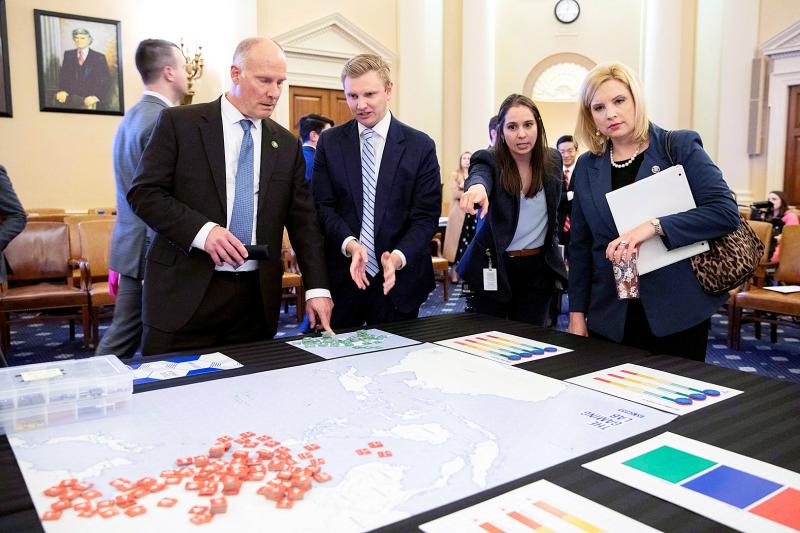
Photo: Reuters
Tsai’s participation would be consistent with the US’ Taiwan policies and would bolster ties between the two countries, while “continuing to exclude Taiwan’s full participation in APEC at the behest of the Chinese Communist Party sends the wrong message” that the US is asking China for permission regarding its foreign relations, it said.
Presidential Office spokeswoman Lin Yu-chan (林聿禪) yesterday said Taiwan has been playing an active role in APEC for years and would follow the usual procedure to make the “most appropriate” arrangements for the meetings this year.
Minister of Foreign Affairs Joseph Wu (吳釗燮) said that the government would discuss the best arrangement to participate in the summit.
The US is serving as the APEC host this year and is to hold the APEC CEO summit, in which top business executives are to engage in dialogue with APEC leaders in San Francisco during the week of Nov. 12.
No Taiwanese president has participated in the leaders’ summit since the nation joined APEC in 1991.
Taiwan Semiconductor Manufacturing Co founder Morris Chang (張忠謀) has been attending the meeting on behalf of the president since 2018.
Separately, Taiwan is to send delegations to Peru and Chile to canvass support for its bid to join the Comprehensive and Progressive Agreement for Trans-Pacific Partnership (CPTPP), Deputy Minister of Foreign Affairs Roy Chun Lee (李淳) said yesterday.
Asked how long it would take the CPTPP to process Taiwan’s application, given the UK’s accession followed two years of negotiations, Lee said the UK’s application took longer to process due to Brexit.
Following the precedent set by the UK — the first new member since the bloc’s creation — succeeding applications might be processed faster, he said.
However, the reviewing mechanism is unclear, which makes it difficult to predict the progress, he said.
Japan and Canada openly support Taiwan’s bid to join the bloc and Australia supports the inclusion of countries that meet the bloc’s standards, he said, adding that less is known about the stances of Peru and Chile.
Several delegations have been sent to member states this year to rally support for Taiwan’s bid, he said.
The applications by Taiwan and other countries might be on the agenda when the bloc meets in July, but it would be up to member states whether to set up a working group on Taiwan’s application, he said.

Taiwan, which accounts for more than half of the global outsourced semiconductor assembly and testing market, is well-positioned to develop copackaged optics (CPO) and manufacture precision silicon photonics chips, the Ministry of Economic Affairs said yesterday. Silicon photonics are emerging as a mainstream optical communications technology and is seen as key to overcoming bottlenecks in AI computing power. The technology is a key project under the government’s New 10 Major AI Infrastructure Projects, with industry, government, academia and research institutions working to overcome critical technological hurdles and build a self-reliant silicon photonics supply chain, the ministry said. Nvidia Corp in March invested US$4
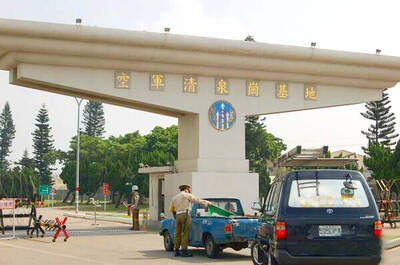
An unauthorized drone intrusion over Ching Chuan Kang Air Base (清泉崗基地) at Taichung International Airport on Tuesday night forced the temporary closure of the base, diverting eight fighter jets and delaying a commercial flight, authorities said. Air Force Command Headquarters said that clear weather had allowed for scheduled night training exercises, but after a drone was spotted entering the airspace, the control tower declared an emergency closure of the airport, forcing eight Indigenous Defense Fighter jets in the air to divert and land at Hsinchu Air Base (新竹基地). Taichung airport director Chang Jui-shu (張瑞澍) said the airspace intrusion lasted from 7:37pm to
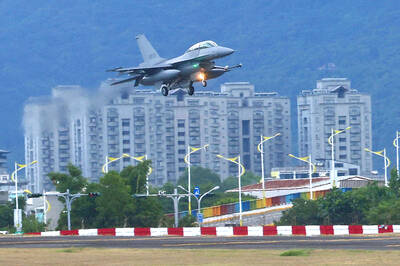
The air force plans to build 26 more hardened aircraft shelters as the number of F-16Vs stationed along Taiwan’s east coast is expected to reach 120 when the final shipment of 66 jets procured from the US arrives. The incoming jets would be stationed at Chihhang Air Base in Taitung County, augmenting the F-16V Block 20s operated by the 5th Tactical Fighter Wing in Hualien County, officials said yesterday. The air force plans to allocate more than NT$6.88 billion (US$218.1 million) from next year to 2031 to build the shelters in Hualien and Taitung as part of the implementation of a “one
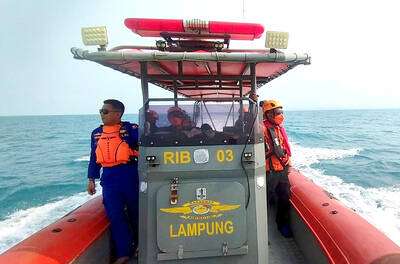
Indonesian rescuers searched for eight people who went missing at sea while heading to a volcanic island to report on an eruption there, officials said yesterday. Anak Krakatau initially erupted for about 25 hours over the weekend, and it has since continued to erupt intermittently with explosions ejecting lava, ash and incandescent volcanic material from the crater, the Indonesian Geology Agency said in a statement. A speedboat carrying five photojournalists, two crew members and a route guide lost contact after leaving Carita, a coastal town in Banten Province, for the volcanic island, Banten Province Search and Rescue Office Chief Al Amrad said. He


 RSS
RSS