


A total of 71 Chinese military aircraft and seven naval vessels were detected around Taiwan from 6am on Sunday to 6am yesterday, the Ministry of National Defense said.
It was the most Chinese military craft detected within a 24-hour period so far this year.
Forty-seven aircraft were spotted either crossing the median line of the Taiwan Strait or entering Taiwan’s southwestern air defense identification zone (ADIZ), the ministry said.
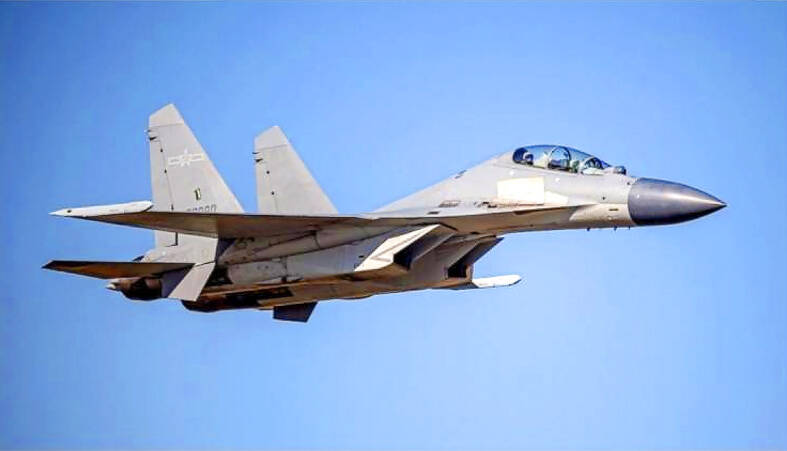
Photo: AP
The armed forces monitored the situation, and tasked combat air patrol aircraft, navy vessels and land-based missile systems to respond to the Chinese activities.
The Chinese planes included 12 Shenyang J-11 and six Sukhoi Su-30 fighter jets, one CASC Rainbow CH-4 uncrewed aerial vehicle, six Chengdu J-10 and 18 J-16 fighter jets, one Shaanxi Y-8 EW, one Y-8 ASW, and one KJ-500 airborne early warning and control plane, as well as one Guizhou WZ-7 Soaring Dragon drone, the ministry said.
The ministry on Sunday evening said the Chinese maneuvers amounted to intimidation and psychological warfare aimed at manipulating public opinion in Taiwan.
It said Taiwan-US cooperation is conducive to freedom, openness, and peace and stability in the Indo-Pacific region, and that the military would continue to improve its preparations based on enemy threats and self-defense needs.
Taiwan’s military is absolutely determined, capable and confident in defending the nation’s sovereignty and ensuring its security, it said.
Speaking at a legislative hearing yesterday, Mainland Affairs Council Minister Chiu Tai-san (邱太三) said he would issue a solemn protest over the incursions.
The ministry every day releases data on Chinese military incursions, not only regarding the nation’s ADIZ, but also crossings of the median line, Chiu said, adding that he is “of course very dissatisfied” with China’s actions.
The sorties by the Chinese People’s Liberation Army (PLA) came after US President Joe Biden on Friday signed into law the Fiscal 2023 National Defense Authorization Act, which includes provisions to authorize US$2 billion in loans to Taiwan to buy US-made weapons.
The act also includes a nonbinding provision that Taiwanese naval forces be included in the Rim of the Pacific military exercises to be carried out by the US military and its allies in the region in 2024.
However, the act does not require the US administration to invite Taiwan to join the drills.
Beijing has strongly objected to the act, seeing it as an attempt to change the “status quo” by challenging the “one China” policy and Sino-US joint agreements on how to handle the issue of Taiwan.
On Sunday, the PLA Eastern Theater Command held joint combat readiness patrols and “strike drills” in the sea and airspace around Taiwan.
“This is a resolute response to the current US-Taiwan provocation,” the command said.
Additional reporting by Chen Yu-fu

‘NO SECURITY RISK’: The Railway Bureau reassured the public that the technicians’ activities were limited to technical guidance and did not involve sensitive systems The Railway Bureau yesterday said it had invited eight Chinese technicians to assist with an airport MRT construction project. The bureau issued the confirmation after an Internet user said Chinese nationals had entered the construction zone of Taiwan Taoyuan International Airport’s Terminal 3 project. They asked why “individuals from an enemy state” were allowed access to such a major national infrastructure project, which raised serious concerns over Taiwan’s industrial safety, sensitive systems and information security. The bureau’s Northern Region Engineering Branch Office said subcontractor Taiwan Handle Industrial Co (台灣手把工業) of the Taoyuan airport MRT’s “Contract No. CU05 Project A14 Station Civil, MEP &

A US uncrewed surface vessel (USV) encountered multiple Chinese warships during an autonomous transit of the Taiwan Strait, US defense company Seasats said in a statement on Wednesday. Seasats announced that a Lightfish USV had completed the first autonomous transit of the Taiwan Strait. Over five days, the USV traversed the entire length of the Strait while constantly monitoring surface vessel traffic, the company said. The Lightfish encountered multiple Chinese warships, one of which was a Chinese People’s Liberation Army Navy (PLAN) Type 056 corvette, it said. The Chinese vessels were operating “well within Taiwan’s exclusive economic zone without transmitting their identity via the
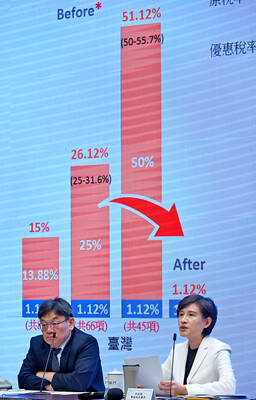
GREATER REACH? Auto parts and wood products would face tariffs of up to 15%, matching those targeting the EU, Japan and South Korea, Vice Premier said The US has announced that preferential tariff treatment for Taiwan’s non-semiconductor Section 232 goods would take effect retroactively from May 1, the Executive Yuan said yesterday. The US government yesterday posted a notice on the Federal Register’s public inspection Web site previewing tariff concessions for Taiwan under a memorandum of understanding (MOU) on Taiwan-US investment after two months of negotiations. The MOU signed on Jan. 15 stipulated three major preferential tariff arrangements: a 15 percent “reciprocal” tariff rate for Taiwan without stacking most-favored nation (MFN) rates; preferential Section 232 treatment for semiconductors and related products; and preferential Section 232 treatment for non-semiconductor

The National Chungshan Institute of Science and Technology yesterday showcased its locally developed variants of the Vision 60 robotic patrol dog, which it plans to deploy on the nation’s outlying territories in the South China Sea. The variants were produced under the Joint Lab project — created by the institute and domestic companies — and assembled with domestically produced motors, lenses and artificial intelligence (AI) systems alongside licensed tech from the US, Missile and Rocket Systems Research Division deputy director Jen Kuo-kang (任國光) told the media event at a military base in Taipei’s Dazhi (大直) area. Taiwan has built up its strengths


 RSS
RSS