


About 500,000 people in the Chinese city of Qingdao are being infected with COVID-19 every day, a senior health official said on Friday, in a rare and quickly censored acknowledgement that the country’s wave of infections is not reflected in official data.
China this month has rapidly dismantled key pillars of its “zero COVID-19” strategy, doing away with snap lockdowns, lengthy quarantines and travel curbs in a jarring reversal of its hallmark containment strategy.
Cities across China have struggled to cope as surging infections have emptied pharmacy shelves, filled hospital wards, and appeared to cause backlogs at crematoriums and funeral homes.

Photo: EPA-EFE
However, the end of strict testing mandates has made caseloads virtually impossible to track, while authorities have narrowed the medical definition of a COVID-19 death in a move experts have said would suppress the number of fatalities attributable to the virus.
A news outlet operated by the Chinese Communist Party in Qingdao on Friday reported the municipal health chief as saying that the eastern city was seeing “between 490,000 and 530,000” new COVID-19 cases a day.
The coastal city of about 10 million people was “in a period of rapid transmission ahead of an approaching peak,” Qingdao Public Health Bureau Deputy Director Bo Tao (薄濤) reportedly said, adding that the infection rate would likely increase by 10 percent over the weekend.
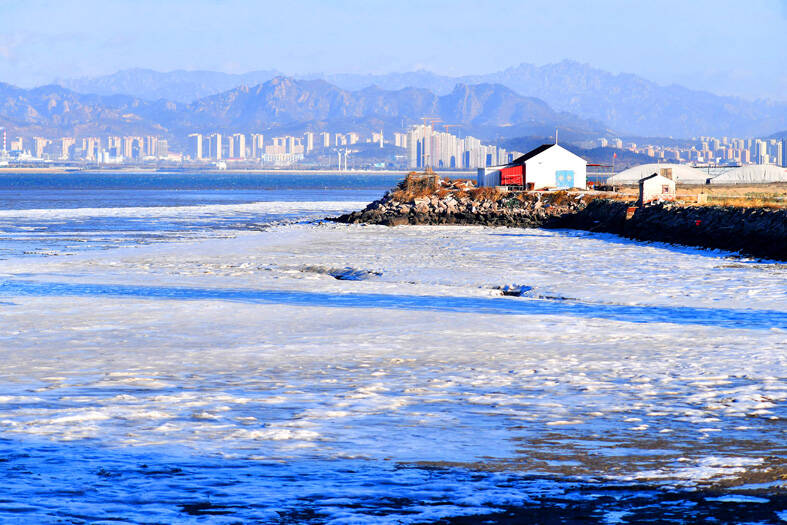
Photo: AFP
The report was shared by several other news outlets, but appeared to have been edited by yesterday morning to remove the case figures.
The Chinese National Health Commission yesterday said that 4,103 new domestic cases were recorded nationwide the previous day, with no new deaths.
Bo’s statement came two days after UK-based analytics company Airfinity Ltd estimated that the whole of China was seeing about 1 million COVID-19 cases per day.
In Shandong, the province where Qingdao is, authorities officially logged just 31 new domestic cases.
The Chinese government keeps a tight leash on the country’s media, with legions of online censors on hand to scrub content deemed politically sensitive.
Most government-run publications have downplayed the severity of the country’s COVID-19 wave, instead depicting the policy reversal as logical and controlled.
Additional reporting by Bloomberg
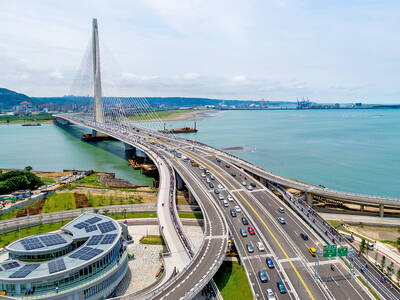
The Ministry of Transportation and Communications yesterday inaugurated the Danjiang Bridge across the Tamsui River in New Taipei City, saying that the structure would be an architectural icon and traffic artery for Taiwan. Feted as a major engineering achievement, the Danjiang Bridge is 920m long, 211m tall at the top of its pylon, and is the longest single-pylon asymmetric cable-stayed bridge in the world, the government’s Web site for the structure said. It was designed by late Iraqi-British architect Zaha Hadid. The structure, with a maximum deck of 70m, accommodates road and light rail traffic, and affords a 200m navigation channel for boats,
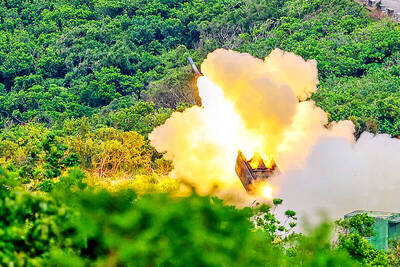
PRECISION STRIKES: The most significant reason to deploy HIMARS to outlying islands is to establish a ‘dead zone’ that the PLA would not dare enter, a source said A High Mobility Artillery Rocket System (HIMARS) would be deployed to Penghu County and Dongyin Island (東引) in Lienchiang County (Matsu) to force the Chinese military to retreat at least 100km from the coastline, a military source said yesterday. Taiwan has been procuring HIMARS and Army Tactical Missile Systems (ATACMS) from the US in batches. Once all batches have been delivered, Taiwan would possess 111 HIMARS units and 504 ATACMS, which have a range of 300km. Considering that “offense is the best defense,” the military plans to forward-deploy the systems to outlying islands such as Penghu and Dongyin so that
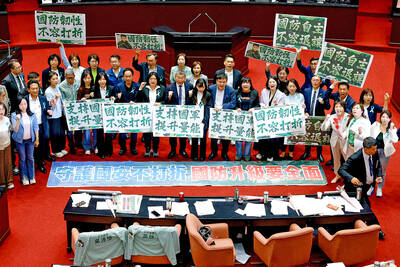
WHAT WAS ALL THAT FOR? Jaw Shaw-kong said that Cheng Li-wen had pushed for more drastic cuts and attacked him, just for the outcome to be nearly identical to his bill The legislature yesterday passed a supplementary budget bill to fund the purchase of separate packages of US military equipment, with the combined amount of spending capped at NT$780 billion (US$24.8 billion). The Chinese Nationalist Party (KMT) and Taiwan People’s Party (TPP) used their legislative majority to pass the bill, which runs until 2033 and has two main funding provisions. One was for NT$300 billion of arms sales already approved by the US for Taiwan on Dec. 17 last year, the other was for NT$480 billion for another arms package expected to be announced by Washington. The bill, which fell short of the NT$1.25

‘CLEAR MESSAGE’: The bill would set up an interagency ‘tiger team’ to review sanctions tools and other economic options to help deter any Chinese aggression toward Taiwan US Representative Young Kim has introduced a bill to deter Chinese aggression against Taiwan, calling for an interagency “tiger team” to preplan coordinated sanctions and economic measures in response to possible Chinese military or political action against Taiwan. “[Chinese President] Xi Jinping [習近平] has directed the People’s Liberation Army to be ready to invade Taiwan by 2027. China has a plan. America should have one too,” Kim said in a news release on Thursday last week. She introduced the “Deter PRC [People’s Republic of China] aggression against Taiwan act” to “ensure the US has a coordinated sanctions strategy ready should


 RSS
RSS