


Nearly three-quarters of Taiwanese are amenable to extending compulsory military service to one year, while 65 percent said they would be willing to take up arms if Taiwan were attacked, a survey showed yesterday.
The length of mandatory military service was one year prior to 2008, and two years prior to 1991. It was gradually reduced and dropped to four months in 2013.
Conscripts also have the option to choose alternative military service, such as administrative jobs in government agencies or working for international cooperation programs.
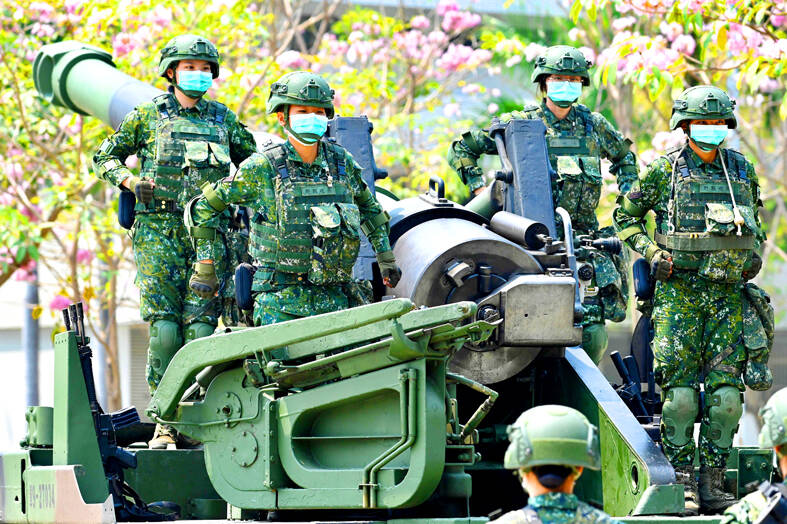
Photo: Sam Yeh, AFP
The survey shows the determination of Taiwanese to defend their country, Taiwan New Constitution Foundation deputy director Song Cheng-en (宋承恩) told a news conference held jointly by World United Formosans for Independence and Taiwan National Security Institute (TNSI) to release the survey.
The US House of Representatives last week approved the “Taiwan Enhanced Resilience Act,” which would provide US$10 billion in security assistance and weapons procurement to modernize Taiwan’s defense capabilities, Song said, adding that this suggests Taiwan’s possible inclusion in the multinational Rim of the Pacific military exercises.
“Looking at these developments, we urge the Ministry of National Defense to pick up the pace on forming cooperative programs with the US, which can boost our defense capabilities and reduce the likelihood of military hostile actions by China,” he said.
The poll also showed that 49.7 percent of respondents believe the government should proactively push to establish diplomatic ties with the US.
In addition, 60.3 percent agree that Taiwan and the US should form a military alliance, while 23.1 percent said they are against it.
TNSI chairwoman Jolan Hsieh (謝若蘭) said the survey also asked people about national identity, and Taiwanese independence or unification with China.
Only 5 percent of respondents identify themselves as solely Chinese, while 31.7 percent identify as solely Taiwanese, down from about 40 percent last year, and 22.2 percent identify themselves as “people of the Republic of China [ROC],” she said.
The percentage of people who identify as “Taiwanese within the ROC” increased to 39.9 percent from 30 percent last year, she said.
The survey, conducted by Focus Survey Research Co from Nov. 29 to Dec. 1, collected 1,084 valid samples and had a margin of error of 2.98 percentage points.

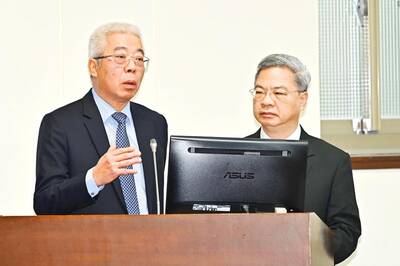
Taiwan has arranged for about 8 million barrels of crude oil, or about one-third of its monthly needs, to be shipped from the Red Sea this month to bypass the Strait of Hormuz and ease domestic supply pressures, CPC Corp, Taiwan (CPC, 台灣中油) said yesterday. The state-run oil company has worked with Middle Eastern suppliers to secure routes other than the Strait of Hormuz, through which about 20 percent of the world’s oil and liquefied natural gas typically passes, CPC chairman Fang Jeng-zen (方振仁) said at a meeting of the legislature’s Economics Committee in Taipei. Suppliers in Saudi Arabia have indicated they

South Korea has adjusted its electronic arrival card system to no longer list Taiwan as a part of China, a move that the Ministry of Foreign Affairs said would help facilitate exchanges between the two sides. South Korea previously listed “Taiwan” as “Taiwan (China)” in the drop-down menus of its online arrival card system, where people had to fill out where they came from and their next destination. The ministry had requested South Korea make a revision and said it would change South Korea’s name on Taiwan’s online immigration system from “Republic of Korea” to “Korea (South),” should the issue not be

Tainan, Taipei and New Taipei City recorded the highest fines nationwide for illegal accommodations in the first quarter of this year, with fines issued in the three cities each exceeding NT$7 million (US$220,639), Tourism Administration data showed. Among them, Taipei had the highest number of illegal short-term rental units, with 410. There were 3,280 legally registered hotels nationwide in the first quarter, down by 14 properties, or 0.43 percent, from a year earlier, likely indicating operators exiting the market, the agency said. However, the number of unregistered properties rose to 1,174, including 314 illegal hotels and 860 illegal short-term rental

AIR ALERT: China’s reservation of airspace over the Yellow Sea and East China Sea could be an attempt to test the US’ response ahead of a Trump-Xi meeting, the NSB head said China’s attempts to infiltrate Taiwan are systematic, planned and targeted, with activity shifting from recruiting mid-level military officers to rank-and-file enlisted personnel, National Security Bureau (NSB) Director-General Tsai Ming-yen (蔡明彥) said yesterday. The Chinese Communist Party’s (CCP) integrates national security, intelligence operations and “united front” efforts into a dense network to conduct intelligence gathering and espionage in Taiwan, Tsai said at a meeting of the legislature’s Foreign Affairs and National Defense Committee. It uses specific networks to screen targets through exchange activities and recruiting local collaborators to establish intelligence-gathering organizations, he said. China is also shifting who it targets to lower-ranking military personnel,


 RSS
RSS