


A group of Taiwanese yesterday held blank pieces of paper in Taipei’s Liberty Square in support of protesters in China.
Jen Wu (吳亭臻) said she cofounded the Facebook group “A4 Revolution in Taiwan” as a platform for people to exchange ideas and news about the protests, so that more people could understand what is happening in China.
“We are standing here now in Taiwan, a free and democratic country, as citizens of the global village, to voice our support for people who are fighting against tyranny, no matter what country they are in,” she said.
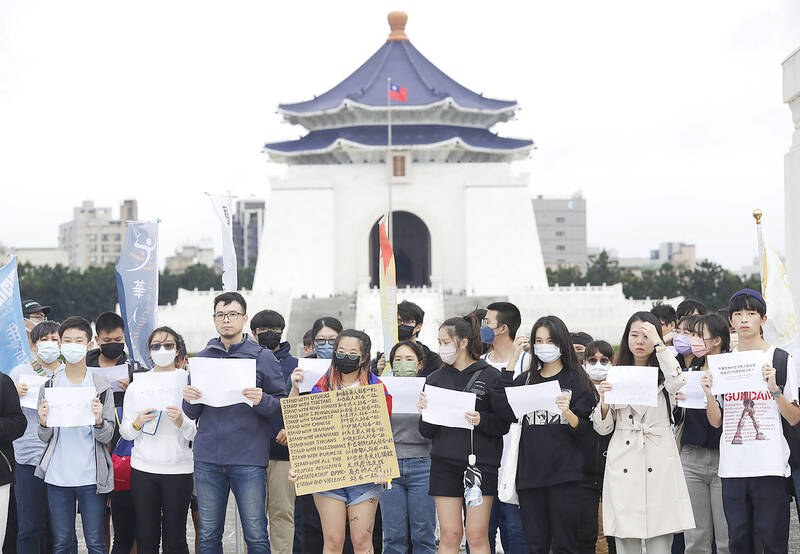
Photo: Chiang Ying-ying, AP
The “Blank Paper Movement” started with protests in several major cities across China over the past week, after a fire on Nov. 24 in Urumqi, Xinjiang, killed 10 people in a building that was under COVID-19 lockdown.
Protesters have demanded an end to the country’s strict “zero COVID” policy, which includes lockdowns and mass testing. They often hold blank pieces of paper to symbolize the lack of freedom of speech in the country and defiance against Beijing’s censorship.
Some have called for democracy, freedom of speech and for Chinese President Xi Jinping (習近平) and the Chinese Communist Party (CCP) to step down.
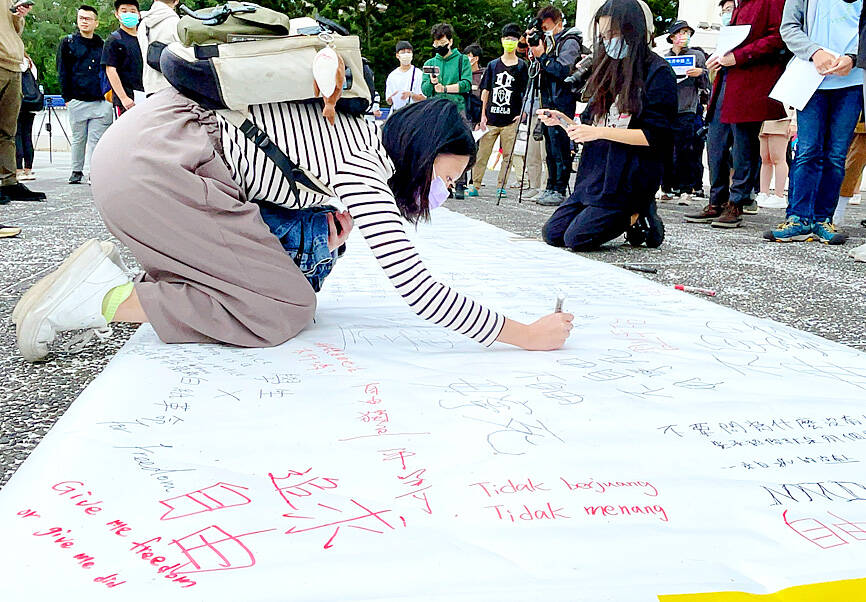
Photo by Chu Pei-hsiung, Taipei Times
Taiwanese human rights and democracy advocate Lee Ming-che (李明哲), who was imprisoned in China for five years after he was convicted of “subversion of state power,” participated in the event in Taipei.
He said it was important to help Taiwanese understand the real situation in China, and let them know that “we refuse to be ruled by such a government, and we refuse to be the same country as that government.”
He said he learned in prison that Chinese laws are designed to control people, not protect them, and CCP officials interpret those laws to their liking.
That is why the CCP imposes strict COVID-19 lockdowns and refuses to use foreign vaccines that are more effective, regardless of the damage to people’s lives and livelihoods, he said.
“This government has implemented ‘one country two systems’ in Hong Kong and Tibet, and the people there have already used their blood and sweat to show us what it is like,” Lee said. “Many cruel and bloody examples show how the Chinese government treats its own people. Do Taiwanese still not understand?”
“The reality of China is not like the glamorous cityscapes portrayed by some media outlets... How many Chinese people’s blood and tears are behind this? Does the Chinese government hear their voices? It has never heard them,” Lee said.
Taiwanese are not supporting the protesters because they might share ethnic Chinese heritage, but because Taiwanese value basic human rights, he said.
Exiled Chinese democracy advocate Wang Dan (王丹) said in a written statement that the Blank Paper Movement has shown the world the conflict between the state and society in China, shattering the fantasy that Chinese embrace the CCP.
The New School for Democracy, International Socialist Forward, Uyghur Human Rights Project, Taiwan Stands With Ukraine and students from National Taiwan University, National Taipei University and other schools also participated in the event.
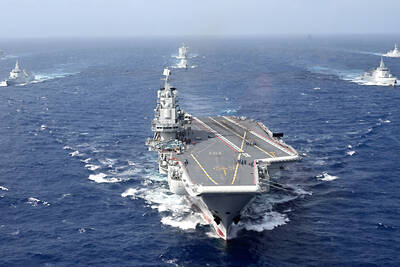
PROVOCATIVE: Chinese Deputy Ambassador to the UN Sun Lei accused Japan of sending military vessels to deliberately provoke tensions in the Taiwan Strait China denounced remarks by Japan and the EU about the South China Sea at a UN Security Council meeting on Monday, and accused Tokyo of provocative behavior in the Taiwan Strait and planning military expansion. Ayano Kunimitsu, a Japanese vice foreign minister, told the Council meeting on maritime security that Tokyo was seriously concerned about the situation in the East China and South China seas, and reiterated Japan’s opposition to any attempt to change the “status quo” by force, and obstruction of freedom of navigation and overflight. Stavros Lambrinidis, head of the EU delegation to the UN, also highlighted South China Sea
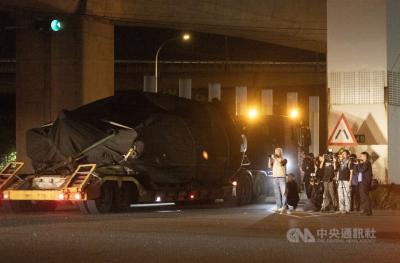
The final batch of 28 M1A2T Abrams tanks purchased from the US arrived at Taipei Port last night and were transported to the Armor Training Command in Hsinchu County’s Hukou Township (湖口), completing the military’s multi-year procurement of 108 of the tanks. Starting at 12:10am today, reporters observed more than a dozen civilian flatbed trailers departing from Taipei Port, each carrying an M1A2T tank covered with black waterproof tarps. Escorted by military vehicles, the convoy traveled via the West Coast Expressway to the Armor Training Command, with police implementing traffic control. The army operates about 1,000 tanks, including CM-11 Brave Tiger
Taiwan Semiconductor Manufacturing Co (TSMC, 台積電), the world’s largest contract chipmaker, said it expects its 2-nanometer (2nm) chip capacity to grow at a compound annual rate of 70 percent from this year to 2028. The projection comes as five fabs begin volume production of 2-nanometer chips this year — two in Hsinchu and three in Kaohsiung — TSMC senior vice president and deputy cochief operating officer Cliff Hou (侯永清) said at the company’s annual technology symposium in Silicon Valley, California, last week. Output in the first year of 2-nanometer production, which began in the fourth quarter of last year, is expected to

Taiwan’s drone exports surged past US$100 million in the first quarter, exceeding last year’s full-year total, with the Czech Republic emerging as the largest buyer, the Ministry of Economic Affairs said. Exports of complete drones reached US$115.85 million in the period, about 1.2 times the total recorded for all of last year, the ministry said in a report. Exports to the Czech Republic accounted for about US$100 million, far outpacing other markets. Poland, last year’s top destination, recorded about US$11.75 million in the first quarter. Taiwan’s drone exports have expanded rapidly in the past few years, with last year’s total


 RSS
RSS