


A 90-year-old Roman Catholic cardinal and five others were yesterday fined by a Hong Kong court after being found guilty of failing to register a now-defunct fund that aimed to help people arrested in widespread protests three years ago.
Cardinal Joseph Zen (陳日君), a retired bishop and a vocal Hong Kong democracy advocate, arrived at court in a black outfit and used a walking stick.
He was in May arrested on suspicion of colluding with foreign forces under the Beijing-imposed National Security Law. His arrest sent shockwaves through Hong Kong’s Catholic community, and the Vatican at the time said it was monitoring the development of the situation closely.
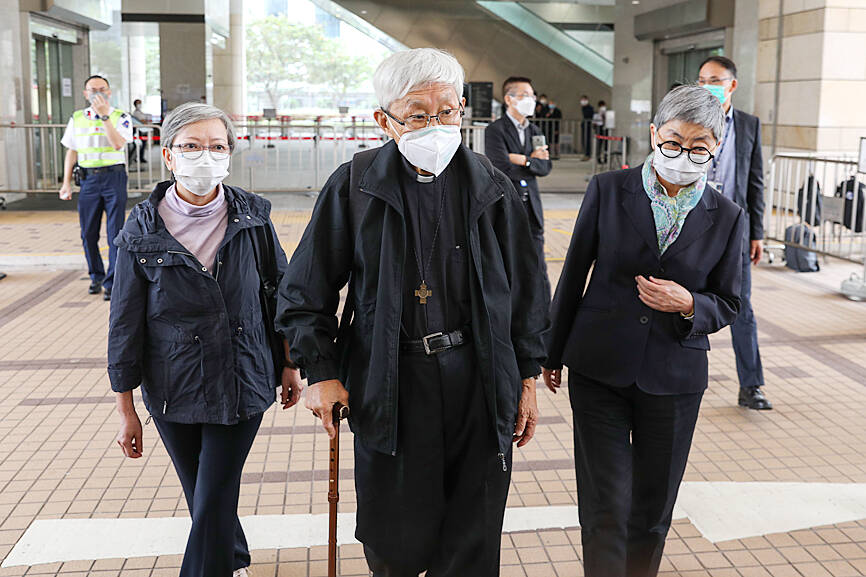
Photo: EPA-EFE
While Zen the and other democracy advocates have not yet been charged with national security-related offenses, they were charged with failing to properly register the 612 Humanitarian Relief Fund, which helped pay medical and legal fees for arrested protesters beginning in 2019. It ceased operations in October last year.
Zen was a trustee of the fund, alongside singer Denise Ho (何韻詩), academic Hui Po-keung (許寶強), and former pro-democracy Hong Kong lawmakers Margaret Ng (吳靄儀) and Cyd Ho (何秀蘭).
They were each fined HK$4,000 (US$512).
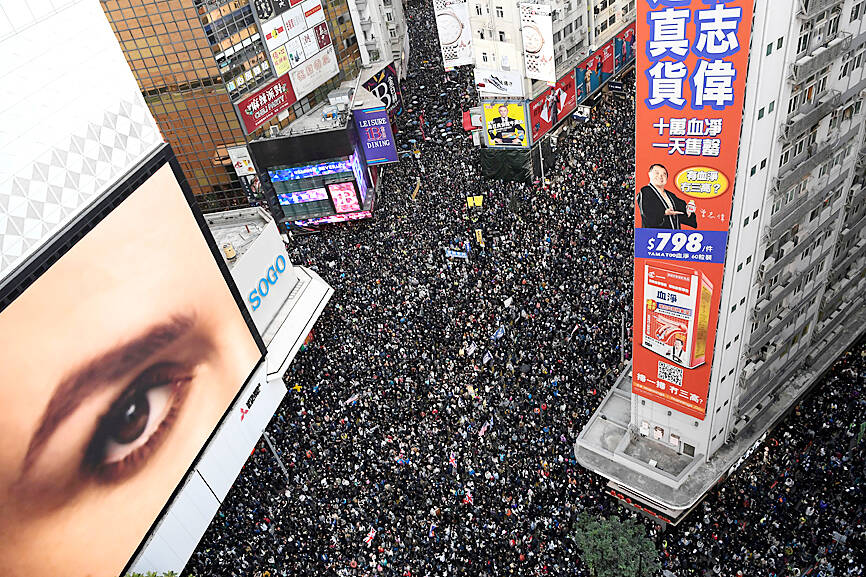
Photo: REUTERS
A sixth defendant, Sze Ching-wee (施城威), was the fund’s secretary and was fined HK$2,500.
The Hong Kong Societies Ordinance requires local organizations to register or apply for an exemption within a month of their establishment. Those who failed to do so face a fine of up to HK$10,000, with no jail time, upon first conviction.
Handing down the verdict, Principal Magistrate Ada Yim (嚴舜儀) ruled that the fund is considered an organization that is obliged to register, as it was not purely for charity purposes.
The judgement holds significance as it is the first time that residents had to face a charge under the ordinance for failing to register, Ng told reporters after the hearing.
“The effect to other people, to the many, many citizens who are associated together to do one thing or another, and what will happen to them, is very important,” said Ng, a veteran lawyer. “It is also extremely important about the freedom of association in Hong Kong under Societies Ordinance.”
Zen said his case should not be linked with the territory’s religious freedoms.
“I haven’t seen any erosion of religious freedoms in Hong Kong,” he said.
The 2019 protests were sparked by a since-withdrawn bill that would have allowed criminal suspects to be extradited to mainland China. Critics worried that such suspects would disappear into China’s opaque and frequently abusive legal system. Opposition morphed into months of unrest in the territory.
The National Security Law has crippled Hong Kong’s democracy ndmovement since its enactment in 2020, with many democracy advocates being arrested or jailed.
The impact of the law has also damaged faith in the future of the territory, with a growing number of people responding to the shrinking freedoms by emigrating.
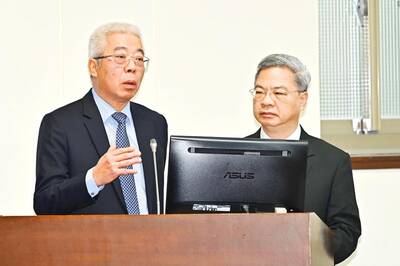
Taiwan has arranged for about 8 million barrels of crude oil, or about one-third of its monthly needs, to be shipped from the Red Sea this month to bypass the Strait of Hormuz and ease domestic supply pressures, CPC Corp, Taiwan (CPC, 台灣中油) said yesterday. The state-run oil company has worked with Middle Eastern suppliers to secure routes other than the Strait of Hormuz, through which about 20 percent of the world’s oil and liquefied natural gas typically passes, CPC chairman Fang Jeng-zen (方振仁) said at a meeting of the legislature’s Economics Committee in Taipei. Suppliers in Saudi Arabia have indicated they

South Korea has adjusted its electronic arrival card system to no longer list Taiwan as a part of China, a move that the Ministry of Foreign Affairs said would help facilitate exchanges between the two sides. South Korea previously listed “Taiwan” as “Taiwan (China)” in the drop-down menus of its online arrival card system, where people had to fill out where they came from and their next destination. The ministry had requested South Korea make a revision and said it would change South Korea’s name on Taiwan’s online immigration system from “Republic of Korea” to “Korea (South),” should the issue not be

CCP ‘PAWN’? Beijing could use the KMT chairwoman’s visit to signal to the world that many people in Taiwan support the ‘one China’ principle, an academic said Chinese Nationalist Party (KMT) Chairwoman Cheng Li-wun (鄭麗文) yesterday arrived in China for a “peace” mission and potential meeting with Chinese President Xi Jinping (習近平), while a Taiwanese minister detailed the number of Chinese warships currently deployed around the nation. Cheng is visiting at a time of increased Chinese military pressure on Taiwan, as the opposition-dominated Legislative Yuan stalls a government plan for US$40 billion in extra defense spending. Speaking to reporters before going to the airport, Cheng said she was going on a “historic journey for peace,” but added that some people felt uneasy about her trip. “If you truly love Taiwan,

Tainan, Taipei and New Taipei City recorded the highest fines nationwide for illegal accommodations in the first quarter of this year, with fines issued in the three cities each exceeding NT$7 million (US$220,639), Tourism Administration data showed. Among them, Taipei had the highest number of illegal short-term rental units, with 410. There were 3,280 legally registered hotels nationwide in the first quarter, down by 14 properties, or 0.43 percent, from a year earlier, likely indicating operators exiting the market, the agency said. However, the number of unregistered properties rose to 1,174, including 314 illegal hotels and 860 illegal short-term rental


 RSS
RSS