


British government departments were on Thursday ordered to stop installing Chinese-made surveillance cameras at “sensitive sites,” drawing a strong rebuke from one of the companies targeted.
The move comes with the government moving more forcefully against China and its companies on security grounds. Last week, it ordered a Chinese-owned firm to divest most of Newport Fab LLC, Britain’s biggest semiconductor maker.
A report by Big Brother Watch said ost public entities in the UK use security cameras made by Zhejiang Dahua Technology Co (浙江大華科技) or Hikvision Digital Technology Co (海康威視).
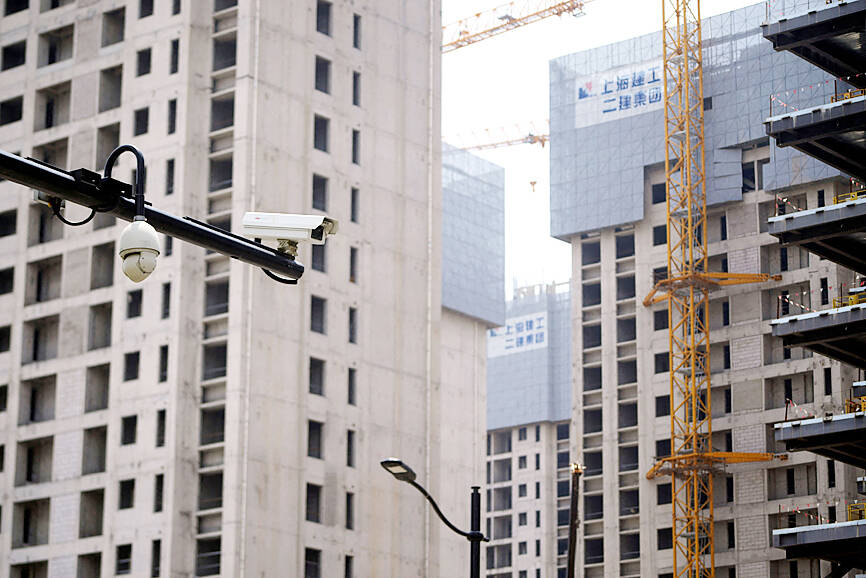
Photo: REUTERS
In July, a group of 67 British lawmakers urged the government to ban the sale and use of surveillance equipment made by the two companies, whose products have allegedly been implicated in rights abuses against the Uighur minority in Xinjiang.
However, the government’s new order stopped short of an outright ban on the companies. It instead discouraged the use of “visual surveillance systems” made by firms required by Chinese law to share intelligence with Beijing’s security services.
No such cameras should be connected to “core networks” at government departments, and ministries should consider replacing them rather than waiting for scheduled upgrades, it said.
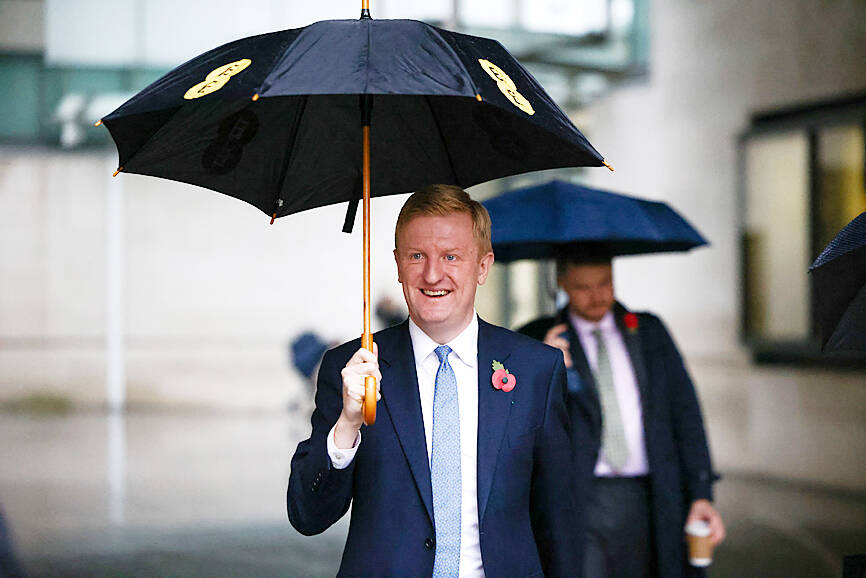
Photo: REUTERS
A government review has concluded that “in light of the threat to the UK and the increasing capability and connectivity of these systems, additional controls are required,” British Chancellor of the Duchy of Lancaster Oliver Dowden told parliament.
“Departments have therefore been instructed to cease deployment of such equipment on to sensitive sites, where it is produced by companies subject to the national intelligence law of the People’s Republic of China,” he said.
Some British ministries have already been removing Hikvision gear, after one of the firm’s cameras in June last year caught then British secretary of state for health and social care Matt Hancock kissing an aide in contravention of COVID-19 rules. He was forced to resign.
In response to Dowden’s statement, a spokesman for the company said it was “categorically false to represent Hikvision as a threat to national security.”
Hikvision “cannot transmit data from end-users to third parties,” he said. “We do not manage end-user databases, nor do we sell cloud storage in the UK.”
“We have always been fully transparent about our operations in the UK and have been engaging with the UK government to clarify misunderstandings about the company, our business, and address their concerns,” the spokesman said. “We will seek to urgently engage further with ministers to understand this decision.”
South Korea has adjusted its electronic arrival card system to no longer list Taiwan as a part of China, a move that the Ministry of Foreign Affairs said would help facilitate exchanges between the two sides. South Korea previously listed “Taiwan” as “Taiwan (China)” in the drop-down menus of its online arrival card system, where people had to fill out where they came from and their next destination. The ministry had requested South Korea make a revision and said it would change South Korea’s name on Taiwan’s online immigration system from “Republic of Korea” to “Korea (South),” should the issue not be

Tainan, Taipei and New Taipei City recorded the highest fines nationwide for illegal accommodations in the first quarter of this year, with fines issued in the three cities each exceeding NT$7 million (US$220,639), Tourism Administration data showed. Among them, Taipei had the highest number of illegal short-term rental units, with 410. There were 3,280 legally registered hotels nationwide in the first quarter, down by 14 properties, or 0.43 percent, from a year earlier, likely indicating operators exiting the market, the agency said. However, the number of unregistered properties rose to 1,174, including 314 illegal hotels and 860 illegal short-term rental
Both sides of the Taiwan Strait share a political foundation based on the “1992 consensus” and opposition to Taiwanese independence, Chinese Nationalist Party (KMT) Chairwoman Cheng Li-wun (鄭麗文) today said during her meeting with Chinese President Xi Jinping (習近平). Both sides of the Strait should plan and build institutionalized and sustainable mechanisms for dialogue and cooperation based on that foundation to make peaceful development across the Strait irreversible, she said. Peace is a shared moral value across the Strait, and both sides should move beyond political confrontation to seek institutionalized solutions to prevent war, she said. Mutually beneficial cross-strait relations are what the
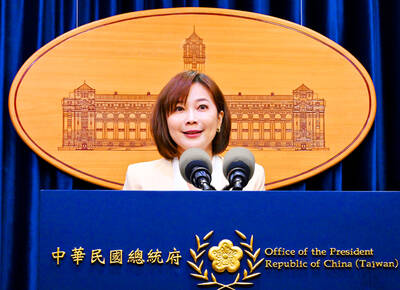
ECONOMIC COERCION: Such actions are often inconsistently applied, sometimes resumed, and sometimes just halted, the Presidential Office spokeswoman said The government backs healthy and orderly cross-strait exchanges, but such arrangements should not be made with political conditions attached and never be used as leverage for political maneuvering or partisan agendas, Presidential Office spokeswoman Karen Kuo (郭雅慧) said yesterday. Kuo made the remarks after China earlier in the day announced 10 new “incentive measures” for Taiwan, following a landmark meeting between Chinese President Xi Jinping (習近平) and Chinese Nationalist Party (KMT) Chairwoman Cheng Li-wun (鄭麗文) in Beijing on Friday. The measures, unveiled by China’s Xinhua news agency, include plans to resume individual travel by residents of Shanghai and China’s Fujian


 RSS
RSS