

The Kaohsiung District Prosecutors’ Office yesterday charged army Colonel Hsiang Te-en (向德恩) with corruption, accusing him of pledging allegiance to China and receiving payment from Chinese operatives to work as a spy.
Prosecutors asked a court to sentence Hsiang to 12 years in prison.
Hsiang is head of the Kaohsiung-based Army Infantry Training Command’s Operations Research and Development Division.
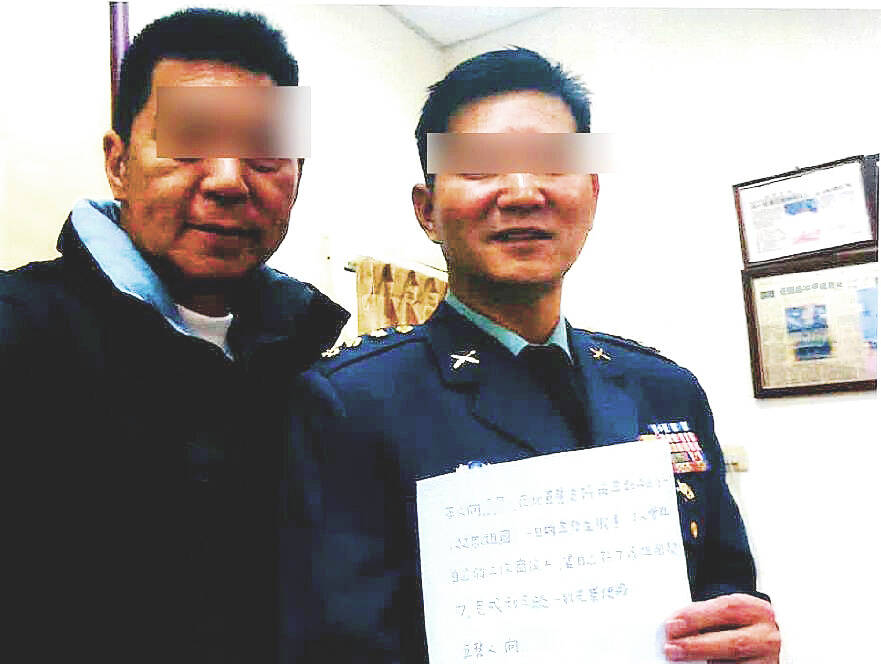
Photo: Copied by Huang Chia-lin, Taipei Times
He allegedly signed a “pledge of surrender” and promised to “serve, as best he may, in his office for the benefits of the motherland in the event of war across the [Taiwan] Strait,” the office said.
Hsiang could not be charged with contraventions of Article 2 of the National Security Act (國家安全法) or treason under the Criminal Code, because evidence had been removed from the cellphones of those implicated, it said.
Hsiang, 49, was recruited by Shao Wei-chiang (邵維強) to work as a Chinese spy, the indictment said.
Shao is a retired lieutenant who had until June 2019 worked as a Kinmen regional reporter for China Television. He also claimed to be a director at Want Want China Times Media Group’s (旺旺中時集團) Times International Advertising Co (時際創意傳媒), president of Kinmen County’s Cross-Strait Cultural and Economic Tourism Development Association, and the owner of a travel agency, the indictment said.
Shao learned in 2005 that his travel agency employed a woman named Yu (尤), whose then-husband, Hsiang, was in the military and began to make overtures to win Hsiang over, the indictment said.
Yu and Hsiang divorced in June 2018.
Shao treated Hsiang to banquets and gifts, and told Hsiang that he was a distant relative of late Chinese People’s Liberation Army general Xiang Shouzhi (向守志), the indictment said.
In January 2020, Hsiang donned his military uniform and made a video, stating: “I, Hsiang Te-en, here do pledge that I support the peaceful unification of both sides of the [Taiwan] Strait. I will serve the motherland and the organization, to the best of my abilities, while remaining in my current position, to ensure the holy and honorable mission of ushering in peaceful reunification as early as possible,” the indictment said.
Hsiang received NT$40,000 a month for working as a spy, totaling NT$560,000 over 14 months, it said.
When he was being led out of an army base on Sept. 26, Hsiang said that he had signed the pledge after seeing other senior officers making similar pledges, the indictment said.
Hsiang has denied the corruption charges.
Implicated military personnel are being investigated by the Ministry of National Defense, the office said.
The ministry said that its Political Warfare Bureau is looking into other military officials who might be involved.
The incident highlights the threat that Chinese intelligence operations pose to the military, the ministry said, adding that its preventive measures are effective.
The ministry will continue to bolster counterespionage education for officers, as well as rank-and-file soldiers, it said.
The ministry would also work closely with national security agencies to thwart Chinese intelligence-gathering efforts, it added.
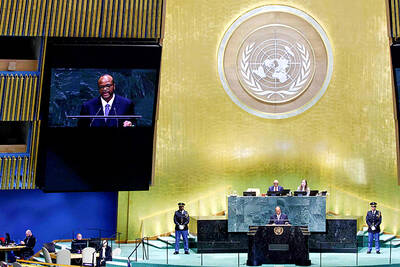
UNITY: Lai thanked the nations who spoke up for Taiwan, saying that democracies must stand together to face global authoritarian expansion Taiwan yesterday thanked eight European and Indo-Pacific countries for opposing unilateral changes to the “status quo” in the Taiwan Strait in a joint statement earlier this week, as well as three of Taiwan’s allies for speaking up for the nation’s participation in the UN at the body’s General Assembly in New York. Minister of Foreign Affairs Lin Chia-lung (林佳龍) welcomed the support and expressed his appreciation for the countries’ stance, the Ministry of Foreign Affairs said in a statement. Foreign ministers and senior representatives of Australia, France, Germany, Japan, New Zealand, Poland, South Korea and the UK issued a statement on Tuesday
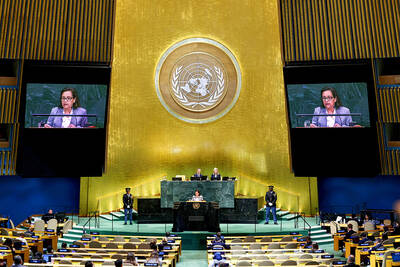
PLEA: How the UN addresses Taiwan’s security issue would be a test of its strength and relevance, Marshall Islands President Hilda Heine told the UN General Assembly Only Taiwan’s elected government can represent the people of Taiwan, Marshall Islands President Hilda Heine said on Friday at the UN General Assembly, calling for the nation’s inclusion in the UN. Taiwan and its 23 million people are a reality, and only its democratically elected government can represent it, Heine said when addressing the 81st session of the UN General Assembly General Debate. Appropriate ways must be found for Taiwan’s substantive participation in UN meetings if the UN is to be truly inclusive and effective in years to come, she said. UN member states would experience pressure to accept a
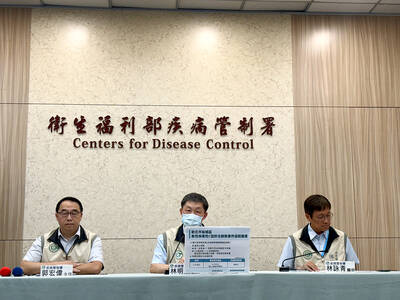
AT-RISK GROUPS: Of the accumulated 1,586 severe cases and 304 related deaths in this flu season, 65.8% were older people and 83.2% had chronic diseases, an official said The Centers for Disease Control (CDC) yesterday said that 165 severe flu cases and 30 flu-related deaths were reported last week, the highest weekly numbers in this flu season, and that cases might continue to increase, urging people to take precautions. Medical visits for flu-like illnesses increased by 1.4 percent to 141,374 last week, with 11.8 percent being emergency visits, showing that the seasonal flu is still in its epidemic period, CDC Epidemic Intelligence Center Director Guo Hung-wei (郭宏偉) said. From Tuesday last week to Monday, 165 severe flu cases and 30 flu-related deaths were confirmed, the highest weekly numbers
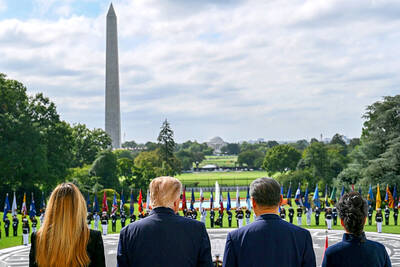
FACTS DISTORTION: The MAC rejected Xi’s remarks that the US and ‘China’ fought side-by-side during WWII, saying the ROC was Washington’s true ally during the war Taiwan yesterday denounced Chinese President Xi Jinping’s (習近平) comments to US President Donald Trump on the nation’s future, after Xi appeared to push Trump for a subtle change in stance that could erode US support for Taiwan. Xi told Trump in Washington on Thursday that he hoped the US would adhere to the “correct position” of opposing Taiwanese independence, according to a Chinese readout of the talks. That would be a tougher version of Washington’s long-standing formulation that it does not “support” independence. There was no immediate White House readout of the exchange. Xi’s remarks represent “the consistent Chinese approach of distorting facts


 RSS
RSS