


A fraught UN climate summit yesterday wrapped up with a landmark deal on funding to help vulnerable countries cope with the devastating effects of global warming — but there was also anger over its failure to push further ambition on cutting emissions.
The two-week talks in Egypt’s Red Sea resort of Sharm el-Sheikh, which at times appeared to teeter on the brink of collapse, delivered a major breakthrough on a fund for climate “loss and damage.”
Pakistani Minister of Climate Change Sherry Rehman said that COP27 “responded to the voices of the vulnerable, the damaged and the lost of the whole world.”

Photo: Reuters
“We have struggled for 30 years on this path, and today in Sharm el-Sheikh this journey has achieved its first positive milestone,” she told the summit.
Tired delegates applauded when the loss and damage fund was adopted as the sun came up yesterday, following almost two extra days of negotiations that went round-the-clock.
However, jubilation over that achievement was countered by stern warnings.

Photo: Reuters
UN Secretary-General Antonio Guterres said the UN climate talks had “taken an important step towards justice” with the loss and damage fund, but fell short in pushing for the urgent carbon-cutting needed to tackle global warming.
“Our planet is still in the emergency room,” Guterres said. “We need to drastically reduce emissions now, and this is an issue this COP did not address.”
A final COP27 statement covering the broad array of the world’s efforts to grapple with a warming planet held the line on the aspirational goal of limiting global warming to 1.5°C from pre-industrial levels.
It also included language on renewable energy for the first time, while reiterating previous calls to accelerate “efforts towards the phasedown of unabated coal power and phase-out of inefficient fossil fuel subsidies.”
That failed to go much further than a similar decision from last year’s COP26 meeting in Glasgow on key issues around cutting planet-heating pollution.
European Commission First Vice President Frans Timmermans said the EU was “disappointed,” adding that more than 80 nations had backed a stronger emissions pledge.
“What we have in front of us is not enough of a step forward for people and planet,” he said.
“It doesn’t bring enough added efforts from major emitters to increase and accelerate their emission cuts,” said Timmermans, who 24 hours earlier had threatened to walk out of the talks rather than getting a “bad result.”
Alok Sharma, who chaired COP26 in Glasgow, said a passage on energy had been “weakened, in the final minutes.”
German Minister of Foreign Affairs Annalena Baerbock said she was frustrated that the emissions cut and fossil fuel phase-out were “stonewalled by a number of large emitters and oil producers.”

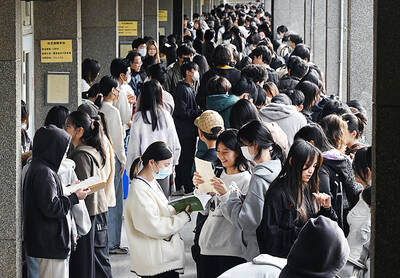
A global survey showed that 60 percent of Taiwanese had attained higher education, second only to Canada, the Ministry of the Interior said. Taiwan easily surpassed the global average of 43 percent and ranked ahead of major economies, including Japan, South Korea and the US, data from the Organisation for Economic Co-operation and Development (OECD) for 2024 showed. Taiwan has a high literacy rate, data released by the ministry showed. As of the end of last year, Taiwan had 20.617 million people aged 15 or older, accounting for 88.5 percent of the total population, with a literacy rate of 99.4 percent, the data

NEW LOW: The council in 2024 based predictions on a pessimistic estimate for the nation’s total fertility rate of 0.84, but last year that rate was 0.69, 17 percent lower An expected National Development Council (NDC) report expects the nation’s population to drop below 12 million by 2065, with the old-age dependency ratio to top 100 percent sooner than 2070, sources said yesterday. The council is slated to release its latest population projections in August, using an ultra-low fertility model, the sources said. The previous report projected that Taiwan’s population would fall to 14.37 million by 2070, but based on a new estimate of the total fertility rate (TFR) — the average number of children born to a woman over her lifetime — the population is expected to reach 12 million by

CCP ‘PAWN’? Beijing could use the KMT chairwoman’s visit to signal to the world that many people in Taiwan support the ‘one China’ principle, an academic said Chinese Nationalist Party (KMT) Chairwoman Cheng Li-wun (鄭麗文) yesterday arrived in China for a “peace” mission and potential meeting with Chinese President Xi Jinping (習近平), while a Taiwanese minister detailed the number of Chinese warships currently deployed around the nation. Cheng is visiting at a time of increased Chinese military pressure on Taiwan, as the opposition-dominated Legislative Yuan stalls a government plan for US$40 billion in extra defense spending. Speaking to reporters before going to the airport, Cheng said she was going on a “historic journey for peace,” but added that some people felt uneasy about her trip. “If you truly love Taiwan,
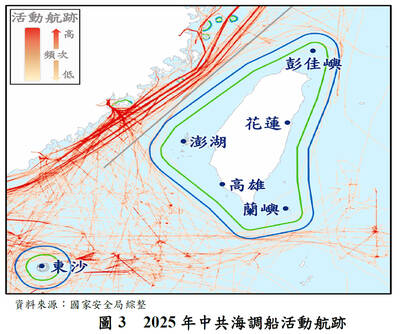
INTENSIFYING THREATS: Beijing’s tactics include massive attacks on the government service network, aircraft and naval vessel incursions and damaging undersea cables China is prepared to interfere in November’s nine-in-one local elections by launching massive attacks on the Taiwanese government’s service network (GSN), a report published by the National Security Bureau showed. The report was submitted to the Legislative Yuan ahead of the bureau’s scheduled briefing at the Foreign Affairs and National Defense Committee tomorrow. The national security team has identified about 13,000 suspicious Internet accounts and 860,000 disputed messages, the bureau said of China’s cognitive warfare against Taiwan. The disputed messages focus on major foreign affairs, national defense and economic issues, which were produced using generative artificial intelligence (AI) and distributed through Chinese


 RSS
RSS