


Australian Prime Minister Anthony Albanese yesterday said he raised with Chinese President Xi Jinping (習近平) his concerns about trade “blockages,” but did not walk away from their first face-to-face talks with any promises that the US$13 billion barriers to Australian exports would be lifted.
The Australian government described the talks on the sidelines of the G20 summit in Indonesia as the first formal bilateral meeting between the two nations’ leaders since 2016, when Xi met then-Australian prime minister Malcolm Turnbull in the Chinese city of Hangzhou.
Bilateral relations plummeted since then over issues including Australia’s ban on Chinese telecommunications giant Huawei Technologies Co’s (華為) involvement in 5G networks, calls for an independent inquiry into the COVID-19 pandemic and new laws banning covert international interference in Australian politics.
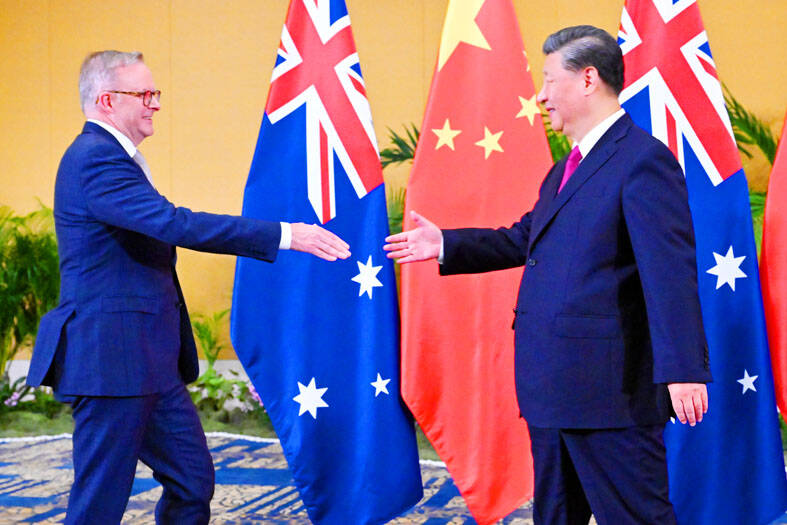
Photo: EPA-EFE
Since the center-left Labor Party came to power in May after nine years of conservative rule, Albanese has been calling for China to lift a series of official and unofficial barriers to Australian exports, including beef, wine, seafood, wood and coal that cost US$13 billion a year.
Albanese described his 30-minute meeting with Xi as “successful,” “positive,” “warm” and “constructive.”
“I put forward Australia’s position when it comes to the blockages in our trading relationship,” Albanese told reporters in Bali, Indonesia.
“It was a positive discussion. We put forward our position. It was not anticipated that a meeting such as that you get immediate declarations. I believe if people thought that would happen, then that was not realistic,” Albanese added.
Xi told Albanese in his opening remarks at the meeting that bilateral relations had “encountered some difficulties” in recent years.
“We should improve, maintain and develop the relations between the two countries, which is in the fundamental interests of the two peoples and conducive to promoting the development of peace in the Asia-Pacific region and the world,” Xi said.
Xi said that Albanese had repeated since becoming prime minister that “China-Australia relations will be handled in a mature way.”
“I attach great importance to your opinion,” Xi said.
Albanese said the two leaders also discussed Taiwan, human rights in China’s Xinjang region, the detention of Chinese-born Australian journalist Cheng Lei (成蕾) and writer Yang Hengjun (楊恒均), and Australia’s desire for Beijing to use its influence on Russia to prevent the use of tactical nuclear weapons in Ukraine.
Australia’s deal with the US and the UK announced last year to create an Australian submarine fleet powered with US nuclear technology was not raised, he said.
He added that both leaders agreed that dialogue between their governments would continue.

NO HUMAN ERROR: After the incident, the Coast Guard Administration said it would obtain uncrewed aerial vehicles and vessels to boost its detection capacity Authorities would improve border control to prevent unlawful entry into Taiwan’s waters and safeguard national security, the Mainland Affairs Council (MAC) said yesterday after a Chinese man reached the nation’s coast on an inflatable boat, saying he “defected to freedom.” The man was found on a rubber boat when he was about to set foot on Taiwan at the estuary of Houkeng River (後坑溪) near Taiping Borough (太平) in New Taipei City’s Linkou District (林口), authorities said. The Coast Guard Administration’s (CGA) northern branch said it received a report at 6:30am yesterday morning from the New Taipei City Fire Department about a

IN BEIJING’S FAVOR: A China Coast Guard spokesperson said that the Chinese maritime police would continue to carry out law enforcement activities in waters it claims The Philippines withdrew its coast guard vessel from a South China Sea shoal that has recently been at the center of tensions with Beijing. BRP Teresa Magbanua “was compelled to return to port” from Sabina Shoal (Xianbin Shoal, 仙濱暗沙) due to bad weather, depleted supplies and the need to evacuate personnel requiring medical care, the Philippine Coast Guard (PCG) spokesman Jay Tarriela said yesterday in a post on X. The Philippine vessel “will be in tiptop shape to resume her mission” after it has been resupplied and repaired, Philippine Executive Secretary Lucas Bersamin, who heads the nation’s maritime council, said

REGIONAL STABILITY: Taipei thanked the Biden administration for authorizing its 16th sale of military goods and services to uphold Taiwan’s defense and safety The US Department of State has approved the sale of US$228 million of military goods and services to Taiwan, the US Department of Defense said on Monday. The state department “made a determination approving a possible Foreign Military Sale” to the Taipei Economic and Cultural Representative Office in the US for “return, repair and reshipment of spare parts and related equipment,” the defense department’s Defense Security Cooperation Agency said in a news release. Taiwan had requested the purchase of items and services which include the “return, repair and reshipment of classified and unclassified spare parts for aircraft and related equipment; US Government

More than 500 people on Saturday marched in New York in support of Taiwan’s entry to the UN, significantly more people than previous years. The march, coinciding with the ongoing 79th session of the UN General Assembly, comes close on the heels of growing international discourse regarding the meaning of UN Resolution 2758. Resolution 2758, adopted by the UN General Assembly in 1971, recognizes the People’s Republic of China (PRC) as the “only lawful representative of China.” It resulted in the Republic of China (ROC) losing its seat at the UN to the PRC. Taiwan has since been excluded from


 RSS
RSS