


The US unsealed criminal charges on Thursday against seven Chinese nationals accused of waging a surveillance and harassment campaign against a US resident and his family, in a bid by the Chinese government to repatriate one of them back to China.
The eight-count indictment, released in a US district court in Brooklyn, New York, is the latest case by the US Department of Justice targeting China’s apparent expatriation campaign, known as Operation Fox Hunt (獵狐行動).
The seven individuals charged are An Quanzhong (安全忠), 55, of Roslyn, New York; his daughter, An Guangyang, 34; and five others still in China: Peng Tian, Chen Chenghua, Ming Chunde, Hou Xuexin and Yuan Weidong.
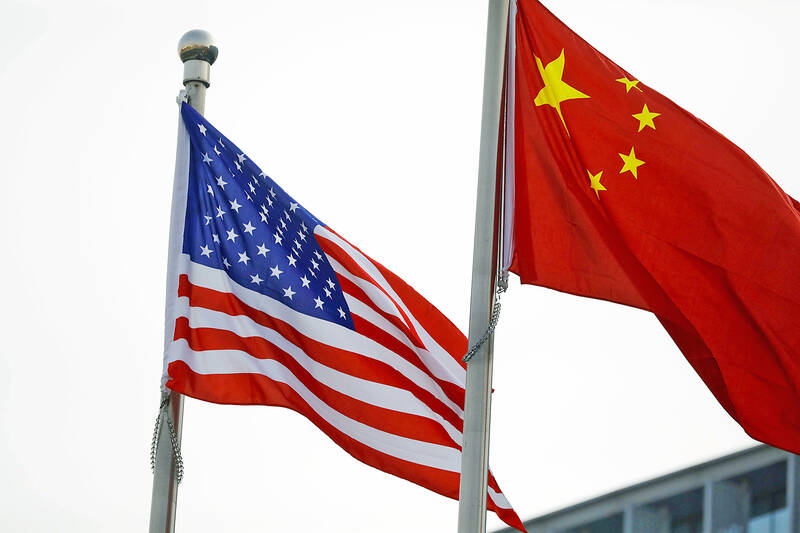
Photo: REUTERS
The lead defendant, An Quanzhong, and his daughter were arrested on Thursday morning. The remainder of the defendants remain at large. The US does not have an extradition treaty with China.
An Quanzhong is accused of working at the behest of the Chinese Provincial Commission for Discipline Inspection to harass and intimidate a Chinese man and his son living in the US. The man and his son are identified only as “John Doe-1” and “John Doe-2.”
As part of the plot, the defendants allegedly coerced a relative of the family to travel from China to the US in a bid to convince John Doe-1 to return to the country.
At a meeting in a restaurant in September 2018, the relative explained to John Doe-2 that he had been forced to travel there by the government as part of a plan to repatriate the 100 most-wanted fugitives, the indictment said.
Other examples of harassment that the family endured included a letter-writing campaign, with one letter warning that “coming back and turning yourself in is the only way out.”
The Chinese government also filed a lawsuit against the father and son in a New York state court, claiming the father had stolen money from a Chinese employer and his son illegally profited from the scheme.
“The victims in this case sought to flee an authoritarian government, leaving behind their lives and family, for a better life here. That same government sent agents to the United States to harass, threaten, and forcibly return them to the People’s Republic of China,” New York FBI Assistant Director Michael Driscoll said.
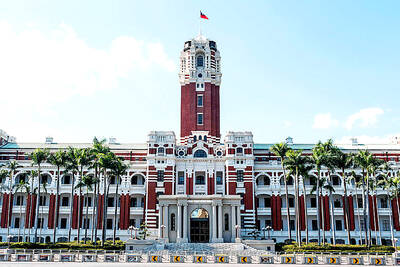
SECURITY: Taipei presses the US for arms supplies, saying the arms sales are not only a reflection of the US security commitment to Taiwan but also serve as a mutual deterrent against regional threats Taiwan is committed to preserving the cross-strait “status quo” and contributing to regional peace and stability, the Presidential Office said yesterday. “It is an undeniable fact that the Republic of China is a sovereign and independent democratic nation,” Presidential Office spokeswoman Karen Kuo (郭雅慧) reiterated, adding that Beijing has no right to claim sovereignty over Taiwan. The statements came after US President Donald Trump warned against Taiwanese independence. Trump wrapped up a state visit to Beijing on Friday, during which Chinese President Xi Jinping (習近平) had pressed him not to support Taiwan. Taiwan depends heavily on US security backing to deter China from carrying

The subsidiary of Taiwan Semiconductor Manufacturing Co (TSMC, 台積電) in Kumamoto, Japan, turned a profit in the first quarter of this year, marking the first time the first fab of the unit has become profitable since mass production started at the end of 2024. According to the contract chipmaker’s financial statement released on Friday, Japan Advanced Semiconductor Manufacturing Inc (JASM), a joint venture running the fab in Kumamoto, posted NT$951 million (US$30.19 million) in profit in the January-to-March period, compared with a loss of NT$1.39 billion in the previous quarter, and a loss of NT$3.25 billion in the first quarter of
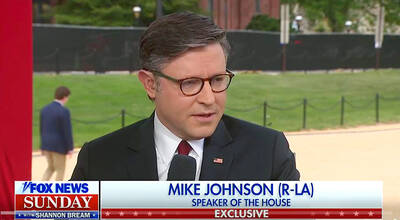
RESOLUTE BACKING: Two Republican senators are planning to introduce legislation that would impose immediate sanctions on China if it attempts to invade Taiwan US House of Representatives Speaker Mike Johnson on Sunday reaffirmed US congressional support for Taiwan, saying the US and “all freedom-loving people” have a stake in preventing China from seizing Taiwan by force. Johnson made the remarks in an interview with Fox News Sunday on US President Donald Trump’s summit with Chinese President Xi Jinping (習近平) last week. In an interview that aired on Friday on Fox News, just as Trump wrapped up a high-stakes visit to China, he said he has yet to green-light a new US$14 billion arms package to Taiwan and that it “depends on China.” “It’s a very good
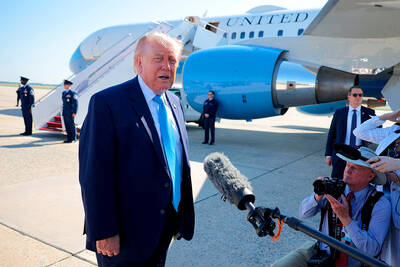
US President Donald Trump yesterday said he would speak to President William Lai (賴清德) as his administration considers whether to move ahead with a US$14 billion weapons sale to Taiwan — a potential arms deal that has drawn criticism from China. “Well, I’ll speak to him. I speak to everybody,” Trump told reporters yesterday when asked if he had any plans to call his counterpart, although he did not offer a time frame for when such a conversation could take place. Trump previously said he would speak to the person “that’s running Taiwan,” without specifying who he meant. “We have that situation very


 RSS
RSS