


Ukraine yesterday warned of an emerging “critical” risk to its power grid after Ukrainian President Volodymyr Zelenskiy said that repeated Russian bombardments had destroyed one-third of the nation’s power facilities as winter approaches.
That warning came as Russian forces claimed to have retaken territory from Ukrainian troops in the eastern Kharkiv region, Moscow’s first announced capture of a village there since being nearly entirely pushed out of the region last month.
At the same time, Russian attacks rocked energy facilities in Kyiv and urban centers across the nation, causing blackouts and disrupting water supplies, just one day after the capital was bombarded with a swarm of suicide drones.
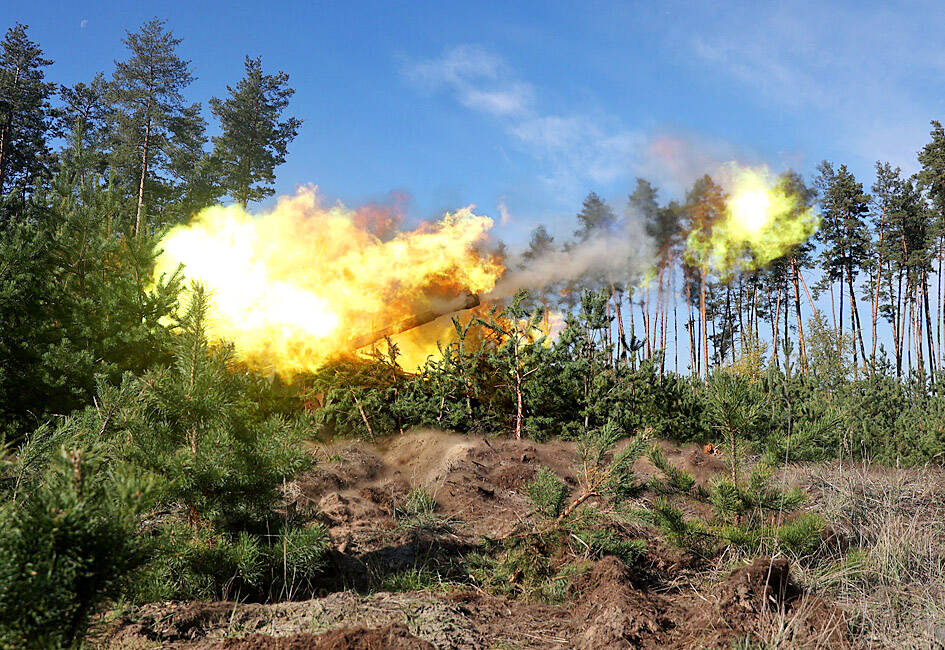
Photo: AFP
“The situation is critical now across the country because our regions are dependent on one another... It’s necessary for the whole country to prepare for electricity, water and heating outages,” Kyrylo Tymoshenko, deputy head of the Ukrainian president’s office, told Ukrainian television.
The strikes in the early hours yesterday hit Kyiv, Kharkiv in the east, Mykolaiv in the south, and central regions of Dnipro and Zhytomyr, where officials said hospitals were running on backup generators.
Drones also bombarded Kyiv on Monday leaving five dead, officials said, in what the presidency described as an attack of desperation.
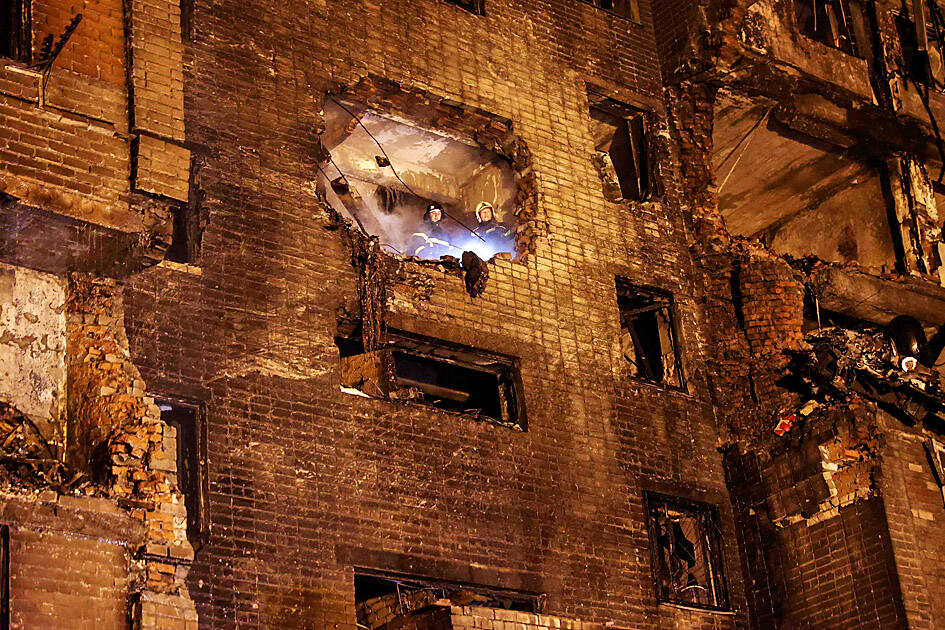
Photo: AFP
It was the second Monday in a row that Russia launched punitive strikes which military observers have said appear to be Moscow’s response to battlefield losses.
Zelenskiy described the repeated targeting of energy infrastructure as “another kind of Russian terrorist attacks.”
“Since October 10, 30 percent of Ukraine’s power stations have been destroyed, causing massive blackouts across the country,” he wrote on Twitter.
He said the attack meant that there was “no space left for negotiations with [Russian President Vladimir] Putin’s regime.”
Following the wave of kamikaze drone attacks against Kyiv on Monday, Ukrainian Minister of Foreign Affairs Dmytro Kuleba demanded EU sanctions on Iran, accusing Tehran of providing Russia with drones.
The Kremlin yesterday said that it has no knowledge of its army using Iranian drones in Ukraine.
“Russian tech is being used,” Kremlin spokesman Dmitry Peskov said, referring other questions to the Russian Ministry of Defense.
Separately, Russia yesterday said a “technical malfunction” probably caused a Russian warplane to crash into a block of flats in Yeysk, near Ukraine, killing at least 13 people, including three children.
Investigators said they were questioning the pilots of the Sukhoi Su-34, who managed to parachute out of the plane before it crashed on Monday into the nine-story building, engulfing it in flames.
Nineteen people were injured, four of them critically.
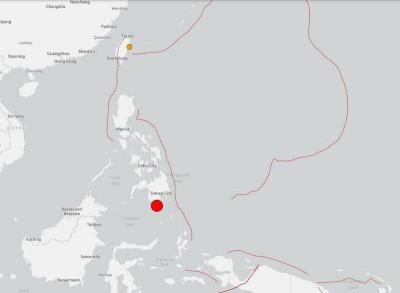
A magnitude 7.8 earthquake struck off the southern coast of Mindanao in the Philippines at 7:38am today, prompting the US Tsunami Warning System to issue an alert for neighboring countries, including Taiwan. The system issued a purple alert indicating a "tsunami threat." The potential threat zone includes Taiwan, the Philippines, Papua New Guinea, Yap and Palau. Philippine authorities were assessing the damage from the quake, with the office of civil defense seeking to verifying initial reports that 15 people had been killed and 129 injured in the region, mostly from falling debris. Arlene Hollero, disaster chief of Maasim town in the Philippines' Sarangani Province,

‘GRAY ZONE’ PRESSURE: Beijing’s activities are intended to create the deceitful impression that China has jurisdiction over the area around Taiwan, the CGA said Taiwan’s rights over its territorial waters and exclusive economic zone must not be violated by any country, the Mainland Affairs Council said yesterday, adding that it will not accept any unprovoked actions. The council issued the remarks in response to the China Coast Guard conducting maritime enforcement drills near eastern Taiwan and claiming to fully exercise China’s maritime administrative law enforcement authority. The Coast Guard Administration (CGA) has been closely monitoring the situation and is taking concrete steps to defend the nation’s sovereignty and secure its waters, the council said. China has no sovereign rights over the waters off eastern

RESILIENCE: Taiwan plays a key role in semiconductors, energy, information infrastructure and advanced manufacturing, AIT Director Raymond Greene said Taiwan’s continued investment in deterrence and resilience remains vital, especially in uncrewed systems and other emerging technologies, American Institute in Taiwan (AIT) Director Raymond Greene said yesterday. Greene made the remarks at the annual National Strategic Summit on Supply Chain Resilience held by the Research Institute for Democracy, Society and Emerging Technology (DSET), a government-backed think tank. As Taiwan last year became the US’ fourth-largest trading partner and supply chain security is becoming more important, cooperation in emerging technologies continues to deepen between the two countries, he said. The US is committed to accelerating innovation, building key infrastructure, strengthening cooperation

The National Chungshan Institute of Science and Technology yesterday showcased its locally developed variants of the Vision 60 robotic patrol dog, which it plans to deploy on the nation’s outlying territories in the South China Sea. The variants were produced under the Joint Lab project — created by the institute and domestic companies — and assembled with domestically produced motors, lenses and artificial intelligence (AI) systems alongside licensed tech from the US, Missile and Rocket Systems Research Division deputy director Jen Kuo-kang (任國光) told the media event at a military base in Taipei’s Dazhi (大直) area. Taiwan has built up its strengths


 RSS
RSS