

A magnitude 6.8 earthquake struck eastern Taiwan at 2:44pm yesterday, killing one person — a worker at a cement factory in Hualien County’s Yuli Township (玉里), who was struck by falling equipment, and at least 79 persons injured.
The quake, centered in Taitung County’s Chihshang Township (池上), also caused an apartment building and two bridges in Hualien to collapse. It was the strongest earthquake to hit the nation so far this year and followed a magnitude 6.4 tremor late on Saturday.
Rescuers in Yuli Township yesterday saved all four people trapped under rubble at the apartment building, and others rescued three people, who were crossing the nearby Kaoliao Bridge (高寮大橋) when it collapsed, the Hualien County Government said.
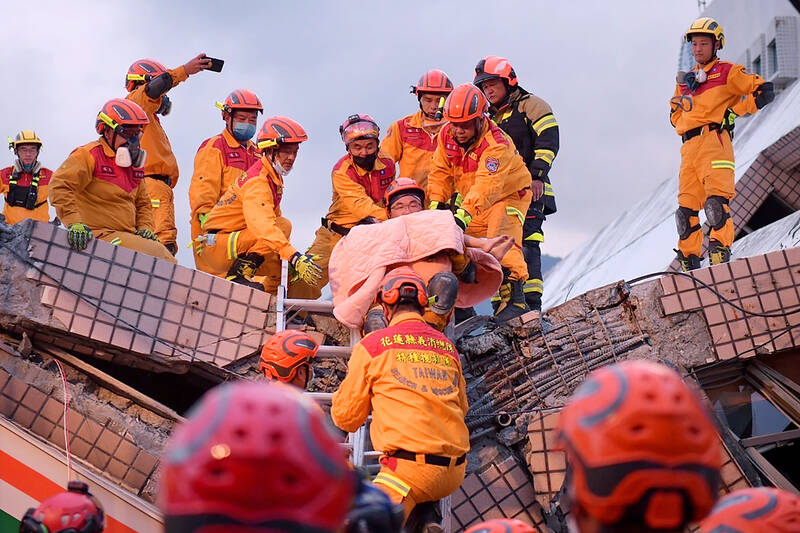
Photo: AP
The Luntien Bridge (崙天大橋) connecting Hualien’s Jhuosi (卓溪) and Fuli (富里) townships also collapsed.
Damage was also reported at the Yuli Bridge (玉里橋), impeding traffic on Highway No. 9.
Six cars of Tzuchiang Express train No. 402 derailed in Hualien’s Dongli Station after being hit by a collapsing concrete canopy.
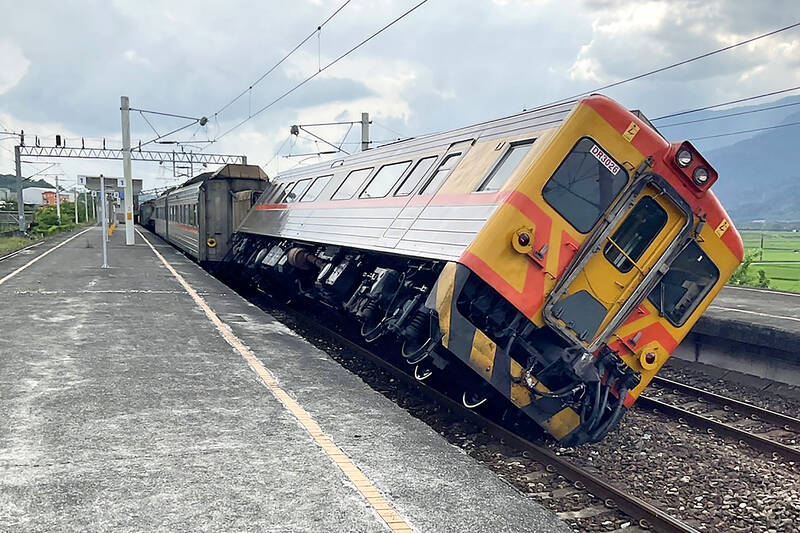
Photo: AFP / Taiwan Railways Administration
The Taiwan Railways Administration said that 20 passengers had left the train before the derailment.
Train services were suspended between Hualien and Taitung, the agency said.
It also reported damage to railway tracks and cables along railway lines in the two east coast counties.
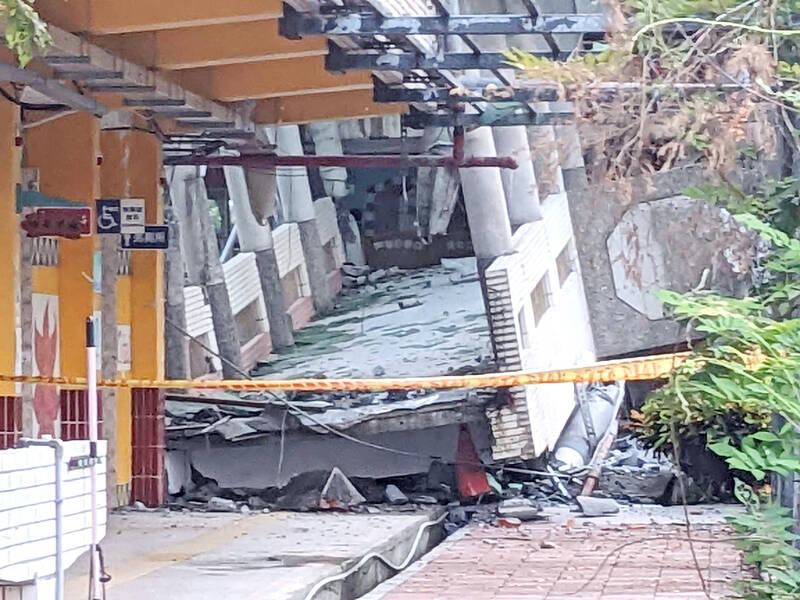
Photo: CNA
Nearly 400 travelers were trapped on Yuli’s Chikeshan (赤科山), as a road was damaged by a landslide triggered by the earthquake, local residents said.
Cellphone reception was weak, likely due to utility poles being damaged by landslides, they said.
The quake also damaged water pipes in Yuli, where power outages affected more than 7,000 households.
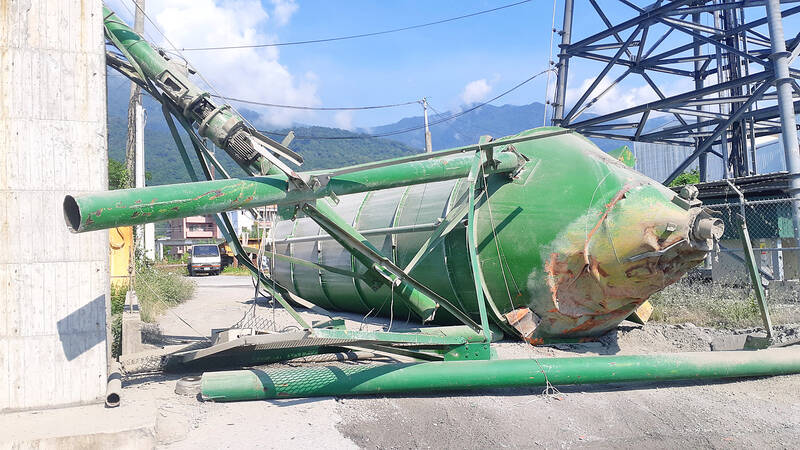
Photo: Huang Ming-tang, Taipei Times
Hualien County Commissioner Hsu Chen-wei (徐榛蔚) announced that schools and offices in Yuli, Fuli and Jhuosi townships would remain closed today, citing damage to homes, roads and other infrastructure.
Taitung County Commissioner Yao Ching-ling (饒慶鈴) announced school and office closures in Chihshang, Guanshan (關山), Luye (鹿野), Yenping (延平) and Haiduan (海端) townships.
Shaking was felt as far away as Taipei and Kaohsiung, with residents posting videos on social media of light fixtures swaying.
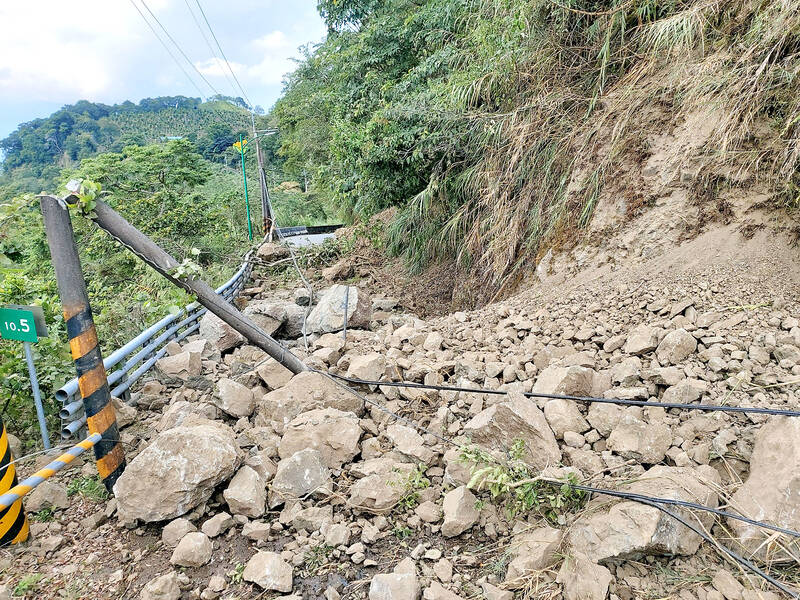
Photo courtesy of a member of the public
A 36-year-old man sustained injuries in Taoyuan’s Bade Civil Sports Center when part of the ceiling fell on a badminton court, the Taoyuan Fire Department said.
Isolated power outages were also reported in Taipei, Tainan, Kaohsiung, New Taipei City and Taitung County.
The Japan Meteorological Agency issued a tsunami advisory for several islands in Japan’s Okinawa Prefecture near Taiwan, but later lifted it.
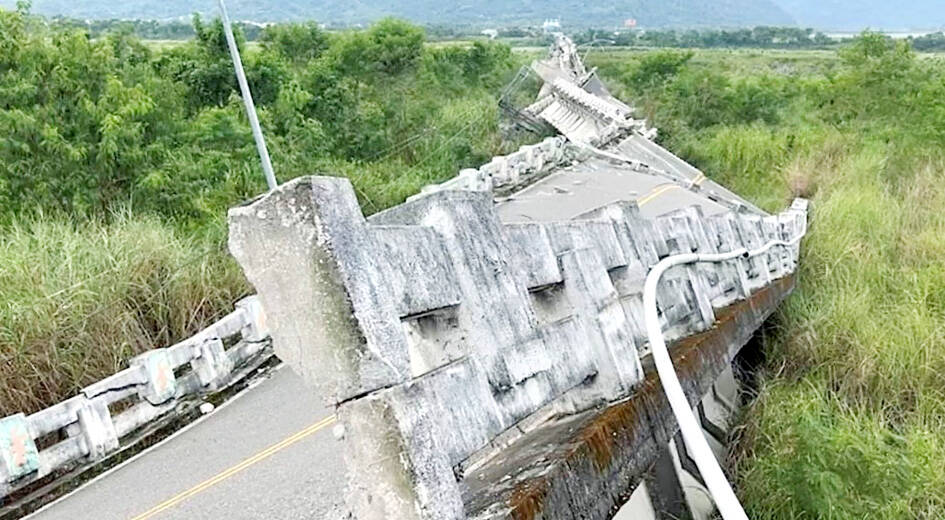
Photo: CNA
The magnitude 6.4 foreshock on Saturday night also caused damage to facilities in Taitung, including in Taitung City, and in Guanshan, Chihshang and Luye townships.
An 80-year-old colonial-era house in Taitung City, as well as the 68-year-old Wanan Brick Kilns in Chihshang were damaged. Hundreds of urns in a columbarium in Luye were damaged. In Guanshan, a rice mill and a concrete plant were damaged.
Additional reporting by agencies

PATROL PARTNERS: The ‘Chiayi’ and the ‘Penghu’ departed for a two-day joint patrol of Palau’s exclusive economic zone, the CGA’s second diplomatic visit to the country The Coast Guard Administration (CGA) set a record for its southernmost deployment of a coast guard vessel as the vessels Chiayi and the Penghu reached Palau’s Pulo Anna Island on Saturday in a cooperative exercise between the two countries. The island, about 217 nautical miles (401km) southwest of Koror in the Palauan state of Sonsorol and 1,220 nautical miles from Taiwan’s southernmost point, Oluanpi (鵝鑾鼻), is the furthest south a CGA vessel has sailed. The two vessels are in Palau for the coast guard’s second diplomatic visit to the country. They docked at Malakal Harbor on Tuesday last week. The coast guard

BATCH 1: The military has plans to assign the weapons to the army to defend Taiwan proper, as well as outlying islands and the navy for the Marine Corps, the official said Taiwan is to receive 500 Stinger missiles and 178 launchers from the US by the end of the year, the first batch under a planned two-stage acquisition totaling 2,621 missiles and 763 launchers, a defense official said yesterday on condition of anonymity. The portable missiles would play a vital role in the nation’s air defense capabilities, the source said. The army plans to deploy 2,235 missiles and 657 launchers to defend Taiwan proper and outlying islands, they said, citing military documents. The navy is allotted 295 missiles and 85 launchers to arm the Marine Corps and some surface vessels that lack air defense

The European Parliament on Wednesday adopted a recommendation on EU-China political relations that rejected China’s efforts to restrict Taiwan’s participation in international organizations and exchanges. The recommendation, addressed to the European Council, the European Commission and EU High Representative for Foreign Affairs and Security Policy Kaja Kallas, includes several references to EU-Taiwan relations and expresses support for closer ties, saying they would bring positive benefits and have strategic importance. Describing Taiwan as a valuable partner in trade and technology, the European Parliament said it “rejects China’s attempts to coerce international organizations, third countries and other actors into restricting Taiwan’s international participation and

Former president Tsai Ing-wen (蔡英文) on Monday arrived in San Francisco, receiving a warm welcome from hundreds of overseas Taiwanese as she launched a week-long visit. Accompanied by Representative to the US Alexander Yui (俞大?), and head of Taiwan’s San Francisco office Wu Chih-hsiang (伍志翔), Tsai arrived at her hotel, waving, smiling and giving high-fives to Taiwanese compatriots amid cheers of “Taiwan’s democracy involves you and me” to welcome her to the San Francisco Bay Area. It is Tsai’s first visit to the US since she left office in May 2024 after serving two four-year terms as president. Tsai is today to deliver


 RSS
RSS