


Shooting down a drone that flew over a Kinmen County island near the Chinese coast was the most “appropriate” course of action for the military after repeated warnings, Premier Su Tseng-chang (蘇貞昌) said yesterday, as a military source said that drone jamming guns had been dispatched to Taiwan’s outlying islands.
For the first time, the military on Thursday shot down an unidentified civilian drone that entered Taiwanese airspace near China’s Xiamen, after the government vowed tough measures against a rise in intrusions.
It was followed yesterday by incursions by several drones near Lieyu Township (烈嶼), which “quickly flew back to Xiamen after troops fired flares to warn them,” the Kinmen Defense Command said.
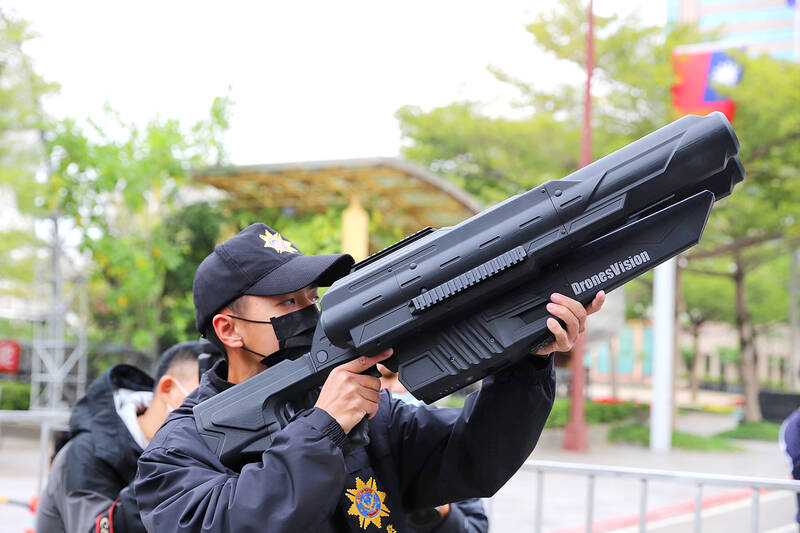
Photo: CNA
To counter drone incursions, a military source told the Central News Agency that drone jamming guns have been sent to Kinmen, Lienchiang County and other outlying islands.
The Ministry of National Defense declined to comment on the guns, saying only that the military would take all necessary steps to counter any threats by China.
China responded by saying that Taiwan was trying to “hype up tensions” over the incident.
Su told reporters that Taiwan had repeatedly issued warnings and asked China “not to encroach on our doorstep.”
“They repeatedly ignored our warnings to leave, and we had no choice but to exercise self-defense and shoot,” he said. “This is the most appropriate reaction after repeated restraint and warnings.”
“We will never provoke, and we will do the most appropriate thing to protect our land and our people,” he added.
Chinese Ministry of Foreign Affairs spokesperson Zhao Lijian (趙立堅) said the Democratic Progressive Party’s (DPP) “attempt to hype up tensions does not mean anything.”
The drone was shot down after entering restricted airspace near Shi Islet (獅嶼) and crashed into the sea, the defense ministry said.
At least two videos of recent drone flybys have circulated widely on Chinese social media, with one apparently showing Taiwanese soldiers throwing stones at the craft.
Su said these videos were made for China’s “propaganda at home,” adding to the anger of Taiwanese.
Politicians yesterday also defended the takedown of the drone.
The action was necessary to ensure the territorial integrity and dignity of the nation, DPP Legislator Lo Chih-cheng (羅致政) said before calling the shooting a boost to military morale and public confidence.
“We have no room for ambiguity when responding to incursions into our airspace by Chinese drones,” he said.
China’s deployment of drones over Kinmen is a “textbook example of the tactics of gray-zone conflict,” DPP Legislator Wang Ting-yu (王定宇) said, adding that the measured response of Taiwanese forces has helped garner support from the country’s allies.
The military has issued drone jamming guns to frontline units and guidelines for the use of force against drones are being written, he said.
This guidelines would authorize responses including the use of jammers, rifle fire and anti-aircraft missiles, depending on the severity of the threat, Wang said.
Taiwan has an imperative to defend its sovereign airspace, and the military acted in accordance with regulations, Chinese Nationalist Party (KMT) Legislator Chiang Wan-an (蔣萬安) said.
The Chinese military’s acts of harassment are pointless and would only increase tensions across the Taiwan Strait, he said, urging China to “exercise restraint.”
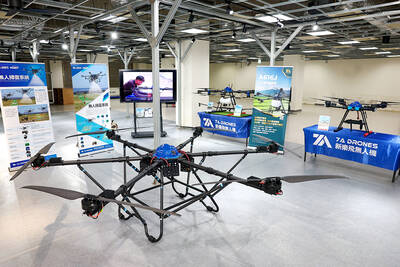
DRONE CENTRAL: Taiwan aims to become Asia’s democratic hub for drones, with most exports focused on high-quality military-grade models, an official said Taiwan’s drone industry is expected to expand significantly by 2030, producing 100,000 units per month and exporting half of them, the Ministry of Economic Affairs said yesterday. Current drone production capacity is about 15,000 units per month, but the industry can quickly scale up as demand increases, Industrial Development Administration Director-General Chiou Chyou-huey (邱求慧) told a news conference in Taipei. Taiwan’s drone output grew 2.5-fold last year to NT$12.9 billion (US$408.3 million) under a government program to develop the uncrewed vehicle sector, he said. The Executive Yuan in October last year approved plans to invest NT$44.2 billion into domestic production of uncrewed aerial
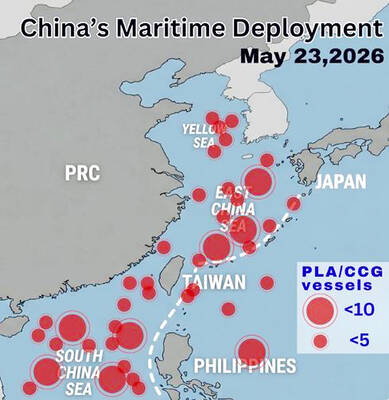
WARNING: China should stop engaging in actions that undermine regional peace and stability, as it would only build resentment among people across the Strait, the CGA said China has deployed more than 100 navy, coast guard and other vessels in waters from the Yellow Sea to the South China Sea and the western Pacific since US President Donald Trump and Chinese President Xi Jinping (習近平) met in Beijing, National Security Council Secretary-General Joseph Wu (吳釗燮) said yesterday. “In this part of the world, #China is the one & only PROBLEM wrecking the #StatusQuo & threatening regional peace & stability,” Wu wrote on X. In a separate post, he said Beijing was coercing Taiwan’s maritime domain, calling it illegal and provocative, after the Coast Guard Administration (CGA) expelled a
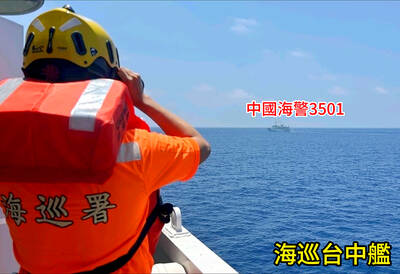
VERBOSE VESSELS: A CGA cutter and a China Coast Guard exchanged verbal barbs for more than a day in Taiwanese-controlled waters before the Chinese vessel left The Taiwanese and Chinese coast guards had a standoff near the strategically located Pratas Islands (Dongsha Islands, 東沙群島) in the north of the South China Sea, the Coast Guard Administration (CGA) said yesterday. The two sides engaged in intense radio exchanges over sovereignty claims during the 33-hour standoff. China Coast Guard vessel 3501 eventually left the restricted waters, 26.6 nautical miles (49.2km) west of the Pratas Islands, at 5pm yesterday, the CGA said. Lying approximately between southern Taiwan and Hong Kong, the Taiwan-controlled Pratas are seen by some security experts as vulnerable to Chinese attack due to their distance — more than
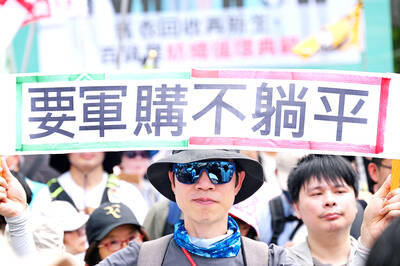
More than 8,000 people took part in a rally in Taipei yesterday to express support for more defense spending, after the opposition slashed the Cabinet’s proposed NT$1.25 trillion (US$39.6 billion) special defense budget and capped it at NT$780 billion. The demonstrators urged the Cabinet to propose another bill. Taiwan Economic Democracy Union convener Lai Chung-chiang (賴中強) said the main problem of the passed budget plan is the removal of funding for critical items, not just that the total amount is smaller. Critical budget items included purchasing or developing uncrewed vehicles, Strong Bow (強弓) missile systems, additional ammunition, artificial intelligence-powered combat systems and Taiwan-US


 RSS
RSS