


Solomon Islands has suspended visits from all foreign navies, citing a need to review approval processes, Solomon Islands Prime Minister Manasseh Sogavare said yesterday, after a US Coast Guard ship was unable to refuel at its port.
The decision comes amid concerns over the Solomons’ growing ties with China in recent years, switching diplomatic recognition from Taipei to Beijing in 2019 and signing a security pact with the Asian power in April.
Western governments are wary that the islands could provide China with a military foothold in a strategically important part of the world.
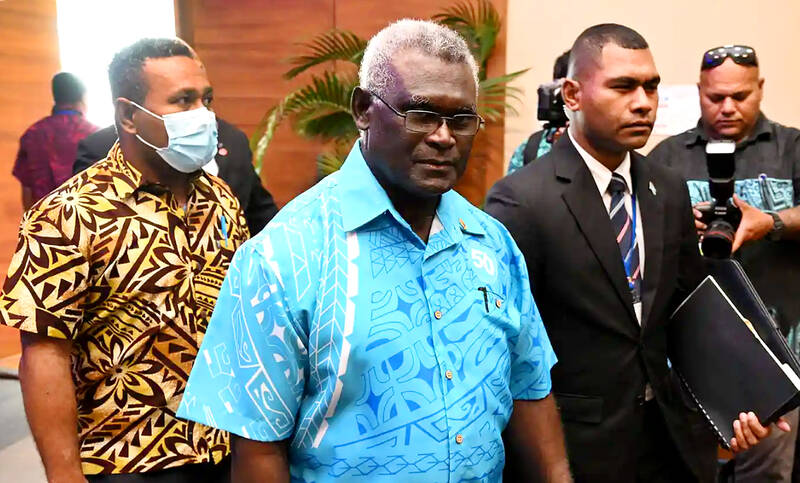
Photo: AFP
In a speech yesterday welcoming a US hospital ship to the capital, Honiara, Sogavare said he was reviewing the process for allowing foreign military vessels to dock in the country.
“We have requested our partners to give us time to review and put in place our new processes before sending further requests for military vessels to enter the country,” Sogavare said.
He also denied reports that a US coast guard ship and a British navy vessel were not allowed to dock in the country, saying delays in processing their approvals meant both were turned away.
The US embassy in Canberra confirmed in a statement that it had received formal notification of the suspension of naval visits.
“The United States received formal notification from the Government of Solomon Islands regarding a moratorium on all naval visits, pending updates in protocol procedures,” an embassy spokeswoman said in a statement.
“The United States is disappointed that the US Coast Guard ship was not able to make this planned stop in Honiara,” the statement said.
“We will continue to closely monitor the situation,” it said.
Sogavare did not outline the suspension’s length, but promised a “smoother and timelier” approval process for naval visits following the review.
At the welcome ceremony for the US hospital ship Mercy he invited the vessel to return during the Pacific Games, due to be hosted in the country in December next year.
The US embassy said the Mercy — on a humanitarian mission to the country — had received clearance to dock before the moratorium was put in place.
Sogavare has deepened his South Pacific nation’s ties with China’s autocratic government and proposed changing the constitution to delay scheduled elections.
The four-time leader has twice been ousted by votes of no confidence, and faced street protests against his decision to switch diplomatic recognition.
After widespread rioting in Honiara demanding his ouster late last year, Sogavare signed a secretive security pact with Beijing that — according to a leaked draft — allows him to call in Chinese security forces to quell further unrest.
That has raised concerns in Canberra and Washington about the prospect of a Chinese military base being established or allowing China to develop dual-use facilities.
Sogavare has several times denied a foreign base would ever be built in his country.
Australia’s foreign affairs department has been contacted for comment.

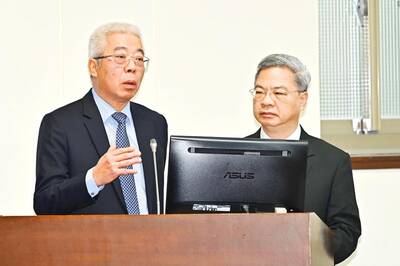
Taiwan has arranged for about 8 million barrels of crude oil, or about one-third of its monthly needs, to be shipped from the Red Sea this month to bypass the Strait of Hormuz and ease domestic supply pressures, CPC Corp, Taiwan (CPC, 台灣中油) said yesterday. The state-run oil company has worked with Middle Eastern suppliers to secure routes other than the Strait of Hormuz, through which about 20 percent of the world’s oil and liquefied natural gas typically passes, CPC chairman Fang Jeng-zen (方振仁) said at a meeting of the legislature’s Economics Committee in Taipei. Suppliers in Saudi Arabia have indicated they
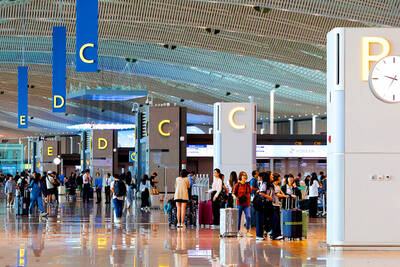
South Korea has adjusted its electronic arrival card system to no longer list Taiwan as a part of China, a move that the Ministry of Foreign Affairs said would help facilitate exchanges between the two sides. South Korea previously listed “Taiwan” as “Taiwan (China)” in the drop-down menus of its online arrival card system, where people had to fill out where they came from and their next destination. The ministry had requested South Korea make a revision and said it would change South Korea’s name on Taiwan’s online immigration system from “Republic of Korea” to “Korea (South),” should the issue not be

Tainan, Taipei and New Taipei City recorded the highest fines nationwide for illegal accommodations in the first quarter of this year, with fines issued in the three cities each exceeding NT$7 million (US$220,639), Tourism Administration data showed. Among them, Taipei had the highest number of illegal short-term rental units, with 410. There were 3,280 legally registered hotels nationwide in the first quarter, down by 14 properties, or 0.43 percent, from a year earlier, likely indicating operators exiting the market, the agency said. However, the number of unregistered properties rose to 1,174, including 314 illegal hotels and 860 illegal short-term rental
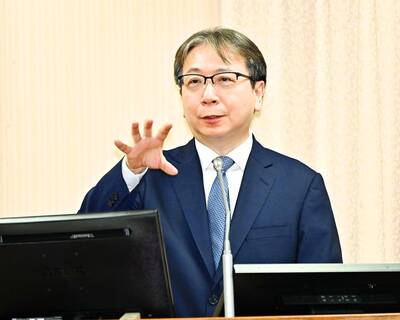
AIR ALERT: China’s reservation of airspace over the Yellow Sea and East China Sea could be an attempt to test the US’ response ahead of a Trump-Xi meeting, the NSB head said China’s attempts to infiltrate Taiwan are systematic, planned and targeted, with activity shifting from recruiting mid-level military officers to rank-and-file enlisted personnel, National Security Bureau (NSB) Director-General Tsai Ming-yen (蔡明彥) said yesterday. The Chinese Communist Party’s (CCP) integrates national security, intelligence operations and “united front” efforts into a dense network to conduct intelligence gathering and espionage in Taiwan, Tsai said at a meeting of the legislature’s Foreign Affairs and National Defense Committee. It uses specific networks to screen targets through exchange activities and recruiting local collaborators to establish intelligence-gathering organizations, he said. China is also shifting who it targets to lower-ranking military personnel,


 RSS
RSS