


Lithuania plans to open a trade office in Taiwan next month and has appointed Paulius Lukauskas, an adviser to Lithuanian Prime Minister Ingrida Simonyte, to head the office, the Lithuanian Economy and Innovation Ministry said on Wednesday.
“Taiwan is included in Lithuania’s priority markets for innovation cooperation, exports and foreign direct investment. In the first half of this year, exports of Lithuanian-origin goods and services to Taipei increased by one-third,” Lithuanian Minister of the Economy and Innovation Ausrine Armonaite was quoted as saying in the statement.
The office in Taipei would not only help diversify Lithuania’s economic representation in Asia, but also promote mutual technological cooperation, the statement said.

Photo: Reuters
Two-way trade for the first six months of this year increased by 92.6 percent year-on-year, it said.
Lukauskas has more than 20 years of experience in industry, and held corporate executive positions before assuming public office, it said.
Lithuania has commercial representatives in its embassies in the UK, the US, Sweden, Norway, Finland, France, Germany, the Netherlands and Israel, and expects to bring the total to 23 by 2024, the statement said.
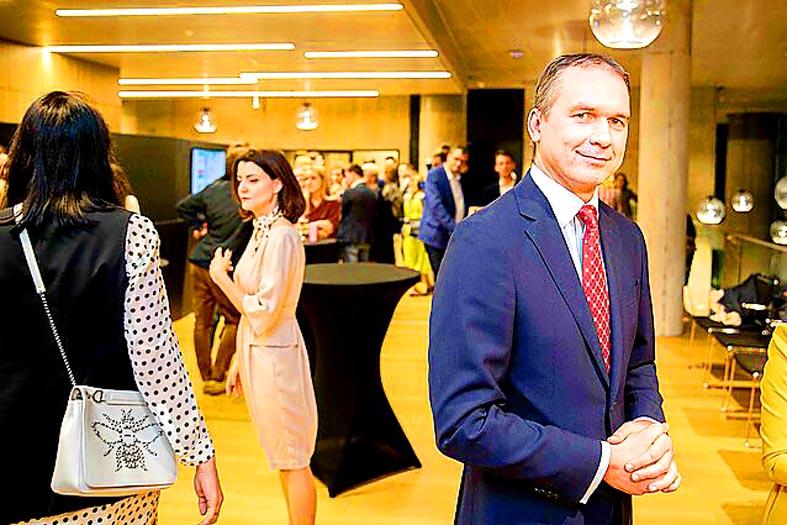
Photo: Screenshot from LRT Televizija
Newly installed commercial representatives are to be stationed in embassies in South Korea, Japan and Poland, and the number of business representatives in the US and German embassies is to be expanded to three each, it said.
Lukauskas is advising Simonyte on strategic reforms, and previously headed Enterprise Lithuania, the country’s entrepreneurship and export development agency.
The new trade office is to be called Lithuania’s Trade Representative Office in Taipei.
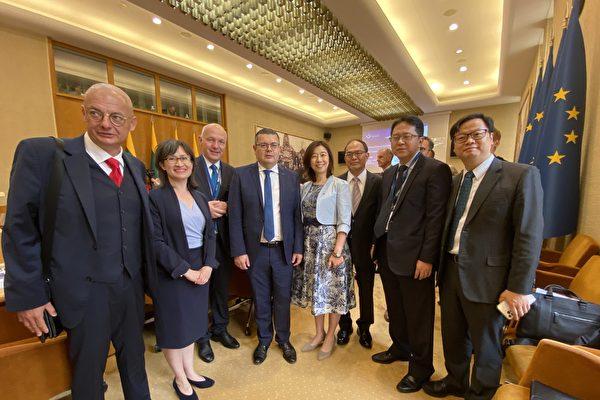
Photo: screengrab from Legislator Lin Ching-yi FB.
Lithuanian officials also said that it would be a commercial office and not diplomatic in nature, the Baltic News Service said.
In Taipei, the Ministry of Foreign Affairs yesterday said it looks forward to close cooperation with the trade office.
The ministry yesterday also welcomed the announcement that a Taiwan-friendly delegation formed by Ukrainian parliamentarians plans to visit the country.
Ukrainian Parliament Foreign Affairs Committee Chairman Oleksandr Merezhko on Wednesday said that the delegation is to consist of 15 cross-party lawmakers, including himself, adding that the delegation would officially form after the parliamentary speaker’s announcement at the next congress at the end of this month.
The delegation hopes to promote friendship with Taiwan and foster ties on the economy, culture, humanitarian aid and other issues, he said.
Ministry spokeswoman Joanne Ou (歐江安) yesterday said that Taiwan has condemned Russia several times after it invaded Ukraine on Feb. 24, and stood together with other democratic countries to support Ukraine by donating supplies and money, which showed “Taiwanese people’s love and humanitarian spirit.”
The delegation’s planned visit is evidence that “Ukraine received firm support and timely help from Taiwan,” she said, adding a quote from Confucius: “Virtue is never left to stand alone. He who has it will have neighbors.”
The government hopes that the war in Ukraine would end soon, she said, adding that Taiwan would be happy to help with Ukraine’s post-war reconstruction and help its people return to normal life.
Democratic Progressive Party Legislator Huang Shih-chieh (黃世杰) said yesterday that the Legislative Yuan is preparing the establishment of a Taiwan-Ukrainian lawmakers’ friendship association.
The association is to be launched next month and would hold talks with the delegation via videoconference to express Taiwan’s support for Ukraine, Huang said.
More than 30 cross-party legislators have joined the association.
Huang said he hopes that once the association is established, it can arrange more mutual visits and build substantive exchanges with Ukraine.


RESILIENCE: Taiwan plays a key role in semiconductors, energy, information infrastructure and advanced manufacturing, AIT Director Raymond Greene said Taiwan’s continued investment in deterrence and resilience remains vital, especially in uncrewed systems and other emerging technologies, American Institute in Taiwan (AIT) Director Raymond Greene said yesterday. Greene made the remarks at the annual National Strategic Summit on Supply Chain Resilience held by the Research Institute for Democracy, Society and Emerging Technology (DSET), a government-backed think tank. As Taiwan last year became the US’ fourth-largest trading partner and supply chain security is becoming more important, cooperation in emerging technologies continues to deepen between the two countries, he said. The US is committed to accelerating innovation, building key infrastructure, strengthening cooperation

The National Chungshan Institute of Science and Technology yesterday showcased its locally developed variants of the Vision 60 robotic patrol dog, which it plans to deploy on the nation’s outlying territories in the South China Sea. The variants were produced under the Joint Lab project — created by the institute and domestic companies — and assembled with domestically produced motors, lenses and artificial intelligence (AI) systems alongside licensed tech from the US, Missile and Rocket Systems Research Division deputy director Jen Kuo-kang (任國光) told the media event at a military base in Taipei’s Dazhi (大直) area. Taiwan has built up its strengths

RIGHT DIRECTION: Taiwan’s efforts to prevent forced labor include a proposal to ‘fully prohibit’ employers from withholding workers’ documents, an official said Taiwan is to establish a mechanism to restrict imports of goods linked to forced labor, the Executive Yuan said yesterday, after the US proposed imposing additional tariffs on Taiwanese goods over labor concerns. “The Ministry of Labor and the Ministry of Economic Affairs are to establish an interministerial review procedure,” Executive Yuan spokesperson Michelle Lee (李慧芝) said at a news briefing in Taipei. “The government is to use the Foreign Trade Act [貿易法] as the legal basis to restrict imports of goods produced with forced labor” and bring its supply chain governance more in line with international standards on human rights, resilience

NOT IMMEDIATE: Taiwan has a chance to appeal the proposed 10 percent tariff before it starts, while other countries face a 12.5 percent tariff from the trade office Taiwan is among 60 economies determined by the US to have failed to impose or enforce a ban on the importation of goods produced with forced labor, according to a notice released on Tuesday by the Office of the US Trade Representative (USTR), which proposed imposing an additional 10 percent or more tariff on them. The USTR in a statement said that following an investigation, it had determined under Section 301 of the Trade Act of 1974 that the failure of the 60 economies to impose and effectively enforce a prohibition on the importation of goods produced with forced labor is


 RSS
RSS