

The Ministry of Foreign Affairs yesterday expressed “sincere gratitude” toward the US for taking “concrete actions” to maintain security and peace in the Taiwan Strait and the region, after the White House on Friday said it would boost trade with Taiwan and insist on the right of air and sea passage in the area in response to China’s “provocative” behavior.
A new trade plan is to be unveiled within days, while US forces are to transit the Taiwan Strait in the next few weeks, US National Security Council Indo-Pacific Coordinator Kurt Campbell told reporters in a teleconference.
The statement came after Beijing raged at last week’s trip to Taipei by US House of Representative Speaker Nancy Pelosi, launching its largest-ever military drills around Taiwan proper.
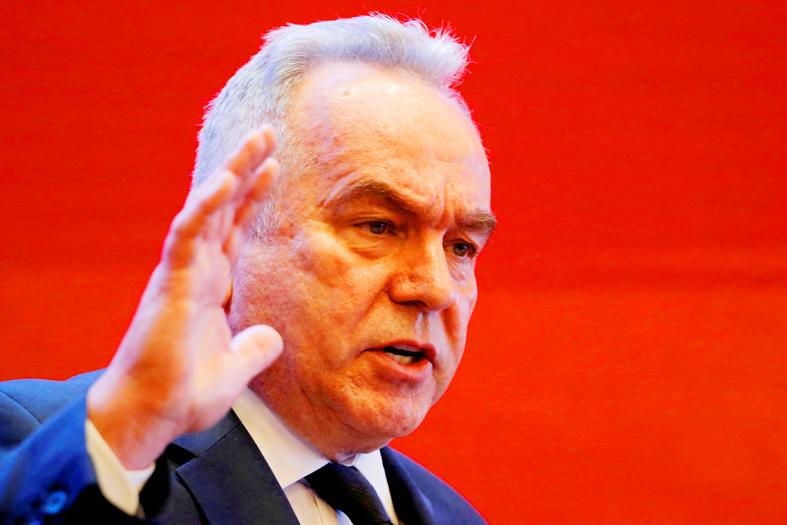
Photo: Reuters
Campbell said that Pelosi’s visit was “consistent” with Washington’s existing policy and that China had “overreacted.”
Beijing used the pretext to “launch an intensified pressure campaign against Taiwan to try to change the status quo, jeopardizing peace and stability across the Taiwan Strait and in the broader region,” he said. “China has overreacted and its actions continue to be provocative, destabilizing and unprecedented.”
In response to China’s drills, the US is reasserting its involvement in the area, while reiterating its policy of “strategic ambiguity” — diplomatically recognizing China, while simultaneously supporting Taiwan.
Campbell said the administration would continue to “deepen our ties with Taiwan, including through continuing to advance our economic and trade relationship.”
“For example, we’re developing an ambitious road map for trade negotiations, which we intend to announce in the coming days,” he said.
The US would also reassert its right to use international air and sea space between Taiwan and China, he said.
US forces “will continue to fly, sail and operate where international law allows, consistent with our long-standing commitment to freedom of navigation,” he said.
“That includes conducting standard air and maritime transits through the Taiwan Strait in the next few weeks,” he told reporters.
Campbell did not confirm what kind of deployment would be made to support the maneuvers, saying he had no “comments about either the nature of our crossings or the timings across the Taiwan Strait.”
In Taipei, the Ministry of Foreign Affairs yesterday said in a statement that China’s “unprovoked military and econom[ic] intimidation” had “further strengthened the unity and resilience of the global democratic camp.”
President Tsai Ing-wen (蔡英文) on Thursday said that China’s threat of force is undiminished, even though Beijing’s largest-ever military drills seemed to be scaling down.
At a rally in the south yesterday for November’s local elections, Tsai said the Democratic Progressive Party was not just facing rival candidates, “but also pressure from China.”
“Taiwanese are very enthusiastic and love freedom and democracy. So many good international friends have come to Taiwan to support us. This is a normal and good thing, but China threatens and intimidates Taiwan,” she said.
“However, I would like to reassure everyone that both our government and the military are prepared, and I will definitely take care of Taiwan,” she added.
Criticizing China’s decision to halt cooperation with Washington on issues including the fight against climate change, Campbell on Friday said that “we have and will continue to keep lines of communication open with Beijing.”
He added that US President Joe Biden and Chinese President Xi Jinping (習近平) have asked staff to arrange an in-person summit, but he declined to comment on reports that this could take place during the G20 meeting in Bali in November.
“We don’t have anything further in terms of details on time or location,” he said.
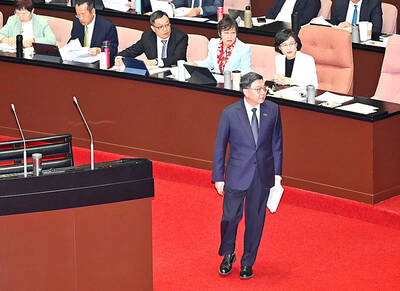
The government is monitoring online rumors that a pneumonic plague outbreak has spread from Russia into China, and it might enhance quarantine measures, Premier Cho Jung-tai (卓榮泰) said yesterday. During a legislative meeting, Democratic Progressive Party Legislator Wang Ting-yu (王定宇) said that rumors had circulated that the disease had spread across several Chinese provinces. He asked Cho whether the government was prepared to prevent the disease spreading to Taiwan, given the volume of traffic between the two sides, and how concerned the government was about the alleged outbreak. The Ministry of Health and Welfare had implemented border quarantine measures after briefing the Executive
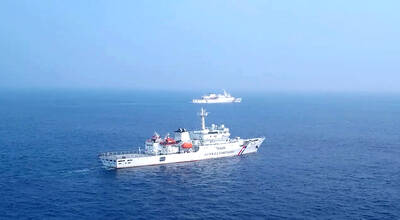
PATROL PARTNERS: The ‘Chiayi’ and the ‘Penghu’ departed for a two-day joint patrol of Palau’s exclusive economic zone, the CGA’s second diplomatic visit to the country The Coast Guard Administration (CGA) set a record for its southernmost deployment of a coast guard vessel as the vessels Chiayi and the Penghu reached Palau’s Pulo Anna Island on Saturday in a cooperative exercise between the two countries. The island, about 217 nautical miles (401km) southwest of Koror in the Palauan state of Sonsorol and 1,220 nautical miles from Taiwan’s southernmost point, Oluanpi (鵝鑾鼻), is the furthest south a CGA vessel has sailed. The two vessels are in Palau for the coast guard’s second diplomatic visit to the country. They docked at Malakal Harbor on Tuesday last week. The coast guard
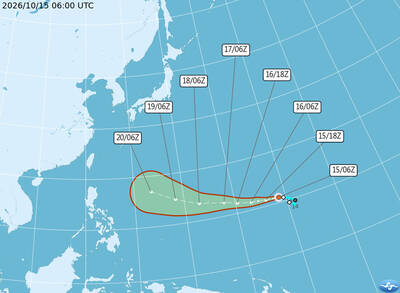
EAST OF GUAM: Tropical Storm Champi is forecast to strengthen into a typhoon, but its effect on Taiwan is uncertain due to the presence of a high-pressure system Tropical Storm Champi formed yesterday and has the potential to increase in strength, the Central Weather Administration (CWA) said yesterday. Forecasters are closely monitoring a Pacific high-pressure system that would dictate whether the storm turns north or moves toward Taiwan next week, the CWA said. The most likely scenario is that it turns northward after passing the Ryukyu Islands, CWA forecaster Cheng Chieh-jen (鄭傑仁) said. As of 8pm yesterday, Champi was east of Guam moving west-northwest at 20kph, CWA data showed. It had maximum sustained winds near the center of 72kph and gusts of up to 101kph, the data showed. If the Pacific high-pressure system
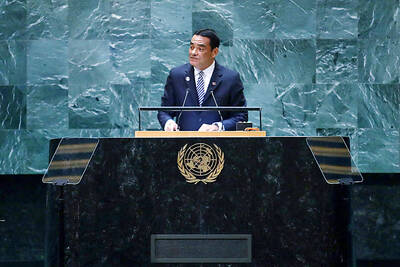
RIGHT TO DIPLOMACY: Under the UN Charter, every state has the right to conduct foreign policy free from external pressure, Belize said in a statement Belize and Paraguay on Monday condemned Beijing sanctions over their countries’ ties with Taiwan, saying China’s actions create unnecessary tensions. Earlier on Monday, Beijing announced sanctions against Paraguayan Minister of Information and Communication Technologies Gustavo Villate and Belizean Minister of Foreign Affairs Francis Fonseca. The Paraguayan Ministry of Foreign Affairs said it rejected the sanctions, writing on X that they created unnecessary friction. It added that it reaffirmed its support for Taiwan and its commitment to democratic values and principles. Villate told the Spanish-language Paraguayan daily ABC Color the sanctions were “predictable” and linked them to several cooperation projects between Taiwan and Paraguay. The projects


 RSS
RSS