


China is using military drills to prepare for an invasion of Taiwan, and its anger over US House of Representatives Speaker Nancy Pelosi’s visit is just an excuse, Minister of Foreign Affairs Joseph Wu (吳釗燮) said yesterday.
Speaking in English at a news conference in Taipei, Wu accused China of “gross violations of international law.”
“China has used the drills in its military playbook to prepare for the invasion of Taiwan,” he said. “It is conducting large-scale military exercises and missile launches, as well as cyberattacks, disinformation and economic coercion, in an attempt to weaken public morale in Taiwan.”
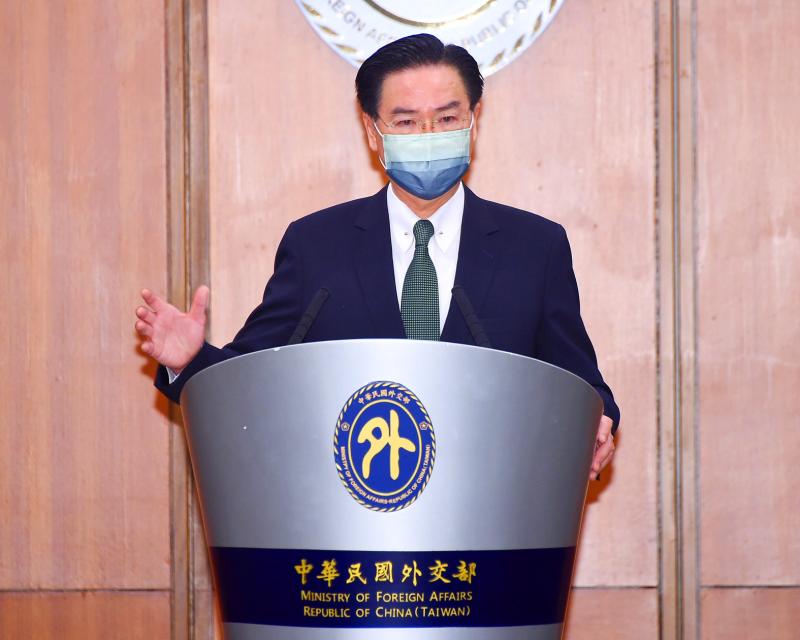
Photo: Tu Chien-jung, Taipei Times
He said the Chinese People’s Liberation Army’s (PLA) activities would have taken far longer to prepare if they were a direct response to Pelosi’s visit.
China’s tactics, including the firing of ballistic missiles, were “clearly trying to deter other countries from interfering in its attempt to invade Taiwan,” and showed that it has much broader geostrategic intentions, he said.
“China’s real intention is to alter the ‘status quo’ in the Taiwan Strait and the entire region,” Wu added.
Beijing has declared ownership of the Taiwan Strait, one of the world’s busiest shipping routes, and aims to influence the international community’s freedom of travel by controlling the stretch of water linking the Yellow Sea to the South China Sea, he said.
In the past week, the PLA has conducted more than 100 sea and air crossings of the median line, constituting “specific action to break the long-standing tacit agreement,” Wu said, adding that it would probably now try to “routinize its actions.”
“Its intentions are not likely to end there,” he said, noting China’s security agreement with the Solomon Islands and its influence across the Pacific, southeast Asia, Africa and Latin America.
Continuing cyberattacks over the past week have also been traced to China and Russia, Wu said, adding that the authorities remained on “high alert,” but would not be cowed.
“China’s continued attempt to intimidate Taiwan will not panic us, nor will they defeat us. The values of freedom and democracy cannot be taken away,” he said.
Taiwan began its own scheduled live-fire military drills yesterday in Pingtung County, designed to simulate defensive operations against an attack.
Chinese vessels reportedly continued to run missions off Taiwan’s east coast and in the Strait yesterday, as median line crossings by PLA warplanes also continued.
Asked if China was trying to lure Taiwan’s allies in response to Pelosi’s visit, Wu reiterated that the nation’s diplomatic ties with its 14 allies are stable.
Wu said that some senior officials and heads of state from allied nations are planning to visit Taiwan soon to show their support amid rising cross-strait tensions.
He did not give further details, citing only the example of Saint Vincent and the Grenadines Prime Minister Ralph Gonsalves, who arrived in Taiwan on Sunday for a six-day visit.
Additional reporting by CNA and Reuters

A signaling system malfunction disrupted high-speed rail (HSR) services beginning at 8am today, with trains temporarily reduced to three northbound and three southbound trains per hour as authorities conduct inspections. The malfunction occurred on a section of track in Miaoli County during pre-operation checks early this morning, forcing northbound and southbound trains to use a single track, the HSR operator said. The regular schedule has been replaced with three hourly trains offering only nonreserved seating in each direction, stopping at every station, it said, adding that business class cars would still have reserved seating. Departures from terminal stations are scheduled at the top

Taiwan is still in the process of assessing the possibility of recruiting workers from Eswatini, the Ministry of Foreign Affairs said yesterday, adding that its goal is to help Eswatini upgrade its vocational training centers. If there are plans to recruit workers from Eswatini, safeguarding national security, protecting public health and ensuring the employment rights of Taiwanese would be prerequisites, Department of West Asian and African Affairs Director-General Yen Chia-liang (顏嘉良) told a news conference. Key considerations would also include filling labor shortages in specific industries, and fostering bilateral professional and technical exchanges, he said. Yen was asked about the progress of labor

A US uncrewed surface vessel (USV) encountered multiple Chinese warships during an autonomous transit of the Taiwan Strait, US defense company Seasats said in a statement on Wednesday. Seasats announced that a Lightfish USV had completed the first autonomous transit of the Taiwan Strait. Over five days, the USV traversed the entire length of the Strait while constantly monitoring surface vessel traffic, the company said. The Lightfish encountered multiple Chinese warships, one of which was a Chinese People’s Liberation Army Navy (PLAN) Type 056 corvette, it said. The Chinese vessels were operating “well within Taiwan’s exclusive economic zone without transmitting their identity via the

VERBOSE VESSELS: A CGA cutter and a China Coast Guard exchanged verbal barbs for more than a day in Taiwanese-controlled waters before the Chinese vessel left The Taiwanese and Chinese coast guards had a standoff near the strategically located Pratas Islands (Dongsha Islands, 東沙群島) in the north of the South China Sea, the Coast Guard Administration (CGA) said yesterday. The two sides engaged in intense radio exchanges over sovereignty claims during the 33-hour standoff. China Coast Guard vessel 3501 eventually left the restricted waters, 26.6 nautical miles (49.2km) west of the Pratas Islands, at 5pm yesterday, the CGA said. Lying approximately between southern Taiwan and Hong Kong, the Taiwan-controlled Pratas are seen by some security experts as vulnerable to Chinese attack due to their distance — more than


 RSS
RSS