


Russia is “ready” to discuss a prisoner swap with Washington at the presidential level, its foreign minister said yesterday, a day after the drug conviction of US basketball star Brittney Griner.
“We are ready to discuss this subject, but only within the framework of the [communication] channel established by” Russian President Vladimir Putin and US President Joe Biden, Russian Minister of Foreign Affairs Sergey Lavrov told a news conference on a visit to Cambodia.
“There is a special channel established by the presidents and despite certain public declarations, it is still functional,” he said.
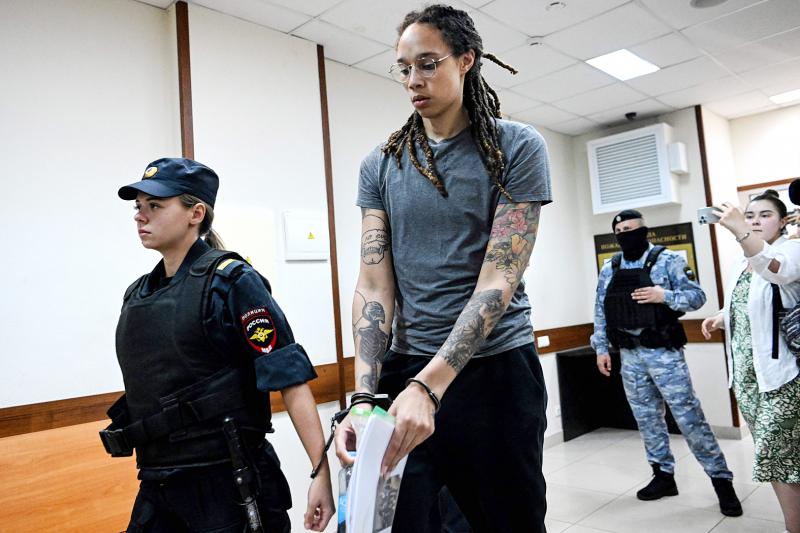
Photo: AFP
“If the Americans again decide to engage in public diplomacy and make thundering declarations ... that’s their business and their problem,” he said, adding that Washington is not able work “in a professional and calm manner.”
However, the discussions would not be held publicly, Kremlin spokesman Dmitry Peskov said.
“If we discuss prisoner exchanges via the press then they will never take place,” he said.
The statements came a day after a Russian court sentenced Griner to nine years in a penal colony on a drug smuggling charge.
The 31-year-old Griner, a two-time US Olympic champion, listened with a blank expression as an interpreter translated the verdict by Judge Anna Sotnikova, but her lawyers said later she was “very upset.”
US President Joe Biden denounced the verdict and sentence as “unacceptable.”
“I call on Russia to release her immediately so she can be with her wife, loved ones, friends and teammates,” Biden said, adding that he would continue to work to bring home Griner and Paul Whelan, an American imprisoned in Russia on an espionage conviction.
Griner, recognized as one of the greatest female players in basketball history, has been detained since Feb. 17 after police said they found vape cartridges containing cannabis oil in her luggage upon arrival in Moscow.
The nine-year sentence was close to the maximum of 10 years that Griner had faced under the charges.
Most Russians possessing small quantities of drugs get at most five years in prison, lawyers said.
Defense attorney Maria Blagovolina told reporters Griner was “very upset, very stressed. She can hardly talk. It’s a difficult time for her.”
On Wednesday last week, US Secretary of State Antony Blinken said Washington had offered a deal to Russia aimed at bringing home Griner and Whelan in a sharp reversal of previous policy.
Details of the proposal were not announced, although a person familiar with the matter said the US has offered to trade convicted Russian arms dealer Viktor Bout for Whelan and Griner.
Russian media have also speculated that Griner could be swapped for Bout, nicknamed “the Merchant of Death,” who is serving a 25-year sentence for conspiracy to kill Americans and providing aid to a terrorist organization.


RESILIENCE: Taiwan plays a key role in semiconductors, energy, information infrastructure and advanced manufacturing, AIT Director Raymond Greene said Taiwan’s continued investment in deterrence and resilience remains vital, especially in uncrewed systems and other emerging technologies, American Institute in Taiwan (AIT) Director Raymond Greene said yesterday. Greene made the remarks at the annual National Strategic Summit on Supply Chain Resilience held by the Research Institute for Democracy, Society and Emerging Technology (DSET), a government-backed think tank. As Taiwan last year became the US’ fourth-largest trading partner and supply chain security is becoming more important, cooperation in emerging technologies continues to deepen between the two countries, he said. The US is committed to accelerating innovation, building key infrastructure, strengthening cooperation

The National Chungshan Institute of Science and Technology yesterday showcased its locally developed variants of the Vision 60 robotic patrol dog, which it plans to deploy on the nation’s outlying territories in the South China Sea. The variants were produced under the Joint Lab project — created by the institute and domestic companies — and assembled with domestically produced motors, lenses and artificial intelligence (AI) systems alongside licensed tech from the US, Missile and Rocket Systems Research Division deputy director Jen Kuo-kang (任國光) told the media event at a military base in Taipei’s Dazhi (大直) area. Taiwan has built up its strengths

RIGHT DIRECTION: Taiwan’s efforts to prevent forced labor include a proposal to ‘fully prohibit’ employers from withholding workers’ documents, an official said Taiwan is to establish a mechanism to restrict imports of goods linked to forced labor, the Executive Yuan said yesterday, after the US proposed imposing additional tariffs on Taiwanese goods over labor concerns. “The Ministry of Labor and the Ministry of Economic Affairs are to establish an interministerial review procedure,” Executive Yuan spokesperson Michelle Lee (李慧芝) said at a news briefing in Taipei. “The government is to use the Foreign Trade Act [貿易法] as the legal basis to restrict imports of goods produced with forced labor” and bring its supply chain governance more in line with international standards on human rights, resilience

NOT IMMEDIATE: Taiwan has a chance to appeal the proposed 10 percent tariff before it starts, while other countries face a 12.5 percent tariff from the trade office Taiwan is among 60 economies determined by the US to have failed to impose or enforce a ban on the importation of goods produced with forced labor, according to a notice released on Tuesday by the Office of the US Trade Representative (USTR), which proposed imposing an additional 10 percent or more tariff on them. The USTR in a statement said that following an investigation, it had determined under Section 301 of the Trade Act of 1974 that the failure of the 60 economies to impose and effectively enforce a prohibition on the importation of goods produced with forced labor is


 RSS
RSS