


The military is ready to counter “any actions that threaten national sovereignty,” Ministry of National Defense spokesman Major General Sun Li-fang (孫立方) said yesterday in response to China’s announcement of military drills near Taiwan.
The Chinese military on Tuesday announced it would hold air and sea live-fire exercises in six locations off Taiwan proper from noon today until noon on Sunday.
The drills would be in response to US House of Representatives Speaker Nancy Pelosi’s visit to Taiwan this week, which China said breached the “one China” principle — a claim that the US has denied.

Photo: CNA
The drills would be “an irrational action that challenges the international order, undermines the status quo in the Taiwan Strait and endangers regional security,” Sun said.
Commenting on Taiwan’s capacity to respond to the drills, Sun said that the military branches are coordinating on surveillance and have a full grasp on everything occurring within Taiwan’s territorial waters and airspace.
“We prepare for war, but we do not seek it. We will not irrationally escalate conflicts, but we will resolutely safeguard national sovereignty and national security,” he said.

Photo: Chen Shin-yu, Taipei Times
Beijing’s tendency to resolve differences by force would only result in regional instability, damage cross-strait relations and harm China’s international image, he said.
Asked whether the military was on heightened alert and whether officers would be asked to refrain from taking leave, Sun said that the military followed an annual training plan and would not implement any special measures.
Ministry official Yu Chian-chang (于健昌) said that the planned drills were “like a sea and air blockade of Taiwan, which seriously violates our territorial waters and territorial sovereignty, and seriously violates the UN Convention on the [Law of the] Sea and other relevant regulations.”

Photo: Reuters
Separately, the Ministry of Foreign Affairs said that the government was maintaining close communication with the US and other regional partners to avoid escalation, and maintain peace and stability in the Taiwan Strait and the Indo-Pacific region as a whole.
The foreign ministry said that China’s request that vessels and aircraft from other countries avoid the areas where it is planning to hold drills “seriously affected international economic and trade exchanges, and the international rules-based order.”
The foreign ministry reiterated that “the Republic of China [ROC] is a sovereign and independent country,” and that “the ROC and the People’s Republic of China are not subordinate to each other.”
The Ministry of Transportation and Communications said that Taiwan is negotiating with Japan and the Philippines to find alternative aviation routes.
There is no need for Taiwan to find alternative routes for sea transportation because ships can avoid Chinese drill zones, it said.
China yesterday said the drills in the Taiwan Strait were “necessary and just” in the wake of Pelosi’s visit.
“The Chinese military’s conducting of military exercises in the sea near ‘China’s’ Taiwan are a necessary and just measure to resolutely protect national sovereignty,” Chinese Ministry of Foreign Affairs spokeswoman Hua Chunying (華春瑩) told a regular news briefing.
“In the current struggle surrounding Pelosi’s Taiwan visit, the United States are the provocateurs, China is the victim. The joint provocation by the US and Taiwan came first, China’s just defense came after,” Hua said.
Additional reporting by AFP and Reuters
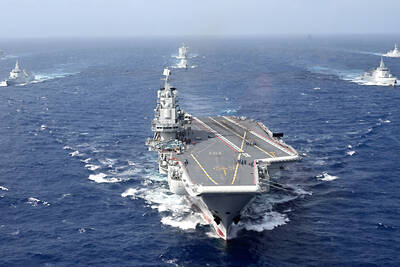
PROVOCATIVE: Chinese Deputy Ambassador to the UN Sun Lei accused Japan of sending military vessels to deliberately provoke tensions in the Taiwan Strait China denounced remarks by Japan and the EU about the South China Sea at a UN Security Council meeting on Monday, and accused Tokyo of provocative behavior in the Taiwan Strait and planning military expansion. Ayano Kunimitsu, a Japanese vice foreign minister, told the Council meeting on maritime security that Tokyo was seriously concerned about the situation in the East China and South China seas, and reiterated Japan’s opposition to any attempt to change the “status quo” by force, and obstruction of freedom of navigation and overflight. Stavros Lambrinidis, head of the EU delegation to the UN, also highlighted South China Sea

SILENCING CRITICS: In addition to blocking Taiwan, China aimed to prevent rights activists from speaking out against authoritarian states, a Cabinet department said The Ministry of Foreign Affairs (MOFA) yesterday condemned transnational repression by Beijing after RightsCon, a major digital human rights conference scheduled to be held in Zambia this week, was abruptly canceled due to Chinese pressure over Taiwanese participation. This year’s RightsCon, the world’s largest conference discussing issues “at the intersection of human rights and technology,” was scheduled to take place from tomorrow to Friday in Lusaka, and expected to draw 2,600 in-person attendees from 150 countries, along with 1,100 online participants. However, organizers were forced to cancel the event due to behind-the-scenes pressure from China, the ministry said, expressing its “strongest condemnation”
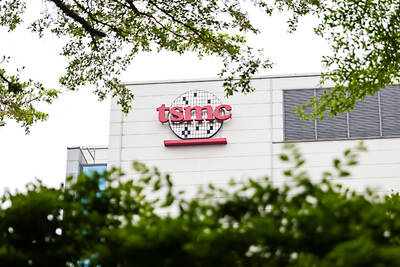
Taiwan Semiconductor Manufacturing Co (TSMC, 台積電), the world’s largest contract chipmaker, said it expects its 2-nanometer (2nm) chip capacity to grow at a compound annual rate of 70 percent from this year to 2028. The projection comes as five fabs begin volume production of 2-nanometer chips this year — two in Hsinchu and three in Kaohsiung — TSMC senior vice president and deputy cochief operating officer Cliff Hou (侯永清) said at the company’s annual technology symposium in Silicon Valley, California, last week. Output in the first year of 2-nanometer production, which began in the fourth quarter of last year, is expected to
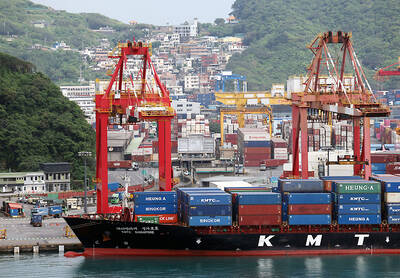
Taiwan’s economy grew far faster than expected in the first quarter, as booming demand for artificial intelligence (AI) applications drove a surge in exports, spilling over into investment and consumption, the Directorate-General of Budget, Accounting and Statistics (DGBAS) said yesterday. GDP growth was 13.69 percent year-on-year during the January-to-March period, beating the DGBAS’ February forecast by 2.23 percentage points and marking the most robust growth in nearly four decades, DGBAS senior official Chiang Hsin-yi (江心怡) told a news conference in Taipei. The result was powered by exports, which remain the backbone of Taiwan’s economy, Chiang said. Outbound shipments jumped 51.12 percent year-on-year to


 RSS
RSS