


UN High Commissioner for Human Rights Michelle Bachelet arrived in China yesterday, the first trip by a holder of the office since 2005 amid concerns that it could lead to an endorsement rather than scrutiny of China’s human rights record.
During the six-day trip, Bachelet plans to visit Xinjiang, where the UN High Commissioner’s office last year said that it believes the mostly Muslim Uighurs have been unlawfully detained, mistreated and forced to work.
The Chinese Ministry of Foreign Affairs said that it welcomes her, but rejects “political manipulation” when asked by reporters if she could visit the detention centers, re-education camps and prisons where rights groups say Uighurs have been mistreated.

Photo: Reuters
China has repeatedly denied any mistreatment of Uighurs.
“The purpose of the private visit is to enhance exchanges and cooperation between both sides, and promote the international cause of human rights,” ministry spokesman Wang Wenbin (汪文斌) told a news conference yesterday.
He said that Bachelet’s visit would be conducted in a “closed loop,” referring to a way of isolating people within a “bubble” to prevent COVID-19 from potentially spreading.
That means Bachelet would not be able to have free and spontaneous in-person meetings with anyone who has not been prearranged by China to be brought inside the “bubble.”
Wang also said that the media would not be traveling with Bachelet because of the pandemic.
The trip has been long in the making after Bachelet in 2018 said that she wanted unfettered access to Xinjiang. China said the visit should not be based on a presumption of guilt.
The World Uyghur Congress urged Bachelet in a letter to ensure that her team can move freely, access all detention facilities and have unsupervised contact with Uighurs.
“We are concerned the trip might do more harm than good. China could use it for propaganda purposes,” World Uyghur Congress spokesperson Zumretay Arkin said.
International scrutiny of the Chinese government’s actions in Xinjiang heightened in 2018 after the UN said that 1 million Uighurs were being held in “massive internment camps” set up for political indoctrination.
China initially denied the existence of any camps, then later admitted it had set up “vocational training centers” with dormitories where people can “voluntarily” check themselves in to learn about law, Chinese-language and vocational skills.

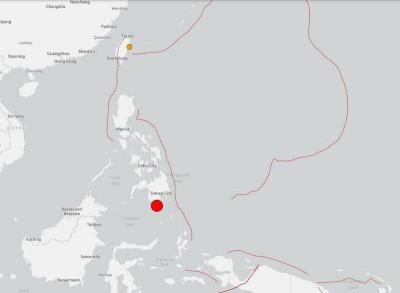
A magnitude 7.8 earthquake struck off the southern coast of Mindanao in the Philippines at 7:38am today, prompting the US Tsunami Warning System to issue an alert for neighboring countries, including Taiwan. The system issued a purple alert indicating a "tsunami threat." The potential threat zone includes Taiwan, the Philippines, Papua New Guinea, Yap and Palau. Philippine authorities were assessing the damage from the quake, with the office of civil defense seeking to verifying initial reports that 15 people had been killed and 129 injured in the region, mostly from falling debris. Arlene Hollero, disaster chief of Maasim town in the Philippines' Sarangani Province,

RESILIENCE: Taiwan plays a key role in semiconductors, energy, information infrastructure and advanced manufacturing, AIT Director Raymond Greene said Taiwan’s continued investment in deterrence and resilience remains vital, especially in uncrewed systems and other emerging technologies, American Institute in Taiwan (AIT) Director Raymond Greene said yesterday. Greene made the remarks at the annual National Strategic Summit on Supply Chain Resilience held by the Research Institute for Democracy, Society and Emerging Technology (DSET), a government-backed think tank. As Taiwan last year became the US’ fourth-largest trading partner and supply chain security is becoming more important, cooperation in emerging technologies continues to deepen between the two countries, he said. The US is committed to accelerating innovation, building key infrastructure, strengthening cooperation

The National Chungshan Institute of Science and Technology yesterday showcased its locally developed variants of the Vision 60 robotic patrol dog, which it plans to deploy on the nation’s outlying territories in the South China Sea. The variants were produced under the Joint Lab project — created by the institute and domestic companies — and assembled with domestically produced motors, lenses and artificial intelligence (AI) systems alongside licensed tech from the US, Missile and Rocket Systems Research Division deputy director Jen Kuo-kang (任國光) told the media event at a military base in Taipei’s Dazhi (大直) area. Taiwan has built up its strengths

RIGHT DIRECTION: Taiwan’s efforts to prevent forced labor include a proposal to ‘fully prohibit’ employers from withholding workers’ documents, an official said Taiwan is to establish a mechanism to restrict imports of goods linked to forced labor, the Executive Yuan said yesterday, after the US proposed imposing additional tariffs on Taiwanese goods over labor concerns. “The Ministry of Labor and the Ministry of Economic Affairs are to establish an interministerial review procedure,” Executive Yuan spokesperson Michelle Lee (李慧芝) said at a news briefing in Taipei. “The government is to use the Foreign Trade Act [貿易法] as the legal basis to restrict imports of goods produced with forced labor” and bring its supply chain governance more in line with international standards on human rights, resilience


 RSS
RSS