


Serbia on Saturday publicly displayed a recently delivered Chinese anti-aircraft missile system, raising concerns in the West and among some of Serbia’s neighbors that an arms buildup in the Balkans could threaten a fragile peace in the region.
The sophisticated HQ-22 surface-to-air system was last month delivered by a dozen Chinese air force Y-20 transport planes in what was believed to be the largest airlift delivery of Chinese arms to Europe in history.
Although Serbia officially seeks membership in the EU, it has been arming itself mostly with Russian and Chinese weapons, including T-72 battle tanks, MiG-29 fighter jets, Mi-35 attack helicopters and drones.
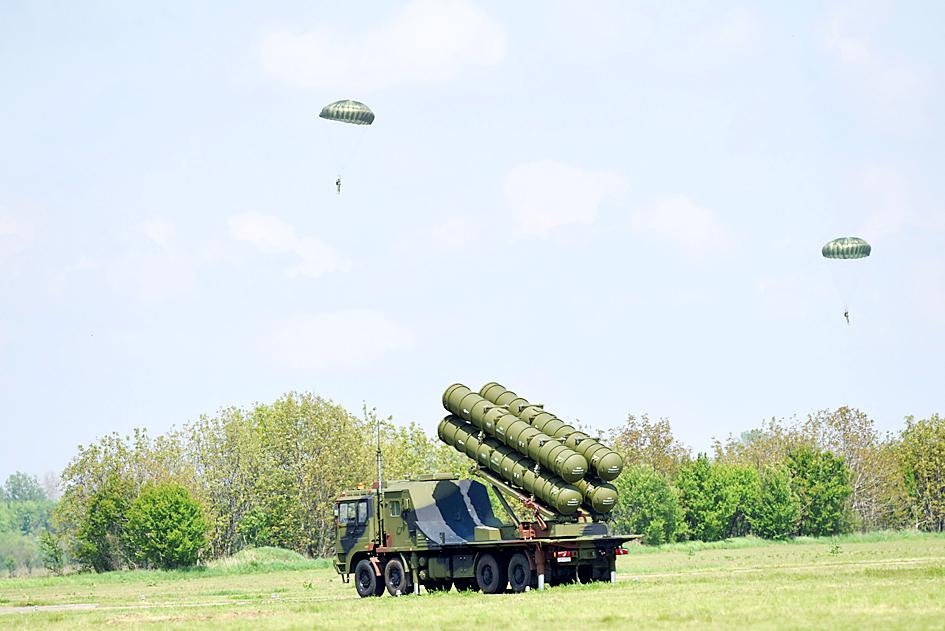
Photo: Reuters
In 2020, US officials warned Belgrade against purchasing HQ-22 missile systems, the export version of which is known as the FK-3, saying that if Serbia really wanted to join the EU and other Western alliances, it must align its military equipment with Western standards.
The Chinese missile system has been widely compared with the US Patriot and the Russian S-300 surface-to-air missile systems, although it has a shorter range than the more advanced S-300 system.
Serbia is the first operator of the Chinese missiles in Europe.
Serbian President Aleksandar Vucic said at the end of the arms display at a military airport near Belgrade that the Chinese missiles, as well as other recently delivered military hardware, are not a threat to anyone and only represent a “powerful deterrent” against potential attackers.
“We will no longer allow [ourselves] to be a punching bag for anyone,” Vucic said, apparently referring to NATO’s 78-day bombardment of Serbia for its bloody crackdown against Kosovo Albanian separatists in 1999.
Serbia, which was at war with its neighbors in the 1990s, does not recognize the independence that Kosovo declared in 2008.
It still has frosty relations with NATO members Croatia and Montenegro, as well as Bosnia, whose separatist Bosnian-Serb leader Milorad Dodik attended the military drill on Saturday.
Serbia is negotiating a purchase of French multipurpose Dessault Rafale jets, as well as British Eurofighter Typhoon fighters, Vucic said.
Only “political hurdles” would prevent the purchase of the Western aircraft, he added.
There are widespread concerns that Russia could push its ally Serbia into an armed conflict with its neighbors to try at least partly to shift public attention from the war in Ukraine.

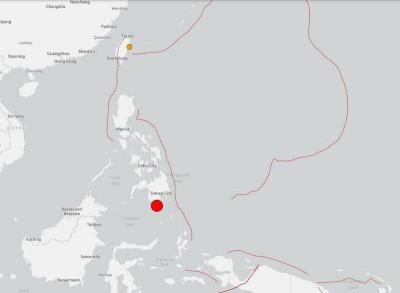
A magnitude 7.8 earthquake struck off the southern coast of Mindanao in the Philippines at 7:38am today, prompting the US Tsunami Warning System to issue an alert for neighboring countries, including Taiwan. The system issued a purple alert indicating a "tsunami threat." The potential threat zone includes Taiwan, the Philippines, Papua New Guinea, Yap and Palau. There were no immediate reports of major damage in the Philippines or Indonesia. The quake struck at a depth of 10km, said the German Research Centre for Geosciences, which had earlier pegged the earthquake at magnitude 8.2. Phivolcs, the Philippine agency, said the quake was magnitude 7 and
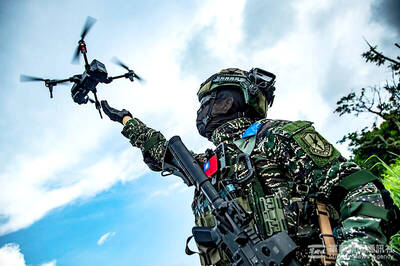
RESILIENCE: Taiwan plays a key role in semiconductors, energy, information infrastructure and advanced manufacturing, AIT Director Raymond Greene said Taiwan’s continued investment in deterrence and resilience remains vital, especially in uncrewed systems and other emerging technologies, American Institute in Taiwan (AIT) Director Raymond Greene said yesterday. Greene made the remarks at the annual National Strategic Summit on Supply Chain Resilience held by the Research Institute for Democracy, Society and Emerging Technology (DSET), a government-backed think tank. As Taiwan last year became the US’ fourth-largest trading partner and supply chain security is becoming more important, cooperation in emerging technologies continues to deepen between the two countries, he said. The US is committed to accelerating innovation, building key infrastructure, strengthening cooperation

The National Chungshan Institute of Science and Technology yesterday showcased its locally developed variants of the Vision 60 robotic patrol dog, which it plans to deploy on the nation’s outlying territories in the South China Sea. The variants were produced under the Joint Lab project — created by the institute and domestic companies — and assembled with domestically produced motors, lenses and artificial intelligence (AI) systems alongside licensed tech from the US, Missile and Rocket Systems Research Division deputy director Jen Kuo-kang (任國光) told the media event at a military base in Taipei’s Dazhi (大直) area. Taiwan has built up its strengths

RIGHT DIRECTION: Taiwan’s efforts to prevent forced labor include a proposal to ‘fully prohibit’ employers from withholding workers’ documents, an official said Taiwan is to establish a mechanism to restrict imports of goods linked to forced labor, the Executive Yuan said yesterday, after the US proposed imposing additional tariffs on Taiwanese goods over labor concerns. “The Ministry of Labor and the Ministry of Economic Affairs are to establish an interministerial review procedure,” Executive Yuan spokesperson Michelle Lee (李慧芝) said at a news briefing in Taipei. “The government is to use the Foreign Trade Act [貿易法] as the legal basis to restrict imports of goods produced with forced labor” and bring its supply chain governance more in line with international standards on human rights, resilience


 RSS
RSS