


British Prime Minister Boris Johnson yesterday arrived in India touting job-creating investment, but facing long odds to get his reluctant counterpart, Narendra Modi, to back Western action against Russia.
Johnson arrived in Gujarat — Modi’s home state and the ancestral home to half of the UK’s British Indians — where he was meeting business leaders and taking a cultural tour of the historic city of Ahmedabad.
He is to leave today for New Delhi to meet Modi, providing him some respite from the “partygate” controversy over his criminal violation of COVID-19 pandemic lockdown rules.
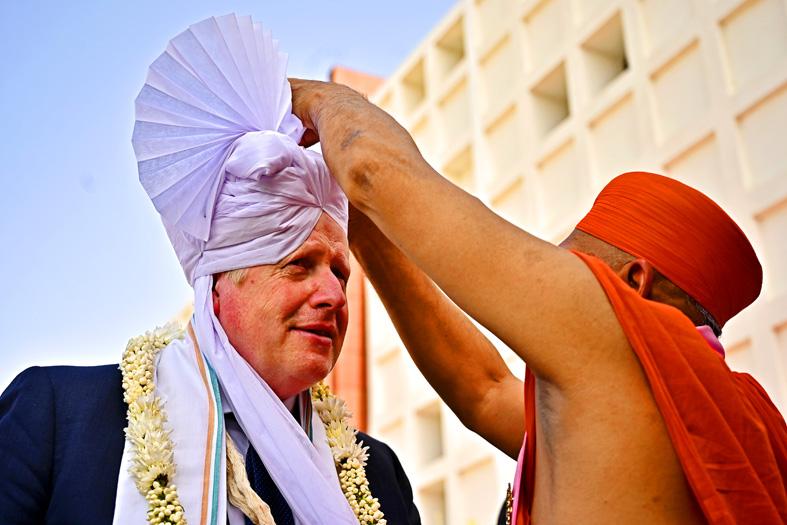
Photo: AP
Johnson likely missed a parliamentary vote yesterday into whether he deliberately misled the House of Commons in previously denying any Downing Street rule-breaking.
The India trip has been twice postponed because of COVID-19 flare-ups in each country, and was briefly in doubt again this week when the vote was announced, with opposition leaders insisting Johnson stand down.
However, UK sources said it was seen as too important to put off again. Downing Street said it would seal more than US$1.3 billion in two-way investment deals, creating almost 11,000 jobs in Britain.
“What we’re focusing on today is the incredible opportunities to deepen this partnership,” Johnson told reporters while visiting a factory in Gujarat.
Downing Street said the visit would yield new partnerships on defense, artificial intelligence and green energy, along with investment deals in areas including robotics, electric vehicles and satellite launches.
However, London acknowledged that it is some way off clinching a post-Brexit trade deal with Modi’s government, which wants more visas for Indians to work or study in the UK.
Meanwhile, India has refused to openly condemn Moscow for its invasion of Ukraine, reliant as it is on Russian imports of energy, agricultural goods and military hardware.
“India and Russia have historically a very different relationship, perhaps than Russia and the UK have had over the last couple of decades,” Johnson said. “We have to reflect that reality, but clearly I’ll be talking about it to Narendra Modi.”
Johnson is to tout the benefits of India moving more quickly toward renewables — a pertinent strategic issue as countries attempt to pivot away from Russian energy.
“Both our countries are excessively reliant on foreign hydrocarbons, and we need to move away from that together,” Johnson said. “One of the things that we’re talking about is what we can do to build partnerships on hydrogen, on electric vehicles, on offshore wind, on all the ways that you can reduce the cost of energy for people with green technology.”
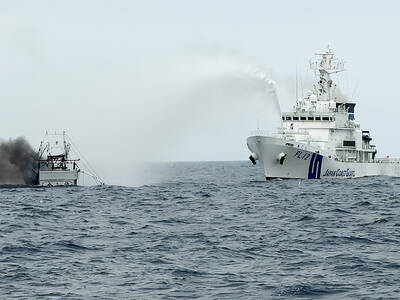
CREDIT-GRABBER: China said its coast guard rescued the crew of a fishing vessel that caught fire, who were actually rescued by a nearby Taiwanese boat and the CGA Maritime search and rescue operations do not have borders, and China should not use a shipwreck to infringe upon Taiwanese sovereignty, the Coast Guard Administration (CGA) said yesterday. The coast guard made the statement in response to the China Coast Guard (CCG) saying it saved a Taiwanese fishing boat. The Chuan Yu No. 6 (全漁6號), a fishing vessel registered in Keelung, on Thursday caught fire and sank in waters northeast of Diaoyutai Islands (釣魚台). The vessel left Keelung’s Badouzih Fishing Harbor (八斗子漁港) at 3:35pm on Sunday last week, with seven people on board — a 62-year-old Taiwanese captain surnamed Chang (張) and six

The Legislative Yuan’s Finance Committee yesterday approved proposed amendments to the Amusement Tax Act (娛樂稅法) that would abolish taxes on films, cultural activities and competitive sporting events, retaining the fee only for dance halls and golf courses. The proposed changes would set the maximum tax rate for dance halls and golf courses at 50 and 20 percent respectively, with local governments authorized to suspend the levies. Article 2 of the act says that “amusement tax shall be levied on tickets sold or fees charged by amusement places, facilities or activities” in six categories: “Cinema; professional singing, story-telling, dancing, circus, magic show, acrobatics

Tainan, Taipei and New Taipei City recorded the highest fines nationwide for illegal accommodations in the first quarter of this year, with fines issued in the three cities each exceeding NT$7 million (US$220,639), Tourism Administration data showed. Among them, Taipei had the highest number of illegal short-term rental units, with 410. There were 3,280 legally registered hotels nationwide in the first quarter, down by 14 properties, or 0.43 percent, from a year earlier, likely indicating operators exiting the market, the agency said. However, the number of unregistered properties rose to 1,174, including 314 illegal hotels and 860 illegal short-term rental
INFLATION UP? The IMF said CPI would increase to 1.5 percent this year, while the DGBAS projected it would rise to 1.68 percent, with GDP per capita of US$44,181 The IMF projected Taiwan’s real GDP would grow 5.2 percent this year, up from its 2.1 percent outlook in January, despite fears of global economic disruptions sparked by the US-Iran conflict. Taiwan’s consumer price index (CPI) is projected to increase to 1.5 percent, while unemployment would be 3.4 percent, roughly in line with estimates for Asia as a whole, the international body wrote in its Global Economic Outlook Report published in the US on Monday. The figures are comparatively better than the IMF outlook for the rest of the world, which pegged real GDP growth at 3.1 percent, down from 3.3 percent


 RSS
RSS